NOAA’s 2026 Atlantic hurricane season outlook calls for above-normal activity, 17 to 25 named storms, up to 6 major hurricanes. Hurricane season starts June 1. If you don’t own a generator, the time to buy is now: demand spikes in August and September, inventory gets picked over, and prices jump.
We looked at portable generators across every use case, from quiet inverter generators for sensitive electronics and camping to dual-fuel whole-house units for extended outages. Here’s how each category breaks down, which models perform, and how to size your generator before you need it.
Quick Picks: Best Portable Generators for Hurricane Season 2026
| Award | Model | Running Watts | Fuel | Best For | Buy |
|---|---|---|---|---|---|
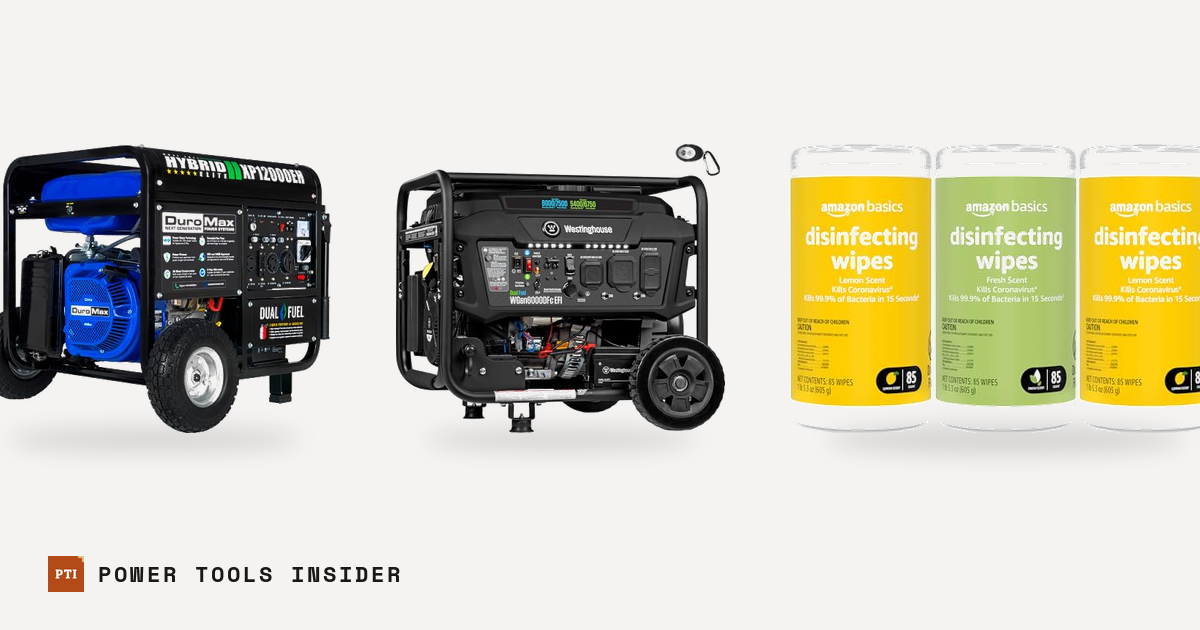
| Best Emergency Backup | Westinghouse WGen7500 | 7,500W | Gas | Power essentials + window AC. Most popular whole-home backup for 3-4 days post-storm. | Buy Now |
| Best Whole-House Dual-Fuel | DuroMax XP12000EH | 12,000W | Gas / Propane | Dual-fuel flexibility when local gas runs out. Powers central AC, refrigerators, sump pumps simultaneously. | Buy Now |
| Best Quiet Inverter | Honda EU2200i | 1,800W | Gas | Quietest generator available (48 dB). Runs CPAP, laptop, phone charging overnight. RV-safe clean power. | Buy Now |
| Best Under $1,000 | Generac GP3000i | 2,300W | Gas | Inverter generator clean power at a lower price than Honda. Handles sensitive electronics safely. | Buy Now |
| Best Budget Inverter | Champion 2500W Ultralight | 1,850W | Gas | Lightest 2500W inverter in the class. Pair it with stabilized gas stored in cans rotated yearly. | Buy Now |
| Best Mid-Range Inverter | PowerSmart 4,400W | 3,500W | Gas | Mid-range inverter power for window AC + fridge + devices. Price leader for the wattage class. | Buy Now |
Best Portable Generators for Hurricane Season 2026: Full Reviews
Westinghouse WGen7500, Best Emergency Backup
Running Watts: 7,500 | Peak Watts: 9,500 | Fuel: Gasoline
The Westinghouse WGen7500 is the go-to recommendation for homeowners who want to keep their household running through a multi-day outage. At 7,500 running watts, it handles the load that most households actually need: a window air conditioner (1,200, 1,500W), a refrigerator (800W), lights, and device charging simultaneously. The 6.6-gallon fuel tank runs at half load for 16 hours, enough to keep things running through the night without a 3 AM refuel.
The electric start makes it practical for repeated daily starts (versus pull-starting a generator for the fifth time in the heat). Remote start adds convenience. It’s not an inverter generator, conventional generators like this produce slightly less “clean” power, but modern appliances and even most electronics tolerate conventional generator power fine. If you’re running medical equipment (CPAP, oxygen concentrators), step up to an inverter generator.
Pros
- 7,500 running watts handles household essentials + window AC
- Electric start, no pull-starting through heat and humidity
- 16-hour runtime at half load on one tank
- Remote start capability for added convenience
- Widely available, strong brand support network
Cons
- Conventional generator, not inverter-clean power (don’t run sensitive medical equipment)
- Louder than inverter alternatives (~74 dB)
- Gasoline only, no dual-fuel option on base WGen7500
- Heavy (~200 lbs), needs wheel kit to move easily
| Spec | Value |
|---|---|
| Running Watts | 7,500 |
| Peak/Surge Watts | 9,500 |
| Fuel Type | Gasoline |
| Tank Capacity | 6.6 gallons |
| Runtime (50% load) | ~16 hours |
| Start Type | Electric + remote |
| Outlets | 4× 120V duplex, 1× 30A RV, 1× 30A twist-lock |
| Noise Level | ~74 dB at 23 feet |
Bottom Line: The Westinghouse WGen7500 is the most practical large portable generator for homeowners. It’s powerful enough for real load, runs long enough to sleep through the night, and the electric start makes multi-day operation manageable. Start here if you’re looking at whole-home emergency backup.
DuroMax XP12000EH, Best Whole-House Dual-Fuel
Running Watts: 12,000 | Peak Watts: 12,000 | Fuel: Gasoline or Propane
The DuroMax XP12000EH solves the hurricane logistics problem that catches people off guard: after a major storm, gas stations are empty, and the lines for gas stretch for hours. The XP12000EH runs on propane from a standard 20-lb tank, the same type you use for a gas grill. Propane stores indefinitely, doesn’t go stale, and isn’t subject to the post-storm panic-buying that drains every gas station in the affected area.
At 12,000 watts, this handles loads the WGen7500 can’t: a central air conditioning unit (3,500, 5,000W), multiple refrigerators, a sump pump (750, 1,000W), and device charging all at once. If you’re running a household of 4+ through a week-long outage, this is the appropriate scale. The dual-fuel design means you run propane when gas is unavailable and switch to gas when supplies recover.
Pros
- Dual-fuel: propane when gas unavailable, gas when propane runs low
- 12,000W handles central AC + multiple appliances simultaneously
- Electric start with remote operation
- Propane stores indefinitely, prep year-round, not just during storm warnings
- Handles the heaviest household load without compromise
Cons
- Large and heavy, requires significant storage space
- Propane consumption is higher than gasoline for equivalent output
- Overkill for smaller homes or partial-load needs
- Premium price point for the dual-fuel 12kW class
| Spec | Value |
|---|---|
| Running Watts | 12,000 |
| Peak/Surge Watts | 12,000 |
| Fuel Type | Dual-fuel (Gas / Propane) |
| Start Type | Electric + remote |
| Outlets | Multiple 120V/240V outlets |
Bottom Line: The DuroMax XP12000EH is the right tool when you need to run a whole house, not just the essentials. The dual-fuel design is the real advantage: propane stores year-round so you can prep in January rather than panic-buying gas in August when a storm approaches. If your home has central AC and you want full comfort through a multi-day outage, this is the generator to buy.
Honda EU2200i, Best Quiet Inverter Generator
Running Watts: 1,800 | Peak Watts: 2,200 | Fuel: Gasoline
The Honda EU2200i is the benchmark for portable inverter generators, and it has held that position for two decades. At 48, 57 dB, it’s the quietest generator you can buy at this capacity, quieter than a normal conversation. It runs so quietly you can sleep in the same tent or room while it operates. The “clean” sine wave output (total harmonic distortion below 3%) means you can safely run CPAPs, laptops, phone chargers, and other sensitive electronics without risk of damage.
It’s not a whole-home generator, 1,800 running watts handles a CPAP (50, 100W), laptop (65W), phone charging (20W), a few LED lights (50W total), and a small fan. If you’re preparing for a storm as a single person or couple, or you need safe medical-grade power, the EU2200i is the correct tool. For larger loads, pair two EU2200i units in parallel to get 4,400W clean power.
Pros
- Quietest generator available, 48 dB at 1/4 load (quieter than conversation)
- Clean sine wave output, safe for CPAPs, medical equipment, sensitive electronics
- Parallel capable, link two EU2200i units for 4,400W
- Honda reliability, industry standard for longevity and quality
- Eco-Throttle mode for fuel efficiency
Cons
- 1,800 running watts, insufficient for AC units or high-draw appliances
- Premium price, significantly more expensive than budget inverter alternatives
- Gasoline only, no propane option on base model
- Small tank (0.95 gallon), needs refueling every 4, 8 hours depending on load
| Spec | Value |
|---|---|
| Running Watts | 1,800 |
| Peak/Surge Watts | 2,200 |
| Fuel Type | Gasoline |
| Tank Capacity | 0.95 gallon |
| Noise Level | 48-57 dB |
| THD (Power Quality) | <3% (safe for sensitive electronics) |
| Parallel Capability | Yes (two EU2200i 4,400W) |
| Weight | 47.4 lbs |
Bottom Line: The Honda EU2200i is the right answer when noise and clean power matter more than raw wattage. For CPAP users, medical equipment, and anyone sleeping near their generator during a multi-day outage, there’s nothing better. The premium price is justified by Honda’s reliability track record over 20+ years.
Generac GP3000i, Best Under $1,000 Inverter
Running Watts: 2,300 | Peak Watts: 3,000 | Fuel: Gasoline
Generac’s GP3000i delivers inverter-generator clean power at a significantly lower price than Honda. At 2,300 running watts, 500 more than the EU2200i, it handles a larger load: window AC at minimum setting (around 1,000W), refrigerator (800W), and device charging. Generac is the most widely distributed generator brand in the U.S., with service centers and parts available nationally.
The clean sine wave output means sensitive electronics and CPAPs are safe here too. The eco-mode throttles down during light loads for fuel efficiency. One practical note: Generac was the subject of a recall expansion for pressure washers in 2026 related to CO/auto-start risk, unrelated to the GP3000i generator line, but worth knowing the brand’s current recall profile. See our coverage at Generac Expands Recall Over CO/Auto-Start Risk.
Pros
- Inverter clean power, safe for electronics, computers, medical equipment
- 2,300W, more capacity than Honda EU2200i at lower price
- Eco-mode for fuel efficiency
- Generac service network, parts and service widely available
- Significantly less expensive than Honda at similar wattage
Cons
- Heavier than Honda EU2200i at similar capacity
- Generac’s recent recall activity worth monitoring (check CPSC.gov)
- Gasoline only
| Spec | Value |
|---|---|
| Running Watts | 2,300 |
| Peak/Surge Watts | 3,000 |
| Fuel Type | Gasoline |
| Power Type | Inverter (clean sine wave) |
| Eco Mode | Yes |
Bottom Line: The Generac GP3000i is the smart buy when you want inverter clean power but can’t stomach Honda’s premium price. You get more running watts, safe electronics power, and strong service network support for less money.
Champion 2500W Ultralight, Best Budget Inverter
Running Watts: 1,850 (gas) | Peak Watts: 2,500 | Fuel: Gas
The Champion 2500W Ultralight is the cheapest way into clean inverter power for hurricane prep. It runs on gas only, so rotate stabilized fuel through the season instead of counting on a propane tank sitting in the garage. What you give up in fuel flexibility you get back in weight: it is the lightest 2500W inverter in this guide.
At 1,850W on gas, it handles CPAPs, device charging, and a fan. There is no propane mode on this model, so size your fuel storage around gas: 1,850W covers the same essential loads. Champion generators have an established reputation for budget-priced reliability.
Pros
- Cheapest clean inverter power in the class
- Ultralight: easiest of the budget picks to load and move
- Inverter clean power safe for sensitive electronics and CPAP
- Lightweight for an inverter/dual-fuel combo
Cons
- 1,850W is light-duty, no AC unit support
- Gas only, no propane option for extended outages
- Budget brand, not Honda/Westinghouse reliability level
| Spec | Value |
|---|---|
| Running Watts (Gas) | 1,850 |
| Peak/Surge Watts | 2,500 |
| Fuel Type | Gasoline only |
| Power Type | Inverter (clean sine wave) |
Bottom Line: The Champion 2500W Ultralight is the right budget play when you want clean power at the lowest weight. Buy stabilized gas and a funnel in June, rotate it through the fall, and you’re prepared for the season without pre-storm lines.
PowerSmart 4,400W Inverter, Best Mid-Range Value
Running Watts: 3,500 | Peak Watts: 4,400 | Fuel: Gasoline
PowerSmart fills the mid-range gap between budget 2,500W inverter generators and the premium $1,000+ Honda/Westinghouse tier. At 3,500 running watts, it handles a window AC (1,200W) + refrigerator (800W) + devices without maxing out. The inverter design delivers clean power safe for electronics. At its price point, it’s the most wattage per dollar in the inverter category.
Pros
- 3,500W handles window AC + refrigerator + device charging simultaneously
- Inverter clean power, safe for sensitive electronics
- Best wattage-per-dollar in the mid-range inverter class
- More powerful than Honda EU2200i for considerably less money
Cons
- PowerSmart is a newer brand without Honda/Generac longevity track record
- Gasoline only, no dual-fuel option
- Limited service network vs. major brands
| Spec | Value |
|---|---|
| Running Watts | 3,500 |
| Peak/Surge Watts | 4,400 |
| Fuel Type | Gasoline |
| Power Type | Inverter (clean sine wave) |
Bottom Line: The PowerSmart 4,400W is for buyers who want more than 2,500W but won’t pay Honda prices. You get clean inverter power at mid-range wattage for a budget price. For essential hurricane loads, window AC + fridge + charging, it delivers.
Generator Buying Guide: Sizing, Fuel, and Hurricane-Season Planning
How to Size Your Generator
The most common generator-buying mistake: buying for the total wattage of everything in your home, then wondering why you never actually need that much power. In a hurricane outage, you’re not running your whole house, you’re running your essentials.
Add up your actual hurricane load:
- Refrigerator: 800W (running); 2,400W surge at startup
- Window AC (10,000 BTU): 1,200W running; 3,600W surge
- Sump pump: 750, 1,000W running; 1,500, 2,000W surge
- LED lights (10 bulbs): 100W
- Phone/laptop charging: 100W
- CPAP machine: 50, 100W
The rule: Your generator’s running watts must exceed your total running load. The surge (peak) watts must exceed any single appliance’s startup surge. A refrigerator + window AC + sump pump = roughly 2,750W running, with a 7,200W surge when the sump pump starts at the same moment as the refrigerator compressor. A 7,500W generator with 9,500W peak handles this comfortably.
For whole-house power with central AC, you need 10,000W+ running. For essentials-only without central AC, 5,000, 7,500W is sufficient.
Gas vs. Dual-Fuel vs. Inverter: Which Type Is Right for You?
- Conventional gas generator: Highest wattage per dollar. Loudest (~74 dB). Best for powering appliances and AC when noise doesn’t matter. Not safe for CPAPs or sensitive electronics without surge protection. Westinghouse WGen7500 is the benchmark.
- Dual-fuel (gas + propane): Best for multi-day outages when gas availability is uncertain. Propane stores indefinitely. Slightly less power on propane vs. gas. DuroMax XP12000EH leads this category.
- Inverter generator: Cleanest power output, safe for CPAPs, laptops, and all sensitive electronics. Quietest option (48, 65 dB vs. 74+ dB for conventional). More fuel-efficient at part loads. Limited to lower wattage tiers at reasonable prices. Honda EU2200i and Generac GP3000i lead here.
Transfer Switch: What It Is and Why You Need One
A transfer switch safely connects a portable generator to your home’s electrical panel and isolates your home from the utility line. Without one, you’re running extension cords to individual appliances, inconvenient and limited. With a transfer switch, you flip a switch and your selected home circuits run from the generator just like normal power.
Critical safety point: Never connect a generator directly to your main panel without a transfer switch (called “backfeeding”). Backfeeding energizes the utility lines outside your home and can electrocute utility workers trying to restore power. It’s illegal and genuinely dangerous.
Manual transfer switches cost $300, $600 installed. Automatic transfer switches (which sense a power outage and switch automatically) cost $1,000, $2,500 installed. For whole-house standby, hire a licensed electrician for transfer switch installation.
CO Safety: The Non-Negotiable Rules
Carbon monoxide kills more people during and after hurricanes than the storms themselves. Every year, dozens of people die from generator CO poisoning. The rules are simple and absolute:
- Never run a generator inside a garage, even with the door open. CO travels through walls and floors.
- 20 feet minimum from any window, door, or vent. Place it downwind of your house.
- Install battery-operated CO detectors inside your home if running a generator. CO is colorless and odorless, you won’t know it’s there until you’re incapacitated.
- If your CO detector sounds, evacuate immediately and call 911. Do not pause to gather items.
Also see: Generac Expands Pressure Washer Recall Over CO/Auto-Start Risk for context on how CO risk in outdoor power equipment was front-page news in 2026.
Generator vs. Portable Power Station: When to Use Each
Portable power stations (battery-based, like the Anker SOLIX C1000 or Jackery 1000 V2) are excellent hurricane backup for phones, laptops, CPAP machines, and small appliances, but they top out at 2,000, 3,000W and need to be recharged. Gas generators produce unlimited power as long as you have fuel.
For most homeowners, the right setup is both: a portable power station for quiet overnight CPAP/device charging, and a gas generator for daytime AC and appliance loads. See our full roundup at Best Portable Power Stations 2026.
Hurricane Season Prep Timeline
- Now (June 1+): Buy your generator before demand spikes. Check oil, test start it, run it under load for 30 minutes.
- July: Fill a stable-treated gas can (use Sta-Bil fuel stabilizer). If dual-fuel, stock two 20-lb propane tanks.
- August/September: Before a storm threat: fill gas cans, test the generator, confirm extension cord condition.
- After a storm: Place generator 20+ feet from home before starting. Check oil level before each refuel. Run essential circuits only.
For the full storm-prep tool checklist, see Hurricane Prep Tool Checklist 2026: 7-Day Storm-Ready Loadout. And for cordless tools that pair with generator power: Best Cordless Chainsaws for Hurricane Cleanup 2026 and Best Portable Power Stations 2026.
Frequently Asked Questions
How many watts do I need for a hurricane generator?
For essentials only (refrigerator, lights, phone charging, CPAP): 3,000, 5,000W. For essentials plus a window air conditioner: 5,000, 7,500W. For whole-home backup including central AC: 10,000W+. Always size for running watts, not just peak watts.
Can I run a generator in my garage during a hurricane?
Never. Carbon monoxide from generators kills dozens of people every hurricane season. Even with the garage door open, CO concentrations reach lethal levels within minutes. Place your generator at least 20 feet from your home, downwind of all windows and doors.
What’s the difference between a conventional and inverter generator?
Conventional generators produce AC power directly from the motor, power quality varies with engine speed. Inverter generators convert power to DC and back to AC electronically, producing clean sine wave power (low THD) safe for sensitive electronics, CPAPs, and laptops. Inverter generators are also quieter and more fuel-efficient at partial loads, but cost more per watt.
How long does a portable generator run on one tank of gas?
Runtime varies by tank size and load. A Westinghouse WGen7500 with a 6.6-gallon tank runs approximately 16 hours at 50% load. The Honda EU2200i with a 0.95-gallon tank runs 4, 8 hours depending on load. Plan for 1 gallon per 2, 3 hours at moderate load for most conventional generators.
Should I buy a generator now or wait until hurricane season?
Buy now. Generator inventory depletes rapidly as hurricanes approach, prices increase 20, 50%, and store shelves empty within hours of a storm landfall forecast. June 1 is hurricane season start, buying before that date gets you the best selection and pre-season pricing. Test and run your generator before you need it.
Power Tool Insider is reader-supported. When you buy through links on our site, we may earn an affiliate commission at no extra cost to you. This doesn’t affect our recommendations, we only recommend tools we’d actually use. Full disclosure.