⛈️ 2026 Atlantic Hurricane Season Starts June 1
A portable power station is the safest indoor backup for storm outages, zero emissions, silent, recharges from solar or wall power. See our Hurricane Prep Tool Checklist 2026 for the complete storm-ready power loadout.
Portable power stations have crossed into real jobsite territory. The 2026 lineup runs miter saws, charges cordless batteries, powers work lights, and handles a full 8-hour day in an enclosed garage without fumes, the things a generator used to be required for.
We compared the leading options on the jobsite-relevant numbers: continuous output, recharge speed between sessions, and outdoor durability ratings, then checked owner feedback on how those specs hold up. Below are the four models we’d actually bring to work, with verified prices as of May 2026.
Quick-Pick Table
| Model | Best For | Capacity | Continuous W | Weight | Price | Buy |
|---|---|---|---|---|---|---|
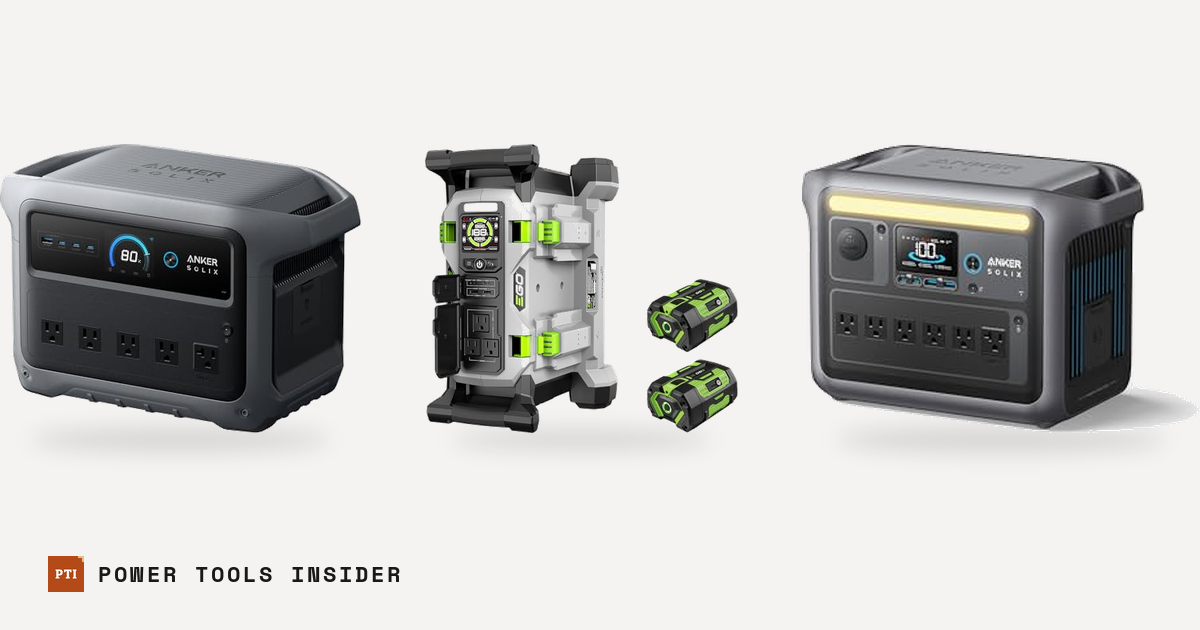
| EGO PST1405-2 | EGO Platform Users | 672-1344Wh* | 1400W | 36 lbs | $899 | Buy Now |
| Anker SOLIX C1000 Gen 2 | Best Overall | 1024Wh | 2000W | 24.9 lbs | $499.99 | Buy Now |
| Anker SOLIX C1000 (Original) | Budget Alternative | 1056Wh | 1800W | ~28 lbs | $449.99 | Buy Now |
| Jackery Explorer 1000 V2 | Best Value | 1070Wh | 1500W | 23.8 lbs | $449 | Buy Now |
| Bluetti Elite 200 V2 | Best for Heavy Tools | 2073.6Wh | 2600W | 53.35 lbs | ~$899 | Buy Now |
*EGO PST1405-2 capacity depends on batteries used. Includes 2× 56V 6.0Ah batteries (≈672Wh). Supports up to 4 EGO 56V batteries for ≈1344Wh maximum.
EGO POWER+ PST1405-2, Best for EGO Platform Users
The EGO Nexus doesn’t have a fixed internal battery. It runs entirely on EGO 56V ARC Lithium packs, the same batteries powering your mower, blower, and string trimmer. Buy it if you already own EGO OPE. If you run a full EGO fleet on a jobsite, you can hot-swap depleted batteries and keep the station running continuously by charging spares from another source. No other unit on this list can do that.
Jobsite case for it: If you’re already carrying 4× 56V 6.0Ah batteries for your EGO OPE, those same packs go straight into the Nexus for ≈1344Wh of usable power. Pass-through charging means you can charge your EGO tools while simultaneously powering AC devices, useful on a job where a battery charger and a work light both need to be running.
- Continuous: 1,400W / Peak: 2,100W (pure sine wave)
- Included batteries: 2× 56V 6.0Ah (≈672Wh); expandable to 4× batteries (≈1344Wh)
- Recharge: 900W via wall, 200W solar, 100W USB-C PD
- Ports: 3× 120V AC, 2× USB-A (fast charge), 1× 100W USB-C PD (in/out)
- Weight: 36 lbs (with 2 included batteries)
- Special: EGO Connect app for monitoring battery status and outlet control
The trade-off: 1,400W continuous is the ceiling. You can’t run a 15A circular saw or miter saw at full load on the Nexus, it’ll hit the limit under heavy draw. Best for: charging cordless batteries, running LED work lights, task lighting, and smaller corded tools (router at 900W, oscillating tool, detail sander). For contractors who need to run a 1,800W saw or heavier, look at the Anker or Bluetti below.
For more on the EGO 56V ecosystem, see our EGO vs Greenworks 2026 platform comparison and our EGO commercial OPE lineup breakdown.
Buy EGO PST1405-2 on Amazon, $899
Anker SOLIX C1000 Gen 2, Best Overall
The C1000 Gen 2 is the fastest-charging unit in this class. HyperFlash tech delivers 1,600W AC input, a full charge in 49 minutes. For a jobsite use case where you’re running a 6-hour shift and need the station topped off during lunch, that recharge window is real. The original C1000 charged in 58 minutes; the Gen 2 shaved nearly 10 minutes while bumping output from 1,800W to 2,000W continuous.
At 2,000W continuous (3,000W peak), it can handle most 15A corded power tools without issue: circular saws, jig saws, compound miter saws under 15A draw, routers, and standard shop vacs. The 1,024Wh LiFePO4 pack gives roughly 30, 45 minutes of continuous high-load tool use, or several hours of mixed tasks (charging batteries + lighting).
- Continuous: 2,000W / Peak: 3,000W
- Capacity: 1,024Wh LiFePO4 (4,000+ cycles, 10-year InfiniPower rating)
- AC recharge: 49 minutes (1,600W HyperFlash)
- Solar input: 600W max, 1.8 hr solar recharge
- UPS switchover: under 10ms (useful for computers/CPAP if doubling as home backup)
- Ports: 10 total
- Weight: 24.9 lbs
- Dimensions: 15.1″ × 8.2″ × 9.6″
The trade-off: 1,024Wh is adequate for half-day jobsite use but you’ll want to recharge at lunch if running continuous tool loads. The Gen 2 is 14% smaller and 11% lighter than the original C1000 (per Anker), which matters when it’s living in a truck bed.
Buy Anker SOLIX C1000 Gen 2 on Amazon, $499.99
Anker SOLIX C1000 (Original), Budget Alternative
The original C1000 pre-dates the Gen 2 by about a year but the core specs hold up: 1,800W continuous (2,400W peak), 1,056Wh LiFePO4, and the same Anker build quality. The main differences from the Gen 2: 200W less continuous output, 9 more minutes to charge (58 min vs. 49 min), and slightly older port layout. At $449.99 with 10% off versus the Gen 2 at $499.99, it saves $50 for buyers who don’t need to run 2,000W tool loads.
The practical case for the original: if your jobsite loads stay under 1,500W, battery chargers, LED work lights, routers, sanders, and oscillating tools, the original C1000 handles it at the lower price. The 1,800W ceiling is tighter than the Gen 2 for heavy corded saws, but fine for most mixed-use jobsite tasks. LiFePO4 chemistry and the 4,000+ cycle lifespan are identical to the Gen 2, so long-term durability is comparable.
- Continuous: 1,800W / Peak: 2,400W (pure sine wave)
- Capacity: 1,056Wh LiFePO4 (4,000+ cycles)
- AC recharge: 58 minutes
- Solar input: 600W max
- Weight: approx. 28 lbs
- Ports: AC outlets + USB-A + USB-C
The trade-off: $50 less than the Gen 2, but 200W less continuous output. If your loads stay under 1,500W, this is the better value. If you’ll regularly run a 15A circular saw or heavy miter saw, step up to the Gen 2 (2,000W) or the Bluetti Elite 200 V2 (2,600W).
Buy Anker SOLIX C1000 Original on Amazon, $449.99
Jackery Explorer 1000 V2, Best Value
At $449 with 44% off (save $350), the Jackery Explorer 1000 V2 is the lowest-barrier entry into a 1kWh-class jobsite power station. It also happens to be the lightest in this comparison at 23.8 lbs, easier to load in and out of a vehicle solo. The 1-hour fast charge (via the emergency charging mode in the Jackery app) matches the Anker’s speed at a lower price.
The 1,500W continuous / 3,000W peak handles most light-to-medium jobsite tools: routers, 10-amp saws, oscillating tools, and battery chargers. Where it gives ground to the Anker Gen 2 is the 500W continuous power gap, a 15A (1,800W) circular saw at load will trip the 1,500W ceiling, though the 3,000W surge peak can handle motor start-up spikes.
- Continuous: 1,500W AC / Peak: 3,000W (pure sine wave)
- Capacity: 1,070Wh LiFePO4 (4,000+ cycles, 10-year lifespan)
- Recharge: 1 hour (emergency charging mode), solar-compatible
- Ports: 3× AC (pure sine wave), 2× USB-C, 1× USB-A, 1× DC car port
- Weight: 23.8 lbs
- Dimensions: 12.87″ × 8.82″ × 9.72″
The trade-off: If your tool load stays under 1,500W (most routers, sanders, smaller saws, battery chargers), the Jackery covers it at the lowest price in this roundup. If you need 1,800W+ for a corded circular saw or miter saw, step up to the Anker Gen 2.
Buy Jackery Explorer 1000 V2 on Amazon, $449
Bluetti Elite 200 V2, Best for Heavy Tools
The Bluetti Elite 200 V2 is the unit for contractors who need to run heavy corded tools all day. 2,600W continuous (3,900W peak with HyperWatt Power Lifting) means a 15A circular saw, a 15A miter saw, or a heavy router table can run without hitting the ceiling. At 2,073.6Wh, it’s nearly twice the capacity of the 1kWh-class units above, plan on 60, 90+ minutes of continuous heavy-tool use, or a full day of mixed light duty.
The downside is weight: 53.35 lbs. This is a two-hand lift, not a one-arm carry. It lives on a job site rather than travels to one daily. If you have a dedicated location (shop floor, enclosed work trailer), the Bluetti makes sense. If you’re loading and unloading from a truck every day, the Anker or Jackery is more practical.
- Continuous: 2,600W / Peak: 3,900W (HyperWatt + Power Lifting)
- Capacity: 2,073.6Wh LFP (17-year lifespan, CNAS-certified automotive-grade cells)
- Recharge: 0, 80% in 50 minutes (TurboBoost); three charging modes via app (Turbo/Standard/Silent)
- Standby draw: 10W (50% less than typical)
- Ports: 4× AC 2600W outlets + DC + USB
- Weight: 53.35 lbs
- Dimensions: 13.78″ × 9.84″ × 12.74″
The trade-off: around $899 and 53 lbs. You’re paying for 2× the capacity and 600W more continuous output than the budget options. For a shop or permanent work site, this is the right call. For daily truck-to-site carries, it’s too heavy.
For context on how dedicated jobsite power stations like the Milwaukee Roll-On 7,200W compare to portable units, see our Milwaukee Roll-On coverage. The Roll-On runs entire tool lineups simultaneously; the Bluetti Elite 200 V2 runs one or two heavy tools at a time, different use cases.
Buy Bluetti Elite 200 V2 on Amazon
How to Size a Power Station for Your Jobsite
Start with your actual tool loads
The nameplate wattage on a tool is the maximum draw. Real-world running watts are lower, a router draws about 600, 900W at light cut depth, not the 1,750W maximum. The watt ratings that matter for sizing:
| Tool | Typical Running W | Surge / Start-Up W | Runs on 1500W Unit? |
|---|---|---|---|
| Router (fixed base, light depth) | 600-900W | 1,200W | Yes |
| Orbital sander | 200-300W | 500W | Yes |
| Corded drill (1/2″) | 400-700W | 1,200W | Yes |
| Oscillating multi-tool | 200-400W | 600W | Yes |
| Shop vac (6.5 peak HP) | 1,000-1,200W | 1,800W | Check surge rating |
| 10″ compound miter saw (12A) | 1,200-1,400W | 2,400W | Marginal |
| 7-1/4″ circular saw (15A) | 1,400-1,800W | 2,800W | No, need 2000W+ |
| EGO battery charger (CH5500E) | 500W | 500W | Yes |
If your primary tool is a circular saw or a 15A miter saw, go with the Anker C1000 Gen 2 (2,000W) or the Bluetti Elite 200 V2 (2,600W). The 1,500W units (Jackery 1000 V2, EGO Nexus) are fine for everything under that threshold.
Capacity math: how long will it last?
Real-world runtime is roughly: Capacity (Wh) × 0.85 ÷ Tool Load (W) = hours at load. The 0.85 factor accounts for inverter efficiency losses.
- Jackery 1000 V2 (1,070Wh × 0.85) running a 900W router: ~1 hour continuous
- Anker C1000 Gen 2 (1,024Wh × 0.85) running a 1,500W circular saw: ~35 minutes continuous cutting
- Bluetti Elite 200 V2 (2,073Wh × 0.85) running a 1,500W saw: ~70 minutes continuous
In practice, you’re not running a saw non-stop, you’re making cuts with idle time in between. Most 1kWh units will handle a full 4-hour work session of typical framing or finish work without a recharge.
Battery platform advantage: the EGO argument
If you’re already deep into the EGO 56V ecosystem for OPE, the PST1405-2 changes the economics. You’re not buying a new power pack, you’re using batteries you already have. Bring four 56V 6.0Ah packs (≈1344Wh total) and you have comparable capacity to the Jackery, powered by assets you already own. For EGO battery platform details, our battery platforms comparison covers EGO 56V alongside Milwaukee M18, DeWalt 20V, Makita 18V, and Bosch 18V.
Gas generator vs. portable power station: actual cost comparison
A 2,000W inverter generator (Honda EU2200i class) runs ~$1,100 new, requires gasoline (~0.1 gal/hr at 25% load = $0.40/hr), needs oil changes, emits CO, can’t be used indoors. A portable power station costs $430, $900, has no fuel cost, requires no maintenance, runs indoors silently, and recharges from AC or solar.
For a 3-year jobsite estimate at 1,000 hours of use:
- Gas generator (EU2200i): $1,100 + 100 gal fuel ($430) + maintenance ($150) = ~$1,680
- Anker SOLIX C1000 Gen 2: $450 + $0 fuel + $0 maintenance = $450 (plus electricity at ~$0.03/recharge)
The break-even point is under 12 months of regular use at these prices.
Frequently Asked Questions
Can a portable power station run a circular saw?
It depends on the station’s continuous watt rating and the saw’s draw. A 7-1/4″ circular saw at full load draws 1,400, 1,800W. The Jackery Explorer 1000 V2 (1,500W continuous) can handle it at moderate depth but may trip under heavy full-depth cuts. The Anker SOLIX C1000 Gen 2 (2,000W continuous) and Bluetti Elite 200 V2 (2,600W) handle it without issue. Always check the surge/peak watt rating, motor start-up spikes are typically 2× the running watt draw.
Can I use a portable power station indoors or in an enclosed garage?
Yes, this is the primary advantage over a gas generator. Portable power stations produce zero emissions and are completely safe indoors, in enclosed garages, basements, and enclosed trailers. Gas generators cannot be used in enclosed spaces due to CO danger. This is the main reason contractors are switching.
How long will a 1kWh power station last on a job site?
For a mixed workload, running a battery charger (500W), LED work lights (50W), and occasional saw cuts, a 1kWh unit will typically last a 4, 6 hour session before needing a recharge. For heavy continuous tool use (constant routing or sawing), plan on 45, 60 minutes per charge. Recharge time for 1kWh units ranges from 49 minutes (Anker C1000 Gen 2) to 1 hour (Jackery Explorer 1000 V2).
What’s the difference between surge watts and continuous watts?
Continuous watts is the sustained load the inverter can handle indefinitely. Surge (or peak) watts is the brief spike the unit can supply at motor start-up, typically lasting under a second. You size the unit based on continuous watts for the heaviest tool you’ll run simultaneously. Surge watts matter for tools with large motors (saws, compressors, shop vacs) that spike hard on startup. All units in this guide use pure sine wave output, which is required for sensitive electronics and motor-driven tools.
How does the EGO Nexus compare to dedicated jobsite power stations like the Milwaukee Roll-On?
Different class entirely. The Milwaukee Roll-On delivers 7,200W and is designed to run an entire tool lineup simultaneously, it’s essentially a mobile electrical panel for commercial construction. The EGO Nexus at 1,400W is for individual tool use: charging batteries, running one corded tool at a time, powering lighting. The Roll-On is built into a cart with M18 batteries powering it; the EGO Nexus uses your existing EGO 56V packs. Different budget, different scale, different use case.
Related PTI Articles
- Battery Platforms Compared 2026, Milwaukee M18 vs DeWalt 20V vs EGO 56V and more
- EGO vs Greenworks 2026: Which Battery Platform Wins the Yard?
- Milwaukee Roll-On 7,200W Power Station: Silent Jobsite Power Without a Generator
- Best Cordless Lawn Mowers 2026
- Ryobi Battery Power Stations for 18V and 40V Users
Updated May 2026. Prices verified as of publication and subject to change.
Affiliate Disclosure: Power Tools Insider participates in the Amazon Associates program. We earn a commission on qualifying purchases through links on this page at no extra cost to you. Prices shown are current as of publication and subject to change.