Finding the best cordless random orbital sander in 2026 means navigating five different battery platforms, brushed vs. brushless motors at the same price point, and marketing claims that don’t always translate to what happens at the workbench. The random orbit action, pad spinning and orbiting simultaneously, is what kills swirl marks. That’s the whole game for furniture refinishing, deck prep, cabinet doors, and any surface that’ll take stain or a clear coat.
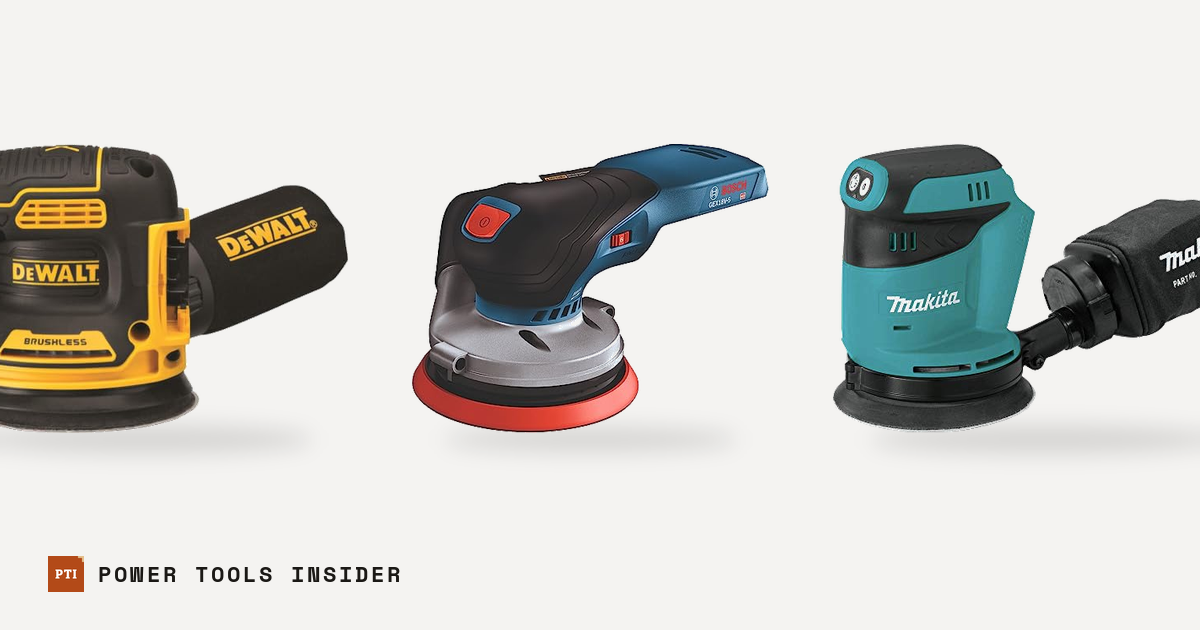
We compared five cordless 5-inch random orbital sanders across every major platform and price point, from Makita’s three-speed LXT at ~$89 to the brushless Bosch GEX18V-5N at $159. Here’s what actually holds up.
Quick Picks: Best Cordless Random Orbital Sanders 2026
| Award | Model | Price | Rating | Why We Picked It | Buy |
|---|---|---|---|---|---|
| Best Overall | Bosch GEX18V-5N | $159 bare | N/A | EC brushless motor, best swirl-free finish, mobile dust collection with tight pad seal. Pro pick for finish work. | Buy Now |
| Best Bang for Buck | DeWalt DCW210B | $97.49 bare | N/A | Brushless 20V MAX under $100. Best value in this roundup, on the platform most buyers already own. | Buy Now |
| Best Finish Control | Makita XOB01Z | ~$89 bare | 4.7/5 (2,700+ reviews) | Three preset speeds beat a variable dial for woodworking. Amazon’s Choice with the strongest finish quality reviews in the group. | Buy Now |
| Best for Milwaukee Users | Milwaukee M18 2648-20 | $149 at HD | 4.5/5 (4,800+ reviews) | Only M18-compatible ROS. Brushed motor at this price is a trade-off, but the ecosystem lock-in is real for M18 platform users. | Buy Now |
| Best Budget Pick | Ryobi PBLSD01B | $129 at HD | N/A | HP Brushless in the ONE+ system. Best choice for Ryobi users upgrading from the older brushed PCL406. | Buy Now |
Best Cordless Random Orbital Sanders 2026: Full Reviews
Bosch GEX18V-5N, Best Overall
Price: $159 (bare tool) | Voltage: 18V | Motor: EC Brushless
The Bosch GEX18V-5N earns the top spot on finish quality. The EC (electronically commutated) brushless motor maintains consistent speed under load, so when you push harder through thick old finish, the pad doesn’t bog down and leave uneven swirl depth. That matters for furniture and cabinet work where inconsistent scratch patterns show up under a clear coat.
Dust collection is the other standout. The mobile dust collection system works with either the included bag or a vacuum hose, and the pad seal is tight enough that you’re actually capturing most of what you sand off. Tight dust collection matters beyond cleanup: fine dust loads sandpaper faster, so good collection extends abrasive life meaningfully.
The downside is price. At $159 bare, it’s the most expensive sander here. You’re paying for finish results and Bosch’s ProCORE 18V battery compatibility. If you’re doing rough prep work or stock removal rather than finish sanding, the DeWalt at $97.49 will get you 80% of the results for $60 less.
Pros
- EC brushless motor holds speed under load, no bog mid-stroke
- Tight dust pad seal: bag or vacuum port, best collection in this group
- Ergonomic palm-grip for extended sanding sessions
- ProCORE 18V battery compatible
- Compact form factor for getting close to work surface
Cons
- $159 bare, most expensive in this roundup
- 18V Bosch is a smaller US ecosystem than DeWalt or Milwaukee
- Speed range adjustable but less granular than a continuous variable dial
| Spec | Value |
|---|---|
| Voltage | 18V (Bosch) |
| Motor | EC Brushless |
| Pad Size | 5 inch |
| Max Speed | 12,000 OPM variable |
| Weight (tool only) | ~2.6 lbs |
| Dust Collection | Dust bag or vacuum port |
| Price (bare) | $159 |
Bottom Line: Best finish quality and dust collection in the group. Worth the premium if you care about swirl-free results on furniture and cabinetry. Pass if you’re doing rough prep, the DeWalt does that job for $60 less.
DeWalt DCW210B, Best Bang for Buck
Price: $97.49 (bare tool) | Voltage: 20V MAX | Motor: Brushless
Under $100 for a brushless cordless ROS on the most-popular battery platform in North America. That’s the entire pitch for the DCW210B, and it delivers. Variable speed from 8,000 to 12,000 OPM covers aggressive stock removal through final finish passes. The brushless motor gives you 30, 40% better runtime vs. brushed equivalents, expect 35, 45 minutes of heavy sanding on a 4.0Ah battery.
The low-profile design keeps your hand close to the work surface, which helps on flat panels and cabinet doors where you want consistent downforce across the full pad. Hook-and-loop paper swaps in seconds. And 20V MAX battery compatibility means the battery already on your drill runs this sander, no new system investment.
Coming soon: DeWalt has two updated models spotted at trade shows, the DCW211 (5″) and DCW230 (6″), expected to ship later in 2026. If you can wait, those should deliver ergonomics updates and a new 6-inch cordless option. For now, the DCW210B is the go-to value pick. See our DeWalt DCW211/DCW230 preview for timing details.
Pros
- Brushless at $97.49, best price-to-performance in the roundup
- 20V MAX: uses batteries you almost certainly already own
- Variable speed dial (8,000, 12,000 OPM) covers all sanding tasks
- Low-profile design for consistent surface pressure
- 2.4 lbs, lightest in the group (tie with Makita)
Cons
- Dust collection not as sealed as the Bosch
- No 6-inch pad option (DCW230 expected later in 2026)
- Continuous variable dial only, no preset speed settings
| Spec | Value |
|---|---|
| Voltage | 20V MAX |
| Motor | Brushless |
| Pad Size | 5 inch |
| Speed Range | 8,000-12,000 OPM variable |
| Weight (tool only) | 2.4 lbs |
| Dust Collection | Bag + port |
| Price (bare) | $97.49 |
Bottom Line: The smart buy for 20V MAX platform users. Brushless performance under $100, solid dust collection, and DeWalt’s platform depth means perpetual battery deals. Best choice for most DIYers who don’t need the Bosch’s finish-quality edge.
Makita XOB01Z, Best Finish Control
Price: ~$89 (bare tool) | Voltage: 18V LXT | Rating: 4.7 (2,700+ reviews)
The Makita XOB01Z’s three preset speed settings, 7,000, 9,500, and 11,000 OPM, separate it from every other sander in this roundup. Variable dials are fine, but preset speeds mean you switch from “aggressive removal” to “final finish coat” with a single button touch rather than re-dialing between passes. For furniture refinishing where you’re cycling between 120-grit removal and 220-grit final finish on the same piece, that repeatability is genuinely useful.
The 4.7-star rating across 2,700+ Amazon reviews is a strong signal. It’s Amazon’s Choice for this category, which typically reflects consistent availability and competitive pricing. Makita’s LXT 18V system is the largest professional cordless platform globally, if you’re a woodworker who already runs LXT tools for routing, drilling, or trim work, this fits the kit naturally.
The XOB01Z’s weakness: brushed motor. At ~$89 that’s expected and tolerable for most DIY use. But if you’re sanding for several hours per week, the brushless DeWalt at $97.49 delivers meaningfully better runtime and runs cooler over long sessions. For typical weekend projects, the Makita’s three-speed system and finish reputation make it the easy recommendation at the price.
Pros
- Three preset speeds, fastest way to switch between removal and finish mode
- 4.7 / 2,700+ reviews, top finish-quality ratings in this roundup
- ~$89 bare, most affordable in the group
- Amazon’s Choice, reliable pricing and availability
- Makita LXT ecosystem, strong for woodworking tool kits
Cons
- Brushed motor, lower runtime and longevity than brushless competition
- Only 3 preset settings, no granular variable speed
- LXT platform less common for US DIYers vs. DeWalt/Milwaukee
| Spec | Value |
|---|---|
| Voltage | 18V LXT |
| Motor | Brushed |
| Pad Size | 5 inch |
| Speed Settings | 3 presets: 7,000 / 9,500 / 11,000 OPM |
| Weight (tool only) | ~2.4 lbs |
| Runtime (4.0Ah) | ~40 minutes |
| Price (bare) | ~$89 |
Bottom Line: Best under-$100 pick for finish work. Three preset speeds outperform a variable dial for woodworking tasks, and the 4.7-star rating is backed by enough reviews to trust. Brushed motor is the only caveat, acceptable for most DIYers, step up to brushless for heavy use.
Milwaukee M18 2648-20, Best for Milwaukee Users
Price: $149 at Home Depot | Voltage: 18V M18 | Rating: 4.5 (4,800+ reviews)
The Milwaukee M18 2648-20 is the only 5-inch random orbital sander available in the M18 system. If you’re running M18 tools across your whole kit, framing nailer, circular saw, drill, impact driver, this sander runs your existing batteries without adding a new ecosystem. The 4,800+ Home Depot reviews and 4.5-star rating confirm it’s a reliable tool that does the job.
The honest trade-off: at $149 bare, this is a brushed motor sander. The Bosch GEX18V-5N ($159) gives you EC brushless for $10 more. The DeWalt DCW210B ($97.49) gives you brushless for $51 less. The premium you’re paying here is for M18 platform compatibility, not motor technology. Milwaukee has not released a brushless M18 ROS as of May 2026.
For typical DIY use, furniture prep, deck sanding, drywall finishing, the brushed motor won’t be a limiting factor. It performs well at 12,000 OPM max with variable speed and a lock-on switch for extended sessions. Where brushed motors fall short is heavy commercial use or all-day sanding, where heat buildup affects performance and tool longevity. For weekend work, the M18’s ecosystem integration outweighs its motor tech disadvantage.
Pros
- Only M18-compatible ROS, runs every M18 battery you own
- 4.5 / 4,800+ Home Depot reviews, proven durability record
- Lock-on switch for extended sanding sessions
- M18 fuel gauge shows remaining battery charge
- 5-year Milwaukee warranty
Cons
- Brushed motor at $149, brushless options available at $89, $159
- No brushless M18 ROS option currently available
- Milwaukee is Home Depot exclusive, not available on Amazon
- Heaviest in the group at 2.7 lbs
| Spec | Value |
|---|---|
| Voltage | 18V M18 |
| Motor | Brushed |
| Pad Size | 5 inch |
| Max Speed | 12,000 OPM variable |
| Weight (tool only) | 2.7 lbs |
| Warranty | 5 years |
| Price (bare at HD) | $149 |
Bottom Line: Buy it if you’re committed to M18 and want sanding in the ecosystem. Pass if you’re building a new kit, you’ll get more motor for less money with the DeWalt or Bosch.
Ryobi PBLSD01B, Best Budget Pick
Price: $129 at Home Depot | Voltage: 18V ONE+ HP | Motor: HP Brushless
Ryobi’s HP brushless series has been systematically closing the gap on Milwaukee and DeWalt in performance per dollar, and the PBLSD01B delivers brushless performance in the ONE+ system at $129 bare. If you already run ONE+ batteries, drill, circular saw, reciprocating saw, adding the PBLSD01B is a battery-compatible upgrade that doesn’t require buying into a new platform.
The HP designation matters here. Ryobi’s HP brushless tools perform noticeably better than the standard brushed ONE+ lineup. If you’re upgrading from the older PCL406 brushed Ryobi sander, you’ll see better runtime, less heat buildup, and smoother speed control under variable load. A starter kit with a 2.0Ah HP battery and charger (PBLSD01K1) is available at Home Depot for $139, a strong value for a brushless platform starter package.
Where the Ryobi loses ground: price relative to platform-agnostic competition. At $129 bare, it’s more expensive than both the Makita XOB01Z (~$89) and DeWalt DCW210B ($97.49). If you’re not already in the ONE+ ecosystem, those are better value buys. The Ryobi earns its spot in this roundup for platform-committed users upgrading their sanding setup.
Pros
- HP Brushless motor, real step up from standard brushed ONE+ tools
- Compatible with all 18V ONE+ and ONE+ HP batteries
- PBLSD01K1 starter kit (sander + 2.0Ah HP + charger) at $139, strong value
- Variable speed for task matching
Cons
- $129 bare, more expensive than DeWalt brushless at $97.49
- Home Depot exclusive, not available on Amazon
- ONE+ platform depth smaller than M18 for pro trades use
| Spec | Value |
|---|---|
| Voltage | 18V ONE+ HP |
| Motor | HP Brushless |
| Pad Size | 5 inch |
| Weight (tool only) | ~2.5 lbs |
| Dust Collection | Bag + vacuum port |
| Price (bare at HD) | $129 |
Bottom Line: Right pick for ONE+ users who want brushless performance without platform switching. Platform-agnostic buyers get better value from DeWalt or Makita.
How to Choose a Cordless Random Orbital Sander
5-Inch vs. 6-Inch Cordless Sanders
Every sander in this roundup is a 5-inch model, the right choice for most tasks. Five inches balances material removal rate with edge control. The pad is small enough to work near edges without running off the surface, large enough to cover wide boards efficiently.
A 6-inch pad is a pro tool for high-volume work: large table tops, cabinet panels, flooring prep. It removes material faster per pass but is harder to control at the edges. DeWalt’s upcoming DCW230 will add a 6-inch cordless option to the 20V MAX lineup. If you regularly sand large surfaces, that model is worth waiting for.
OPM and Variable Speed
Orbits per minute (OPM) determines how fast the pad moves and how aggressively it cuts. Here’s the practical breakdown:
- 7,000, 8,000 OPM: Final finish with 220-grit or finer. Safe for delicate work.
- 9,500, 10,000 OPM: General prep and leveling, 120, 150 grit.
- 11,000, 12,000 OPM: Aggressive removal, stripping old finish, 60, 80 grit.
Variable dials let you fine-tune speed. Makita’s three presets give faster repeatability between pass types. Either works, presets are faster for experienced users cycling between modes, variable dials give beginners more intuitive control.
Brushless vs. Brushed Motors
In this roundup: Bosch, DeWalt, and Ryobi are brushless. Makita and Milwaukee are brushed.
Brushless motors run cooler, last longer, and deliver more runtime per charge, typically 30, 40% better than brushed. For occasional weekend use, the difference is minimal. For regular or all-day sanding, brushless is worth the cost. The DeWalt DCW210B gives you brushless at $97.49, there’s no reason to accept brushed for Amazon-eligible brands at that price.
Dust Collection
Every sander here includes a dust bag and vacuum port. Bags are convenient for portable work; vacuum connection keeps your workspace cleaner and extends abrasive life by preventing fine dust from loading the paper. The Bosch GEX18V-5N has the tightest pad-to-collection seal in this group. All others are adequate for general use.
Pro tip: use dust bags for rough work and connect a shop vac for final finish passes. The difference in paper longevity is significant, fine dust loading is the primary reason sandpaper loses cut efficiency before the abrasive wears out. See our full sander guide for corded options and belt sander comparisons. For abrasives selection, our sandpaper grit guide shows which grit to use at each stage.
Battery Ecosystem Considerations
A bare tool purchase only makes sense if you have compatible batteries on hand. Platform summary:
- 20V MAX (DeWalt): Largest North American DIY platform. Easiest to find battery deals.
- M18 (Milwaukee): Pro trades standard. Most durable batteries in the market.
- 18V LXT (Makita): Largest professional platform globally. Strong for woodworking kits.
- 18V ONE+ HP (Ryobi): Best value entry point. 300+ compatible tools.
- 18V (Bosch): ProCORE tech is excellent quality. Smaller US market selection.
If you’re starting from zero with no existing batteries, buy a kit version, the DeWalt DCW210D1 or Ryobi PBLSD01K1 ($139 with 2.0Ah HP battery + charger) are the best starter bundles at this tier. And if you’re building out your first cordless kit, see our beginner woodworking tool kit guide for platform selection advice beyond just the sander.
When to Go Corded Instead
Cordless is the right call for most jobs. Two cases where corded still wins:
- All-day commercial work: Floor refinishing, large cabinet production runs, or any job where you’re sanding for 6+ consecutive hours. Battery swaps interrupt workflow, and corded power is consistent indefinitely. The Bosch ROS20VSC (~$69 corded) is the benchmark for this use case.
- Fixed bench work with outlets everywhere: If you’re always at the same workbench with an outlet arm’s reach away, corded gives you slightly better stock removal consistency at the same price point. No battery management.
For everything else, jobsite work, furniture refinishing in the living room, garage projects, any task involving movement, cordless wins on flexibility. See our full breakdown of when to go corded vs. cordless for a broader comparison across tool types.
Frequently Asked Questions
Is a cordless random orbital sander as good as corded?
For most DIY and jobsite work, yes. Brushless cordless sanders at 18V, 20V deliver removal rates and finish quality close to corded equivalents. The practical gap is runtime, a 4.0Ah battery gives 30, 45 minutes of heavy sanding before a swap. For all-day production work, corded wins on endurance. For typical projects, the freedom of cordless outweighs that limitation.
What battery platform is best for a cordless sander?
For most North American buyers, DeWalt 20V MAX is the safest starting point, the largest tool selection, easiest to find batteries on sale, and brushless sander available under $100. Milwaukee M18 is the professional trades standard with the most durable batteries. Makita LXT is the best fit if you’re a woodworker already running LXT trim tools, routers, or drill systems. Ryobi ONE+ is the best value entry for budget-conscious buyers starting a full kit. Bosch 18V has excellent tool quality but a smaller US ecosystem. Pick the platform with the most tools you’ll actually buy, you’ll be paying for those batteries for years.
What’s the difference between a random orbital sander and a regular orbital sander?
A regular orbital (sheet) sander vibrates in a fixed elliptical or circular pattern. This creates cross-grain scratches that show under finish, especially on hardwoods. A random orbital sander’s pad both spins and orbits in a random pattern simultaneously. The randomness breaks up swirl marks. For any finish work on wood, always use a random orbital sander. Sheet sanders have their place for large flat areas, drywall, and final finishing of painted surfaces.
What grit sandpaper should I start with on a random orbital sander?
Start with 80-grit for significant material removal or stripping old finish. Move to 120-grit for general prep and leveling. Finish with 180, 220 grit before staining or applying a clear coat. Never skip more than one grit step, jumping from 80 to 220 leaves 80-grit scratches under the surface that appear after staining. See our sandpaper grit guide for a full progression chart by project type.
Do cordless random orbital sanders work for automotive paint prep and bodywork?
Yes, the random orbit pattern is actually standard in automotive paint correction because it prevents the circular swirl marks that show in clearcoat under sunlight. For body filler sanding, use a fixed speed setting (variable speed fluctuations can create inconsistent scratch depth in primer). Start at 80-grit for bulk filler removal, work through 120, 220, then switch to wet-sanding for 400, 800 grit before primer. For full automotive refinishing workflows, see our best paint sprayers guide, the sander is only one part of a complete surface prep setup.
How long does a battery last on a cordless random orbital sander?
Runtime depends on battery capacity, motor type, and how hard you’re pushing the tool. Rough estimate: a 4.0Ah battery on a brushless sander delivers 35, 45 minutes of active sanding under moderate load. Lighter finish passes at lower OPM run longer; heavy 60-grit removal at 12,000 OPM cuts that down. Two batteries in rotation is the practical setup for any project longer than 30 minutes.
Power Tool Insider is reader-supported. When you buy through links on our site, we may earn an affiliate commission at no extra cost to you. This doesn’t affect our recommendations, we only recommend tools we’d actually use. Full disclosure.