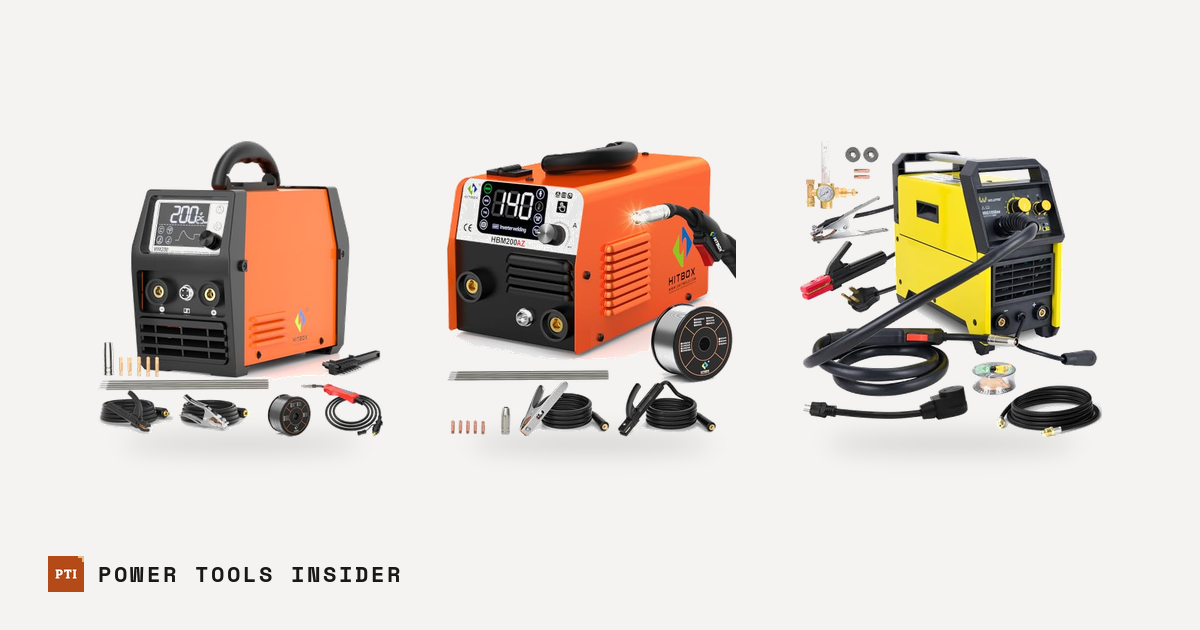
You don’t need a professional setup to weld. A decent MIG welder under $300 lets a DIYer repair trailer frames, build furniture, weld up a cart, or patch a gate, without a $1,000 machine or a welding certificate. The learning curve is real, but MIG is the most forgiving process for beginners: pull a trigger, move the gun, done.
We picked 4 machines that are actually in stock, actually under $300, and actually capable of handling real DIY work, not toy flux core boxes that crater on anything thicker than sheet metal. All prices are at time of writing; Amazon fluctuates.
Best MIG Welders for DIY Under $300, Quick Picks
| Award | Model | Price | Rating | Why We Picked It | Buy |
|---|---|---|---|---|---|
| Most Affordable | HITBOX HBM200 | ~$82 | N/A | Synergy one-knob, 3-in-1, under $85, hard to argue with | Buy Now |
| Best Entry Multi-Process | HITBOX HIM200 | ~$120 | N/A | Adds dual voltage + gas MIG + spool gun for $38 more | Buy Now |
| Best Performance Value | Weldpro MIG155GSV | ~$190 | N/A | 155A, dual voltage, 3-year warranty, real synergy control | Buy Now |
| Best for Absolute Beginners | Forney Easy Weld 261 | ~$295 | N/A | Trusted brand since 1932, manual controls, just plug in and weld | Buy Now |
4 Best MIG Welders for DIY Under $300
HITBOX HBM200, Most Affordable

Price: ~$82 | Voltage: 110V
Under $85 for a working MIG setup sounds like a trap. It’s not. The HBM200 uses IGBT inverter technology, the same topology in pro machines, and a synergy one-knob control that sets wire speed relative to voltage automatically. You dial in material thickness, it compensates. For someone tackling their first weld on 1/8″ steel or sheet metal repair, that’s all you need.
This is flux core only (gasless MIG), plus lift TIG and stick mode. No gas solenoid means you can’t run shielding gas, that’s the tradeoff at this price. At 7.7 lbs it’s genuinely portable. The 60% duty cycle at lower amperages means you can weld for extended sessions without thermal shutdown.
Pros
- Under $85, lowest real entry cost for a working MIG
- One-knob synergy makes setup straightforward
- 7.7 lbs, genuinely portable
- 60% duty cycle handles extended DIY sessions
- IGBT inverter, efficient and durable
Cons
- Flux core only, no gas MIG capability
- 110V only, can’t use on 240V circuits
- 140A ceiling limits max material thickness (~3/16″)
- No spool gun support for aluminum
| Spec | Value |
|---|---|
| Input Voltage | 110V |
| Amperage Range | 30-140A |
| Processes | Flux Core MIG / Lift TIG / Stick |
| Duty Cycle | 60% |
| Wire Size | 0.030-0.035″ |
| Weight | 7.7 lbs |
Bottom Line: If your budget is tight and your welds are on mild steel, the HBM200 is a legitimate starting tool, not a toy. Buy it, learn the process, upgrade later if you outgrow it.
HITBOX HIM200, Best Entry Multi-Process

Price: ~$120 | Voltage: 110V/220V Dual
Spend $38 more than the HBM200 and you unlock a lot: dual voltage (run it on 220V for more power), a gas port for solid wire MIG, and spool gun compatibility for aluminum. The HIM200 is the smarter long-term buy if you think you’ll ever want gas MIG or have access to a 240V outlet in your shop.
Same synergy one-knob control as the HBM200, same compact form factor at 8.8 lbs. The added processes don’t complicate operation, you’re still selecting a material preset and pulling the trigger. At 140A max on 220V, it handles 3/16″ steel comfortably and can push into 1/4″ with technique. The spool gun port means aluminum welding is possible when you’re ready for it.
Pros
- Dual voltage, 110V at home, 220V in a proper shop
- Gas MIG port, cleaner welds on thin material
- Spool gun compatible for aluminum
- Still compact at 8.8 lbs
- Best feature-to-dollar ratio in this category
Cons
- Spool gun sold separately
- 140A ceiling, same as HBM200 at this amperage
- Newer model with less established review history
| Spec | Value |
|---|---|
| Input Voltage | 110V / 220V |
| Amperage Range | 30-140A |
| Processes | Gas MIG / Flux Core / Lift TIG / Stick |
| Duty Cycle | 60% |
| Wire Size | 0.030-0.035″ |
| Weight | 8.8 lbs |
| Spool Gun | Compatible |
Bottom Line: The HIM200 is the pick if you want room to grow. Dual voltage, gas MIG, and spool gun support for $120 is a deal that machines twice the price struggled to match five years ago.
Weldpro MIG155GSV, Best Performance Value

Price: ~$190 | Voltage: 110V/220V Dual
Weldpro MIG155GSV sits in the sweet spot: meaningful power upgrade (155A vs 140A), real synergy control, dual voltage, and a 3-year power source warranty that puts it above anything in its class. At $190, it’s the machine you buy once and don’t replace until you’re doing structural work or production runs.
An extra 15A over a 140A machine moves your practical ceiling from 3/16″ to a comfortable 1/4″ on single-pass welds with 220V input. Its synergy system intelligently matches voltage and wire speed, useful when you’re switching between different material thicknesses mid-project. Weldpro’s 3-year warranty is the strongest in this price range; most budget welders offer 1 year or none.
Weight is the tradeoff: 21 lbs versus the 7-9 lb HITBOX units. Not unmanageable, but you’re not throwing this in a truck toolbox the same way.
Pros
- 155A, meaningful real-world power over 140A units
- 3-year power source warranty, best in class at this price
- Dual voltage, synergy control
- Handles 1/4″ steel comfortably on 220V
- Established brand with service network
Cons
- 21 lbs, noticeably heavier than HITBOX alternatives
- No spool gun included
- Flux core / gas MIG only, no TIG mode
| Spec | Value |
|---|---|
| Input Voltage | 110V / 220V |
| Amperage Range | 30-155A |
| Processes | Flux Core MIG / Gas MIG / Stick |
| Duty Cycle | 60% |
| Wire Size | 0.023-0.035″ |
| Weight | 21.2 lbs |
| Warranty | 3 years (power source) |
Bottom Line: If you’re serious about welding and want a machine that holds up for years of real shop use, the Weldpro MIG155GSV is the right call. The 3-year warranty alone justifies the $70 premium over the HITBOX HIM200.
Forney Easy Weld 261, Best for Absolute Beginners

Price: ~$295 | Voltage: 120V
Forney has been making welding equipment since 1932. The Easy Weld 261 is their entry-level flux core machine, and it earns its spot here on brand trust and simplicity. No digital display, no synergy mode, just infinite voltage and wire speed dials. You set them manually, which is actually a better teaching tool for someone learning to understand the weld process rather than letting a computer compensate.
At 140A on 120V, it handles up to 1/4″ mild steel. The duty cycle is 30%, lower than the HITBOX units, which means you’ll be resting the machine more during long bead sequences. Occasional repair work, a broken bracket or a trailer hitch patch, rarely pushes up against the duty cycle limit. Forney’s US-based customer support and service network add real value if something goes wrong.
Pros
- Trusted American brand in business since 1932
- Manual controls teach you to understand the weld, not just follow presets
- Welds up to 1/4″ mild steel
- US-based customer support and service
- Simple plug-and-weld on standard 120V
Cons
- Flux core only, no gas MIG capability
- 30% duty cycle, lowest in this group
- 120V only, no dual voltage
- Most expensive for what you get vs the HITBOX units
| Spec | Value |
|---|---|
| Input Voltage | 120V |
| Amperage Range | 30-140A |
| Processes | Flux Core MIG |
| Duty Cycle | 30% |
| Wire Size | 0.030″ |
| Weight | 19 lbs |
| Weld Capacity | 1/4″ mild steel |
Bottom Line: Pay the premium for the Forney if brand trust and simple manual controls matter more to you than specs on paper. Not the best value in this lineup, but the most approachable for a complete beginner who wants a known quantity.
Why MIG Is the Right Starting Point
Stick welding (SMAW) has a steeper arc-start learning curve and is messier. TIG welding requires both hands plus a foot pedal, it’s a skill that takes months to develop. MIG (including flux core) lets you focus on travel speed and gun angle without managing a separate electrode or coordinating a pedal. You’re laying functional welds on mild steel within your first hour of practice.
Flux core vs. gas MIG: Flux core wire has flux baked into the core, it shields itself from contamination, no gas needed. Easier to set up, works outdoors in light wind, but leaves a slag layer you chip off and produces more spatter. Gas MIG (solid wire + shielding gas) runs cleaner welds with less spatter and is better for thin metal. Pure DIY on mild steel is well within flux core’s range. If you plan to weld aluminum or thin sheet, you’ll want gas MIG capability.
MIG welders are corded tools, that’s a feature, not a limitation. Unlike cordless tools where battery capacity limits runtime, a corded welder delivers consistent power all day. Don’t let the cord factor you out of picking the right amperage range for your work.
What to Look For in a DIY MIG Welder
Voltage: 110V vs. Dual Voltage
A 110V-only welder plugs into any standard household outlet, no electrician required. A dual voltage machine runs on 110V at home or 220V in a proper shop, and 220V delivers noticeably more arc force and penetration. If you have a 240V outlet or plan to install one, dual voltage gives you real headroom. If you’ll always weld from a standard garage outlet, 110V handles most DIY work fine.
Duty Cycle
Duty cycle is measured over 10-minute intervals. A 60% duty cycle at a given amperage means 6 minutes of welding, 4 minutes cooling. A 30% cycle means 3 minutes on, 7 off. At 30%, the duty cycle rarely limits occasional DIY work, most people naturally pause to reposition or check their bead. For longer production runs, 60% matters significantly.
Amperage and Material Thickness
The rule of thumb is 1 amp per 0.001″ of material thickness. A 140A welder handles material up to about 0.140″ (roughly 3/16″) comfortably on a single pass. For 1/4″ steel, you either need 155A+ or multiple passes at lower amperage. Most home and farm DIY projects, trailer repair, furniture, brackets, gates, fall well within the 140A range.
Flux Core vs. Gas MIG
Flux core: no gas cylinder, no regulator, easier setup, works outdoors, leaves slag, more spatter. Gas MIG: cleaner bead, less spatter, better on thin material, requires gas cylinder and regulator. If you buy a flux-core-only machine now, you’re locked out of gas MIG unless you upgrade the machine itself. If there’s any chance you want gas MIG later, buy a machine with a gas port from the start.
Before and after most welding jobs you’ll be reaching for an angle grinder to prep metal and clean welds, see our guide to the best angle grinders for the tools that make welding faster, or a cordless rotary tool for precision grinding and weld cleanup in tight spots. And for eye protection, our safety glasses guide covers welding-rated options alongside standard shop glasses.
Frequently Asked Questions
Is MIG welding hard to learn?
MIG is the most beginner-friendly arc welding process. You can lay a recognizable bead within your first few practice runs. Getting consistently strong, good-looking welds takes weeks to months of practice, but functional welds on mild steel happen fast. Start with flat position welds on scrap metal before moving to vertical or overhead.
Can I use a MIG welder on standard 110V household power?
Yes, all four welders in this guide run on standard 110V/120V household outlets. No special wiring required. The HITBOX HBM200 is 110V only. The HITBOX HIM200 and Weldpro MIG155GSV are dual voltage, they’ll also run on 220V for more output when a higher-amperage circuit is available. Running a 110V welder on a 20-amp dedicated circuit (rather than a shared 15-amp circuit) reduces tripped breakers during heavy welding.
Do I need gas for MIG welding?
No, flux core wire is a self-shielding MIG process that doesn’t require external shielding gas. It’s the easiest way to start. Gas MIG (solid wire + shielding gas, typically 75% Argon / 25% CO₂) produces cleaner welds but adds cost and setup complexity. Most beginners start flux core and add gas capability later if they need cleaner results on thin material.
What can I weld with a 140A welder?
A 140A machine handles mild steel up to 3/16″ in a single pass, and up to 1/4″ with multiple passes. That covers the vast majority of DIY projects: trailer hitches and frames, garden furniture, metal shelving, brackets, exhaust patches, and light structural repairs. Steel at 3/8″ or thicker needs a 200A+ machine.
What’s the difference between MIG and TIG welding?
MIG (wire feed) is faster, more forgiving, and uses one hand, better for beginners and thicker material. TIG (Tungsten Inert Gas) uses a non-consumable tungsten electrode in one hand and a filler rod in the other, coordinated with a foot pedal for amperage control. TIG produces cleaner, more precise welds and handles thin material, stainless, and aluminum well, but the learning curve is measured in months, not hours. For DIY work on mild steel, MIG is the right tool.
Is flux core the same as MIG welding?
Flux core (FCAW) is a type of MIG welding, both use a continuously fed wire electrode through a gun. The difference is the shielding method: gas MIG uses external shielding gas, while flux core wire contains flux inside that creates its own shielding when it burns. The equipment is the same; you switch processes by changing wire type and removing the gas cup. Most budget welders are marketed as “MIG” but only include flux core capability unless they have a gas solenoid valve.
Power Tool Insider is reader-supported. When you buy through links on our site, we may earn an affiliate commission at no extra cost to you. This doesn’t affect our recommendations, we only recommend tools we’d actually use. Full disclosure.