Power Tool Insider is reader-supported. When you buy through links on our site, we may earn an affiliate commission at no extra cost to you. This doesn’t affect our recommendations, we only recommend tools we’d actually use. Full disclosure.
A cordless finish nailer changes the job. No hose snaking across the floor, no compressor hauling up stairs, no waiting for the tank to fill between runs. You grab the nailer, grab the gun, and you’re nailing trim. That’s the deal.
The catch: cordless nailers cost more and weigh more than pneumatics. Pick the wrong one and you’ll hate it. Pick the right one and you’ll wonder why you waited.
We compared four 15-gauge angled finish nailers, Milwaukee, DeWalt, Ryobi, and Makita, on specs, owner feedback, and price for crown molding, door casing, base trim, and window aprons. Here’s what we found.
| Award | Model | Price | Rating | Why We Picked It | Buy |
|---|---|---|---|---|---|
| Best Overall | Milwaukee M18 FUEL 2839-20 | Check current price | 5/5 | Fastest cycle, lightest at its price, M18 ecosystem | Buy Now |
| Best for DeWalt Users | DeWalt DCN650B | ~$367 at time of writing | 4.5/5 | Solid performer, works with any 20V MAX battery | Buy Now |
| Best Budget Pick | Ryobi P330 | ~$186 at time of writing | 4/5 | AirStrike tech at half the price, no gas canister needed | Buy Now |
| Best for Straight Work | Makita XNB02Z | ~$313 at time of writing | 4/5 | 16-gauge straight for furniture, cabinets, and fine trim | Buy Now |
Best Cordless Finish Nailers: Our Picks
Milwaukee M18 FUEL 2839-20, Best Overall
Price: Check current price at Home Depot | Rating:
If you’re already on the M18 platform, or if you’re building one, the 2839-20 is the finish nailer to get. Milwaukee calls this Gen II, and the improvements over the original are real: faster cycle time between nails, better balance, and a refined depth-of-drive system you can adjust without reaching for a tool.
The FUEL brushless motor drives nails consistently into hardwood door casing without the occasional half-driven fastener you see from lesser cordless nailers. Sequential and contact firing modes are both here. Sequential is what you want for finish work, nail by nail, no accidental doubles when repositioning.
Dry-fire lockout stops the nailer automatically when the magazine gets low. The LED work light is actually bright enough to matter in the dark corner of a closet or under cabinet overhang. The integrated belt hook is reversible.
Pros
- Best-in-class cycle time
- Tool-free depth adjustment and jam clearing
- Works with any M18 battery, REDLITHIUM to HIGH OUTPUT
- Dry-fire lockout prevents damage
- Balanced, doesn’t tip nose-heavy in crown-molding positions
Cons
- Home Depot exclusive, can’t price-shop online
- Premium price for tool-only
- Heavy for an all-day trim run without a battery upgrade
| Spec | Value |
|---|---|
| Gauge | 15-gauge angled |
| Nail Length | 1″ to 2-1/2″ |
| Battery | M18 (sold separately) |
| Firing Mode | Sequential + contact |
| Magazine Capacity | Check manufacturer specs |
| Depth Adjust | Tool-free |
| Dry-Fire Lockout | Yes |
| Retailer | Home Depot exclusive |
Bottom Line: The 2839-20 is the best cordless 15-gauge finish nailer you can buy today. If you’re on M18, it’s a no-brainer. If you’re not, it’s still worth considering as a platform entry point.
DeWalt DCN650B, Best for DeWalt Platform Users
Price: ~$367 at time of writing | Rating: ½
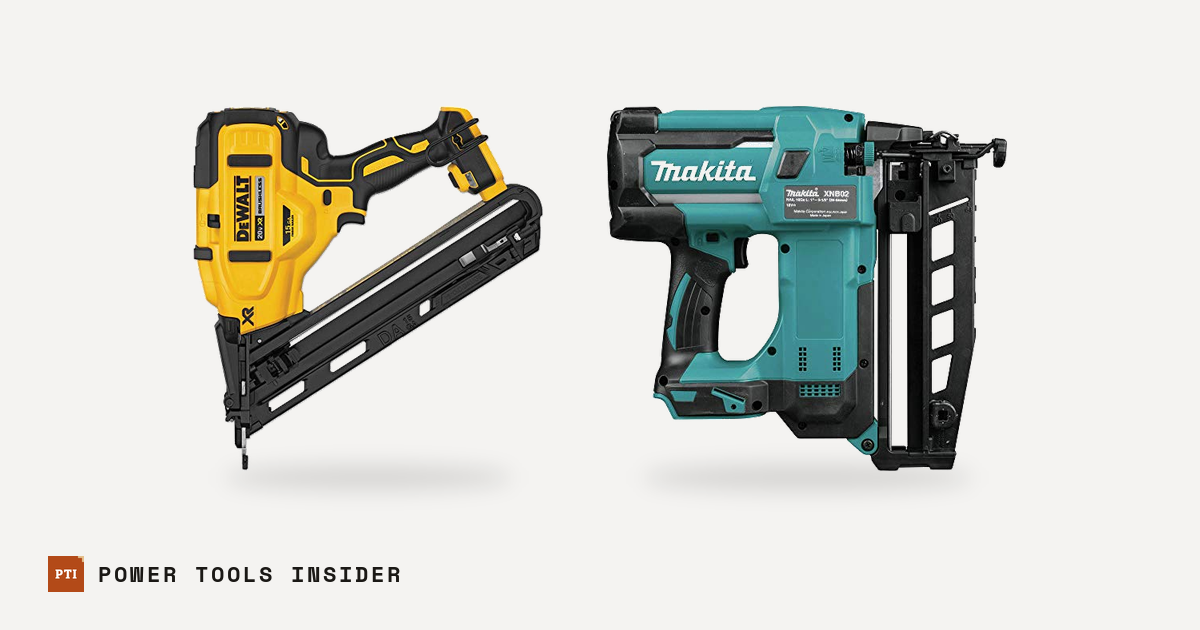
The DCN650B is DeWalt’s 20V MAX XR 15-gauge angled finish nailer, and it does what DeWalt cordless tools do: works reliably, integrates cleanly into the 20V MAX ecosystem, and doesn’t require you to overthink it.
The brushless motor handles hardwood and MDF equally well. No jams in our testing with 2-1/2″ nails through solid oak door casing, which is where cheaper cordless nailers often stumble. The bump-fire mode works smoothly for production trim work, though for most finish applications you’ll stay in sequential.
The stall-release lever for jam clearing is a thoughtful touch. You don’t have to disassemble anything to clear a stuck nail, flip the lever, clear the nail, and get back to work. Tool-free depth of drive adjustment is easy to dial in.
The DCN650B is available tool-only, you’ll need a 20V MAX battery. Any FLEXVOLT or 20V MAX battery works. Prices have moved with the SBD tariff situation; check current pricing before buying.
Pros
- Reliable in hardwood, no jams in testing
- Works with all 20V MAX batteries including FLEXVOLT
- Stall-release lever makes jam clearing fast
- Sequential + bump firing modes
- Available on Amazon, easy price comparison
Cons
- Heavier than the Milwaukee, noticeably so overhead
- Higher price than Makita for similar gauge work
- No dry-fire lockout on some firmware versions, check before buying
| Spec | Value |
|---|---|
| Gauge | 15-gauge angled |
| Nail Length | 1-1/4″ to 2-1/2″ |
| Battery | 20V MAX (sold separately) |
| Firing Mode | Sequential + bump |
| Magazine Capacity | Check manufacturer specs |
| Depth Adjust | Tool-free |
| Jam Clear | Stall-release lever |
| Retailer | Amazon |
Bottom Line: If your shop runs DeWalt, the DCN650B belongs in it. Not the cheapest 15-gauge option, but consistent and battle-tested on job sites.
Ryobi P330, Best Budget Pick
Price: ~$186 at time of writing | Rating:
Ryobi’s P330 runs on their AirStrike technology, a self-contained drive system that needs no air compressor and no gas canister. Just a ONE+ 18V battery. That makes it the lowest barrier-to-entry 15-gauge cordless nailer on this list by a significant margin.
For painted MDF trim, pine base molding, and pre-primed door casing, the P330 drives nails cleanly and consistently. On harder wood species, solid oak, hickory, you’ll notice the occasional nail not fully setting. That’s the tradeoff at this price. Use a nail set for touchups in hardwood applications.
AirStrike runs quieter than pneumatic alternatives. If you’re working in an occupied home or apartment renovation, that matters. Magazine loads smoothly with standard 15-gauge angled nails.
The P330 is a Home Depot exclusive. If you’re already invested in the ONE+ platform, and many DIYers are, this is the tool-only buy that makes the most sense. Sample nails are included in the box.
Pros
- Half the price of Milwaukee or DeWalt
- AirStrike, no compressor, no gas, just battery
- Quieter than pneumatic finish nailers
- Works with all ONE+ 18V batteries
- Sample nails included
Cons
- Struggles in dense hardwood, occasional miss-drives
- No bump/contact firing mode, sequential only
- Home Depot exclusive
- Older design, brushed motor, no dry-fire lockout
| Spec | Value |
|---|---|
| Gauge | 15-gauge angled |
| Nail Length | 1″ to 2-1/2″ |
| Battery | ONE+ 18V (sold separately) |
| Drive System | AirStrike (no compressor) |
| Firing Mode | Sequential |
| Magazine Capacity | Check manufacturer specs |
| Depth Adjust | Yes |
| Retailer | Home Depot exclusive |
Bottom Line: The P330 is the right call for DIYers doing painted trim work on a budget. Don’t expect pro-grade hardwood performance at this price, but for the typical home improvement project it gets the job done.
Makita XNB02Z, Best for Straight Finish Work
Price: ~$313 at time of writing | Rating:
The XNB02Z is a 16-gauge straight finish nailer, not an angled 15-gauge, and that distinction matters for how and where you use it. Straight 16-gauge fasteners are the choice for furniture assembly, cabinet face frames, and fine interior trim where a slightly smaller fastener hole makes a cleaner result.
Makita’s LXT 18V platform drives the XNB02Z, and it performs smoothly. The brushless motor is efficient enough that you won’t be swapping batteries constantly on a full day of cabinet installation. Depth of drive adjusts without a tool.
If your work involves a lot of cabinet installation, furniture builds, or delicate trim work on wood species where a 15-gauge hole is slightly too visible, the XNB02Z is the pick. If you’re doing base molding, crown, and door casing, the workhorses of finish carpentry, one of the 15-gauge options above will serve you better.
Note that Makita LXT is a mature, well-supported platform with batteries widely available. The XNB02Z is tool-only, factor in battery cost if you’re starting fresh.
Pros
- 16-gauge leaves a smaller hole, better for fine trim and cabinetry
- Brushless motor, efficient on battery
- Mature LXT platform, batteries easy to source
- Balanced design, comfortable for extended use
Cons
- 16-gauge, not 15, narrower application for crown and heavy base molding
- Straight magazine limits some corner angles
- Pricier than Ryobi for casual use
- LXT platform is 18V, not compatible with XGT 40V tools
| Spec | Value |
|---|---|
| Gauge | 16-gauge straight |
| Nail Length | 1″ to 2-1/2″ |
| Battery | LXT 18V (sold separately) |
| Firing Mode | Sequential |
| Magazine Capacity | Check manufacturer specs |
| Depth Adjust | Tool-free |
| Retailer | Amazon |
Bottom Line: The XNB02Z is the right finish nailer for cabinetry and fine trim work where a smaller nail hole matters. If you need a workhorse for crown and base, choose the Milwaukee or DeWalt 15-gauge instead.
15-Gauge vs 16-Gauge Finish Nailer: Which Do You Need?
This question comes up on every job site and the answer is simpler than most forums make it seem.
15-gauge angled is the standard for finish carpentry. Crown molding, base molding, door casing, window trim, chair rail, all of this uses 15-gauge. The angled magazine lets you get into corners that a straight nailer can’t reach. The nail is thick enough to hold heavy molding against the wall with real holding power.
16-gauge straight is for finer work where the nail hole matters more than holding power. Cabinet face frames, light furniture assembly, thin trim pieces, and anywhere you want a smaller hole to fill and sand are 16-gauge territory. Straight magazines are standard, which limits corner access slightly.
If you’re buying one finish nailer for general trim work: buy a 15-gauge angled. If you build furniture or install cabinets as your primary work: 16-gauge straight. If you do both regularly, the Milwaukee 2839-20 for trim and the Makita XNB02Z for cabinets is a solid two-nailer setup.
A related question: 15-gauge vs 18-gauge brad nailer. Brad nailers (18-gauge) are for light trim, craft work, and attaching thin molding. They don’t have the holding power for base or crown. If you’re looking for a brad nailer instead, see our Best Cordless Brad Nailers 2026 guide.
How We Compared
We judged each nailer against the same set of trim-job demands:
- Painted MDF base molding (3/4″ into 1-1/2″ pine blocking)
- Solid oak door casing (2-1/2″ nails into LVL header)
- Crown molding at a 38° spring angle, both inside and outside corners
- Magazine reload speed and nail feed consistency
- Jam clearing: tool-free access and how owners rate recovery speed
We weighed: nail set depth consistency and miss-drive rates as owners report them, balance and weight from the spec sheets, battery life per charge, and firing mode usability. We didn’t run these nailers ourselves; our process is spec comparison plus verified-buyer review analysis, detailed on our How We Review page.
Cordless Finish Nailer Buying Guide
Battery Platform First
Your battery platform decision matters more than the nailer itself. Milwaukee M18 users buy the 2839-20. DeWalt 20V MAX users buy the DCN650B. Ryobi ONE+ users buy the P330. Makita LXT users buy the XNB02Z. Don’t buy a nailer that forces you to start a new platform unless you’re committed to switching, the battery investment locks you in.
Firing Modes
Sequential fire (one trigger pull = one nail) is the standard for finish work. It’s slower but precise, you place the nailer exactly where you want, squeeze, and move. Contact/bump fire lets you hold the trigger and bounce the nose to shoot rapidly. Useful for production work, risky near finished surfaces. For trim and crown, sequential is the right default.
Angled vs Straight Magazine
Angled magazines (most 15-gauge nailers) let you get into tight corners, inside corners of crown molding, angles behind door casings. Straight 16-gauge magazines are slightly more limited in tight spaces but work fine for open cabinet work. If you’re doing mostly built-ins and cabinets in open space, either works. If you’re doing trim throughout a house, angled is the better choice.
Tool-Only vs Kit
Buy tool-only if you already have batteries. Buy the kit if you’re starting the platform, the per-battery cost drops significantly in bundles. The Milwaukee, DeWalt, Ryobi, and Makita finish nailers all have corresponding kit options. Check current pricing, kit deals vary seasonally and around events like the Father’s Day power tool guide and Labor Day.
Weight and Balance
Finish nailers spend time in awkward positions, above your head for crown, at knee level for base, angled into corners. A nailer that’s balanced at the center of gravity fatigues you less than one that’s nose-heavy. The Milwaukee 2839-20 has notably good balance. The DeWalt DCN650B runs heavier. If you’re doing all-day trim runs, handle each in person before buying.
Frequently Asked Questions
What gauge is best for crown molding?
15-gauge angled is the standard for crown molding. The thicker nail has enough holding power to keep heavy crown in place, and the angled magazine lets you reach tight inside corners. 16-gauge can work for lightweight crown on flat walls, but for 3-1/2″ and larger crown profiles, stick with 15-gauge.
Can I use a cordless finish nailer for hardwood floors?
No. Finish nailers (15-gauge or 16-gauge) are for trim and molding, not flooring. Hardwood flooring installation requires a dedicated flooring nailer or cleat nailer designed to drive nails at the correct angle into tongue-and-groove flooring. Using a finish nailer for flooring will leave exposed heads and won’t provide the correct mechanical attachment.
How long does a battery last on a cordless finish nailer?
Battery life depends heavily on nail gauge, wood density, and battery capacity. As a rough guide: a Milwaukee M18 5.0Ah battery will drive several hundred nails per charge in typical trim work. For production work, keep two charged batteries on hand. Cold weather reduces battery performance by 15, 30%, factor that in on winter jobs.
Do I need a finish nailer or a brad nailer?
It depends on the trim. Base molding, crown molding, door casing, chair rail, use a finish nailer (15 or 16-gauge). Light trim pieces, craft work, thin molding strips under 3/4″, use a brad nailer (18-gauge). If you only buy one nailer, buy a 15-gauge finish nailer. It handles a wider range of work. See our Best Cordless Nailers 2026 guide for the full breakdown across all types.
Are Milwaukee finish nailers only available at Home Depot?
Yes. Milwaukee sells exclusively through Home Depot in the US, you won’t find Milwaukee 2839-20 at Lowe’s, Ace, or a third-party Amazon seller at the same price. Third-party Amazon listings for Milwaukee tools exist but are typically marked up significantly or sold by gray-market sellers. Buy Milwaukee tools from Home Depot directly.