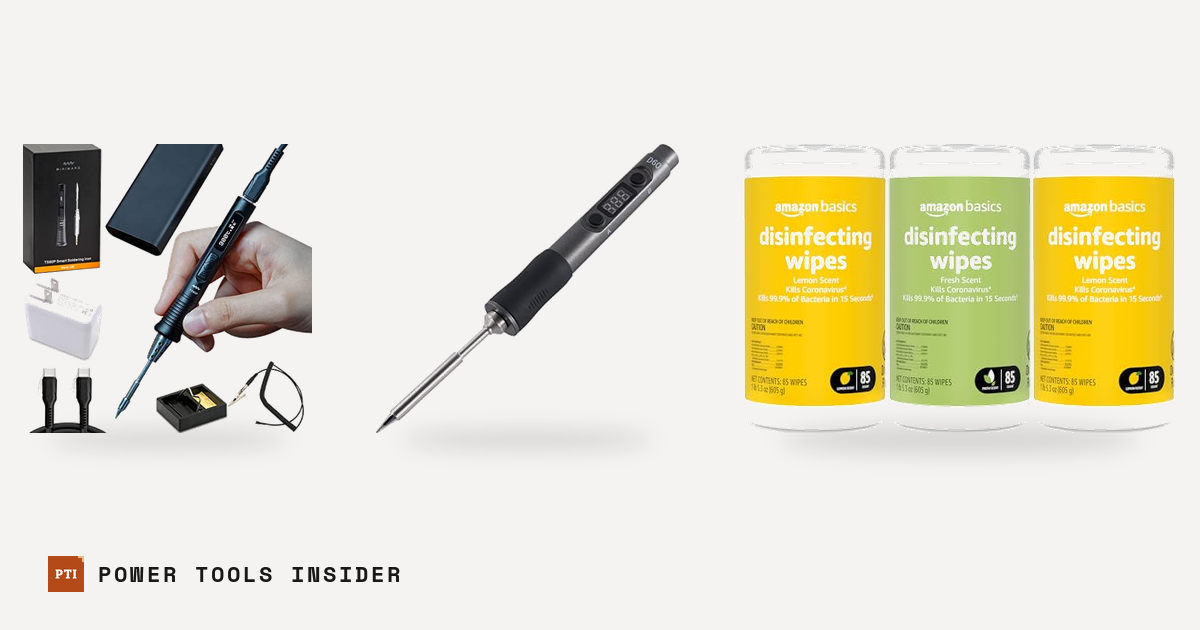
TL;DR: The PINE64 Pinecil V2 is the undisputed champion at $26-88 watts, 6-second heat-up, open-source firmware, and runs off your power tool batteries. Everything else costs more and does less. But if you’re married to a specific battery platform or need something dead simple, I’ve got you covered.
| Pick | Model | Highlights | Price | Buy |
|---|---|---|---|---|
| Best Overall | PINE64 Pinecil V2 | 88W, USB-C PD, QC, DC barrel, LiPo compatible, IronOS firmware, unbeatable value | $26-40 | Buy Now |
| Best Budget | SEQURE SQ-D60B | 60W power, TS100 tip compatibility, under $30 direct | $28-46 | Buy Now |
| Best Portable | Miniware TS80P | 8-second heat-up, CNC aluminum body, premium fit and finish | $90 | Buy Now |
| Best for Field Work | Weller WLBU75 | True cordless with butane, 75W max, 60-min runtime per fill | $70 | Buy Now |
| Best Butane Kit | Berkling BSG-2000 | 5-way adjustable head, 12 attachments, 90-min runtime, torch + heat gun + soldering | ~$75 | Buy Now |
| Best AA Battery | Hakko FX-901 | Uses standard AAs, 120-min runtime with NiMH, legendary Hakko reliability | $35 | Buy Now |
Butane vs Battery vs USB: Which Power Source?
Here’s where most people screw up. They grab whatever’s cheapest without thinking about how they’ll actually use the thing.
Butane (Weller WLBU75, Berkling BSG-2000)
True cordless freedom. No batteries to charge, no cables to pack. Just fill it with butane and you’re good for 60-90 minutes of continuous use. Perfect for automotive work in the field, emergency repairs, or job sites without power. The Weller is a focused soldering iron; the Berkling BSG-2000 is a full multi-tool kit, soldering iron, heat gun, and blow torch in one with 12 attachments and a 5-way adjustable head. The downside? You’re carrying flammable gas, there’s an open flame, and temperature control is basically “hot” or “hotter.” Don’t bring these to an airport unless you enjoy TSA interrogations. For more recommendations, check out our best cordless glue guns guide.
Battery-Powered (Milwaukee M12, AA-powered)
Convenient if you’re already invested in a battery platform. Milwaukee’s M12 soldering iron slides right onto your existing batteries. But here’s the truth: most “cordless” soldering irons that use proprietary batteries are underpowered, overpriced, or both. The Hakko FX-901 with AAs is the exception, grab batteries at any gas station when you’re in a pinch.
USB-C / DC / LiPo (Pinecil V2, TS80P, SQ-D60B)
This is where the magic happens. Modern smart irons run off USB-C PD power banks, DC power supplies, or directly off LiPo batteries. The Pinecil V2 at 88W will melt solder faster than most wall-powered stations. Plus, you can charge it from your laptop charger, power bank, or slap an XT60 connector on a drone battery. It’s the most flexible option and usually the cheapest.
My recommendation? Unless you’re working somewhere electricity literally doesn’t exist, skip butane. USB-C powered smart irons like the Pinecil give you 90% of the performance at 40% of the cost. But if you need a full toolkit for field work, soldering, heat-shrinking, and light brazing all in one package, the Berkling BSG-2000 earns its spot.
Buyer’s Guide: What Actually Matters
Temperature Range
Electronics work typically happens between 300-350°C (570-660°F). Anything less than 400°C max is limiting. The Pinecil hits 450°C, the TS80P stops at 400°C. The Berkling BSG-2000 reaches 450°C in soldering mode and a blistering 1300°C in torch mode. For lead-free solder or heavy copper pours, you want that headroom.
Heat-Up Time
Old-school irons take 60+ seconds. Modern smart irons? Under 10 seconds. The Pinecil V2 hits operating temp in 6 seconds. The TS80P in 8. Even the budget SQ-D60B manages 10 seconds. Butane irons like the Weller and Berkling heat almost instantly once ignited. If you’re waiting longer than that, you’re using yesterday’s technology.
Tip Compatibility
Proprietary tips are a racket. The Pinecil and SQ-D60B use standard TS100 tips, cheap, widely available, and you can get them everywhere from Amazon to AliExpress. The TS80P uses its own 3.5mm jack tips that cost more. The Weller uses proprietary butane tips. The Berkling includes 4 soldering tips out of the box (conical, chisel, angle, and sharp knife) plus a heat deflector and blower tip. Factor replacement tip costs into your decision.
Wattage
More watts = more thermal mass handling. Here’s the breakdown:
- 5-30W: Light duty, small joints, PCB work
- 30-60W: General purpose, most electronics
- 60-88W: Heavy gauge wire, large copper pours, automotive
- 250W+ (butane torch mode): Heat shrink, light brazing, stripping paint
The Pinecil’s 88W is overkill for most people, and I mean that in the best way possible. The Berkling’s 250W in soldering mode is pure butane brute force.
Display & Firmware
Basic irons have a 7-segment display (looking at you, SQ-D60B). Premium options get OLED screens showing real-time temperature, voltage, and status. But the real differentiator is firmware, Pinecil and TS80P run IronOS, an open-source firmware with more features than you’ll ever use. Motion detection, auto-sleep, custom boot logos, temperature curves, it’s hackable hardware at its finest. Butane irons don’t have displays, you learn to judge temperature by feel and flame color.
Mini-Reviews: The Honest Truth
PINE64 Pinecil V2, The DIY Darling
Look, I’m going to be straight with you: at $26 from PINE64 directly, this thing shouldn’t exist. It’s too good for the price.
The Pinecil V2 is a portable soldering iron that runs off basically anything, USB-C PD, Quick Charge, DC barrel jack, or straight off a 3S-5S LiPo battery with an XT60 connector. It pushes 88 watts, heats up in 6 seconds flat, and hits 450°C. That’s more power than most bench stations.
The OLED display shows real-time temperature. It has Bluetooth BLE for some reason (firmware updates? sure). The motion sensor puts it to sleep when you set it down. And it runs IronOS, open-source firmware with 31 language support and more customization options than your average Android phone.
Tips are standard TS100, which means they’re $5-8 instead of $20+. The whole unit weighs 30 grams. Thirty. Grams.
The catch? PINE64 sells out constantly. You might wait weeks for stock. Amazon sellers mark it up to $40 (still worth it). And you’ll need to supply your own power source, though honestly, you probably have three compatible USB-C chargers in your house right now.
Verdict: If you can get one, just buy it. This is the soldering iron equivalent of finding a Ferrari at Honda prices.
Miniware TS80P, The Premium Choice
The TS80P is what happens when engineers decide to make something pretty.
CNC-machined aluminum body. 8-second heat-up. 30 watts of power through a USB-C PD connection. The 0.69-inch OLED display looks crisp, and the whole package feels like a precision instrument, because it is.
Miniware upgraded this from the original TS80’s 18W to 30W, and it makes a real difference. You can actually solder larger joints without waiting for the tip to recover. The included tip ejector lets you swap tips without burning your fingers, and there’s a grounding clip for ESD-sensitive work.
Here’s the problem: it’s $90. More than three times the price of a Pinecil. And while the build quality is genuinely better, you’re paying a lot for aesthetics. The 3.5mm jack tip connection is proprietary, so tips cost more. And 30W, while decent, is still less than half the Pinecil’s output.
Verdict: Buy this if you value fit and finish, want something that looks good on your bench, and don’t mind paying for it. For pure performance per dollar, look elsewhere.
Weller WLBU75, The Field Warrior
Sometimes you need to solder in a barn. Or a crawl space. Or the middle of nowhere. That’s where the WLBU75 shines.
This is a butane-powered iron from Weller, yes, the same Weller that’s been making soldering gear since your grandpa was building Heathkits. It puts out 25-75 watts of adjustable power from butane fuel, giving you up to 60 minutes of continuous use per fill.
The real trick is the convertible tip system. Pop on a different tip and it becomes a hot air torch for heat shrink tubing. There’s even a torch mode for light brazing or lighting things on fire (not recommended, but possible).
Refill takes 20 seconds from a standard butane canister. The viewing window shows fuel level. Auto-shutoff when you cap it prevents accidents.
But let’s be honest: it’s messy. Temperature control is coarse at best. Tips are expensive. And you’re literally carrying pressurized flammable gas in your toolbox.
Verdict: Essential for field service techs, automotive electricians, and preppers. Overkill for bench work.
Berkling BSG-2000, The Complete Butane Toolkit
If the Weller is a focused field iron, the Berkling BSG-2000 is the whole field workshop in a carrying case.
This isn’t just a soldering iron, it’s a 3-in-1 tool that switches between soldering iron, heat gun, and blow torch depending on which of the 12 included attachments you snap on. The 5-way adjustable head locks at any angle, so you can get into tight spots without contorting your wrist.
The numbers are impressive: 250 watts in soldering mode, up to 450°C at the tip, and 90 minutes of runtime per fill, 50% longer than the Weller. The 30ml fuel tank refills in 15 seconds from any standard butane canister. Piezo electronic ignition means no fumbling with lighters.
You get four soldering tips (conical, chisel, angle, and sharp knife), a heat deflector for targeted heating, a hot air blower tip for heat shrink, and both pinpoint and jumbo flame adapters for torch work. The detachable base stand holds the unit upright or horizontal, and the TPA ergonomic grip doesn’t get slippery when your hands sweat.
At around $75, it’s in the same ballpark as the Weller but you’re getting significantly more versatility. The carrying case keeps everything organized instead of rattling around your toolbox.
The trade-off? Like all butane irons, temperature control is coarse compared to smart irons. It’s heavier at 9.6 oz (272g), nearly double the Weller. And 12 attachments means 12 things to lose if you’re not disciplined about the case.
Verdict: The best all-in-one butane soldering kit you can buy. If you need soldering, heat gun, and torch capabilities in one tool, especially for automotive, HVAC, or field service work, this is the move. For pure electronics soldering, stick with the Pinecil.
SEQURE SQ-D60B, The Budget King
FPV drone pilots, this one’s for you.
The SQ-D60B is a no-frills smart iron that costs $28 direct from SEQURE. For that, you get 60 watts of power, USB-C PD and QC support, XT60 connector for LiPo batteries, and 10-second heat-up.
It uses standard TS100 tips (smart). It has auto-sleep and motion wake (smart). It includes a basic stand, stickers, and hex tools in the box (nice touch).
The 7-segment display is basic but functional. The firmware isn’t upgradeable. Build quality is… let’s call it “adequate.” The silicone grip hides the tip retention screw, which is annoying.
But here’s the thing: for under $30, you can toss one in every field bag. Solder an XT60 at the flying field. Repair an ESC at a race. Drop it in a lake and you’re only out pizza money.
Verdict: The perfect beater iron for people who actually use their tools. Not fancy, not precious, just works.
Hakko FX-901, The Reliable Workhorse
Hakko doesn’t make bad soldering equipment. It’s physically impossible, I’m pretty sure it’s against Japanese law.
The FX-901 is a AA-powered iron that delivers 5-6 watts of Hakko reliability in a 76-gram package. No temperature control, no display, no firmware updates. Just a power switch and a ceramic tip.
Pop in four AAs and you get 60 minutes of runtime (alkaline) or 120 minutes (NiMH). Heat-up takes 40 seconds, slow by modern standards, but hey, it’s running on Duracells. The quick-change tip system uses standard Hakko T11 tips.
The safety cap doubles as a stand. There’s a power LED so you don’t drain batteries overnight. And if your AAs die, you can buy replacements literally anywhere on Earth.
Is it powerful? No. Is it fancy? No. Will it still work in 10 years? Absolutely.
Verdict: The perfect glovebox iron. Throw it in your car, forget about it, and it’ll be ready when you need it.
Specs Comparison Table
| Spec | Pinecil V2 | Miniware TS80P | Weller WLBU75 | Berkling BSG-2000 | SEQURE SQ-D60B | Hakko FX-901 |
|---|---|---|---|---|---|---|
| Model # | Pinecil V2 | TS80P | WLBU75 | BSG-2000 | SQ-D60B | FX-901 |
| Power Source | USB-C PD/QC, DC, LiPo | USB-C PD/QC | Butane | Butane | USB-C PD/QC, LiPo | 4x AA |
| Max Power | 88W | 30W | 75W | 250W (solder) / 350W (torch) | 60W | 6W |
| Temp Range | 100-450°C | 100-400°C | Up to 454°C | Up to 450°C (solder) / 1300°C (torch) | 100-400°C | 315°C (fixed) |
| Heat-Up Time | 6 sec | 8 sec | Instant | Instant | 10 sec | 40 sec |
| Weight | 30g | 36.5g | 135g | 272g (9.6 oz) | ~40g | 76g |
| Display | OLED | OLED | None | None | 7-segment | None |
| Tip Compatibility | TS100 | TS80/TS80P (3.5mm) | Weller Butane | Berkling (4 included) | TS100 | Hakko T11 |
| Firmware | IronOS (upgradeable) | IronOS (upgradeable) | N/A | N/A | Fixed | N/A |
| Runtime | Varies by source | Varies by source | 60 min/fill | 90 min/fill (solder) | Varies by source | 60-120 min |
| Included Tips | 1 | 1 | 1 | 12 attachments | 1 | 1 |
| Multi-Function | No | No | Yes (torch mode) | Yes (solder + heat gun + torch) | No | No |
| Price | $26-40 | $90 | $70 | ~$75 | $28-46 | $35 |
| Our Rating | 9.3/10 | 8.7/10 | 8.2/10 | 8.5/10 | 8.0/10 | 7.8/10 |
DIY Projects: What You Can Actually Do With These
Circuit Board Repair
All of these irons handle standard PCB work, but the Pinecil V2 and TS80P shine for SMD components. The precise temperature control and fast heat-up mean you can hit 320°C, solder your QFP chip, and the iron’s back to sleep before you know it. For through-hole, anything over 30W is fine.
Guitar Cable Repair
1/4″ connectors on instrument cables need heat. A lot of it. The Pinecil’s 88W melts the pot and solder in seconds. The Hakko FX-901 at 6W? You’ll be there a while. For audio work, aim for at least 30W unless you enjoy frustration.
Automotive Wiring
Car wiring is often 14-16 gauge with corrosion and mystery heat shrink. The Weller WLBU75 is the classic choice here, no batteries to die mid-job, plenty of heat, and the torch mode shrinks tubing without a separate tool. The Berkling BSG-2000 is even more versatile for automotive work, its dedicated hot air blower tip handles heat shrink cleanly, and the 5-way adjustable head lets you get into engine bay angles the Weller can’t. The Pinecil with a PD power bank is a close second if you have access to power.
FPV Drone Repairs
Field repairs at the flying field demand LiPo compatibility. The Pinecil V2 and SQ-D60B both run straight off 4S-5S batteries via XT60. Keep one in your flight bag and you’ll never miss a race because of a broken pigtail again.
Jewelry & Crafts
For small decorative soldering, the TS80P’s precision and elegant handling shine. The lower weight means less hand fatigue on detailed work, and the fine tips available for the TS80 platform are perfect for jewelry-scale joints. You might also find our best tools for small spaces roundup helpful.
Frequently Asked Questions
Q: Can I use these for plumbing / copper pipe?
No. Plumbing requires much more heat (450°C+) and larger tips than these portable irons can deliver. Get a proper propane torch for pipes.
Q: Will the Pinecil V2 run off my laptop charger?
Most modern USB-C laptop chargers deliver 65W+ and will run the Pinecil beautifully. Older 45W chargers work too, just at reduced performance.
Q: What’s the deal with IronOS firmware?
IronOS is open-source firmware that runs on smart soldering irons. It adds features like motion detection, auto-sleep, detailed settings, and custom boot logos. Pinecil V2 and TS80P both support it.
Q: Are butane irons safe?
Modern butane irons like the Weller WLBU75 and Berkling BSG-2000 have safety features, auto-shutoff when capped, fuel level windows, and piezo ignition. Used properly, they’re safe. Used carelessly near flammable materials, they’re a fire hazard. Treat them with respect and always cap the iron when not in use.
Q: How long do replacement tips last?
With normal use, 6-12 months. Heavy daily use might need replacements every 3-4 months. TS100 tips for the Pinecil/SQ-D60B are $5-8. TS80P tips are $12-15. Buy a few spares.
Q: Can I solder lithium batteries with these?
Technically yes, but be extremely careful. Lithium cells heat up fast and can vent or catch fire. Use a high-wattage iron (Pinecil at 88W), work quickly, and have a fire extinguisher nearby.
Q: What’s the best power bank for these?
Look for USB-C PD with at least 45W output. Anker, Baseus, and UGREEN all make solid options. For field use, the Pinecil running off an M18 battery with a USB adapter is surprisingly effective.
Q: What’s the difference between the Weller WLBU75 and Berkling BSG-2000?
Both are butane-powered, but they serve different needs. The Weller is a simpler, lighter iron focused on soldering with optional torch mode. The Berkling BSG-2000 is a full multi-tool kit with 12 attachments, soldering iron, heat gun, and blow torch, plus a 5-way adjustable head and 50% longer runtime. The Weller is better if you just want to solder; the Berkling is better if you need a versatile field toolkit.
Where to Buy
| Product | Retailer | Price | Link |
|---|---|---|---|
| Pinecil V2 | PINE64 Store | $25.99 | Buy Now |
| Pinecil V2 | Buy Now | $39.99 | Buy Now |
| TS80P | Buy Now | $89.99 | Buy Now |
| TS80P | Adafruit | $89.95 | Buy Now |
| Weller WLBU75 | Buy Now | $69.99 | Buy Now |
| Berkling BSG-2000 | Buy Now | ~$75 | Buy Now |
| SEQURE SQ-D60B | Buy Now | $27.80 | Buy Now |
| Hakko FX-901 | Buy Now | $34.99 | Buy Now |
Prices as of February 2026. Affiliate links, we may earn a commission at no cost to you.
Final Thoughts
The cordless soldering iron market used to be a wasteland of weak, expensive disappointments. Then the smart iron revolution happened, led by the TS100 and perfected by the Pinecil V2.
At $26, the Pinecil V2 is honestly underpriced. It’s not perfect, you need to source your own power supply, stock is unpredictable, and the learning curve is steeper than a basic iron. But nothing else comes close to the performance-per-dollar.
If the Pinecil is a modded Civic with a turbo, the TS80P is a stock BMW, polished, refined, and expensive. The SQ-D60B is the beater truck you don’t mind beating up. The Weller is your grandpa’s toolbox: reliable, analog, and ready when the power’s out. And the Berkling BSG-2000 is the Swiss Army knife of butane tools, it does soldering, heat gun, and torch work in one package for the price of a nice dinner out.
My advice? Buy a Pinecil V2. Buy two, one for your bench, one for your bag. Grab a Berkling if you need a multi-tool for fieldwork. And stop letting wall outlets dictate where you can fix things.
Last updated: February 2026
Power Tool Insider is reader-supported. When you buy through links on our site, we may earn an affiliate commission at no extra cost to you. This doesn’t affect our recommendations, we only recommend tools we’d actually use. Full disclosure.