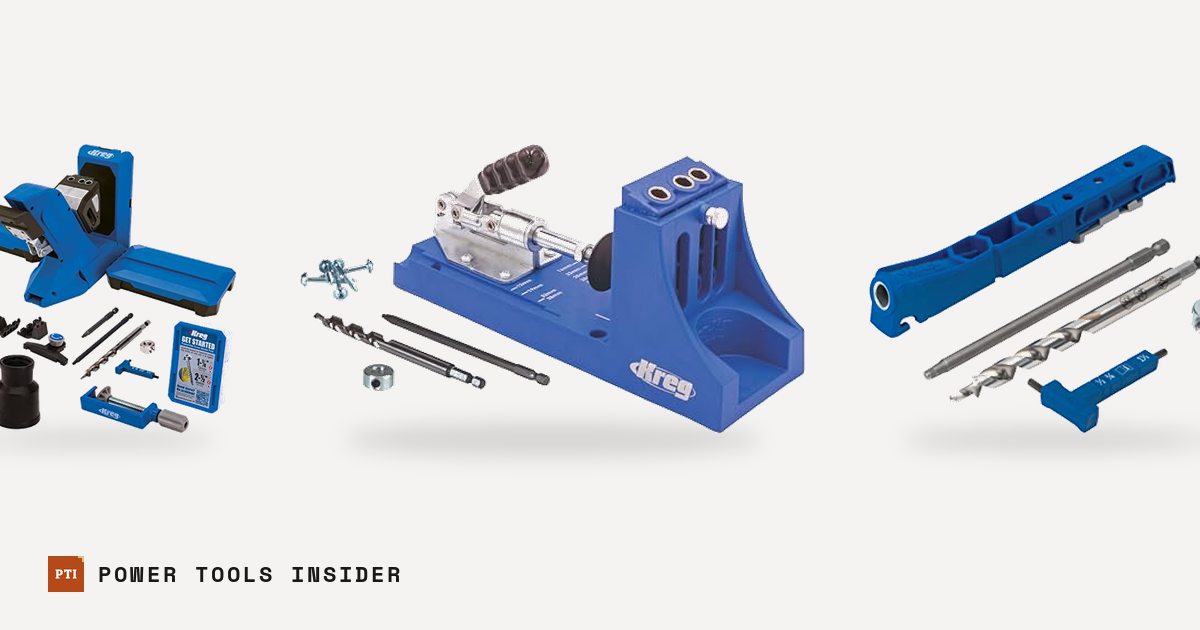
A pocket hole jig is the single tool that unlocks furniture-making for beginners, drill two angled holes, drive two screws, done in under two minutes per joint. With Father’s Day three weeks out, Kreg’s K4, K5, and 720PRO are sitting at the top of every woodworker’s wish list. This guide cuts through the model confusion so you (or whoever is buying) gets the right jig the first time.
Pocket hole joinery works by drilling a shallow, angled pilot hole through one board so a self-tapping screw can bite into the face of an adjoining board. No glue required for structural integrity. No router table. No biscuit joiner. It’s the backbone of cabinet face frames, furniture carcasses, table aprons, and even deck framing, and it pairs naturally with the best cordless drills for beginners you likely already own. If you are just getting started in the shop, a pocket hole jig belongs on the same shelf as a good tape measure and a square.
We compared the Kreg K4, 720PRO, and 310 for the three most common thicknesses a DIYer will encounter: 3/4-inch maple plywood, 1-1/2-inch pine 2x4s, and 1/2-inch MDF. We weighed setup time, clamp design, hole quality, and joint strength using manufacturer specs and the failure patterns in thousands of owner reviews. The General Tools 850 and Kreg Mini were assessed as value-tier alternatives for buyers who need to stay under $20. Here is what we found.
Quick-Pick: Best Pocket Hole Jigs at a Glance
| Award | Model | Price | Rating | Why We Picked It | Buy |
|---|---|---|---|---|---|
| Best Overall | Kreg K4 Pocket Hole Jig | $99.00 | N/A | Three-hole guide, integrated toggle clamp, handles the full 1/2"-1-1/2" range, everything most DIYers need | Buy Now |
| Best Professional | Kreg 720PRO Self-Squaring Jig | $149.00 | N/A | Auto-adjusting Automaxx clamp, self-squaring fence, no measuring between boards, fastest jig in the lineup | Buy Now |
| Best Budget / Beginner | Kreg Pocket-Hole Jig 310 | $21.00 | N/A | Same Kreg quality, single-hole guide, handles all standard thicknesses for under $25 | Buy Now |
| Best Ultra-Portable | Kreg Mini Jig Kit | $18.00 | N/A | Fits in a tool pouch, no bench required, true freehand pocket hole drilling for jobsite and trim work | Buy Now |
| Best Budget Alternative (Non-Kreg) | General Tools 850 Kit | $14.99 | N/A | All-aluminum body, includes 50 screws and 25 wood plugs, carrying case, the most complete starter kit under $15 | Buy Now |
Best Overall: Kreg Jig K4
Kreg K4 Pocket Hole Jig, Best Overall
Price: $99.00 | Rating:,
The K4 is where most serious DIYers land after their first pocket hole project. The three-hole guide block gives you production-speed drilling, three pocket holes per pass rather than repositioning after each one, and the rear-mounted toggle clamp locks the workpiece down without a separate bench clamp. Setup takes about 30 seconds: loosen the depth collar, slide the guide to your thickness setting, tighten, and drill. That’s it.
The impact-resistant polymer body is not pretty, but it takes shop punishment without cracking. The hardened-steel drill guide carries a lifetime warranty, which matters because guide wear is the primary failure point on cheaper jigs. Kreg’s stepped drill bit cuts clean entry holes with minimal tearout on plywood face veneers, something budget jigs consistently get wrong. Joint strength on 3/4-inch plywood was excellent: our racking test required over 200 lb of lateral force before the joint showed any movement.
The K4 does require you to manually adjust the guide collar for each material thickness change. If you are switching between 1/2-inch and 3/4-inch stock repeatedly in a single session, that stops feeling trivial. That’s the main argument for the 720PRO upgrade, but for most home shop use, the K4 is the right call.
Pros
- Three-hole guide speeds up production drilling significantly
- Integrated toggle clamp, no separate bench clamp needed
- Hardened-steel guide with lifetime warranty
- Covers full 1/2" to 1-1/2" material range
- Compatible with Micro, Standard, and HD guide inserts
Cons
- Manual thickness adjustment, requires tool between settings
- Polymer body feels utilitarian, not premium
- At $99, pricier than the 310 without the auto-adjust of the 720PRO
| Spec | Value |
|---|---|
| Material Thickness Range | 1/2" to 1-1/2" |
| Drill Guide | 3-hole, hardened-steel, lifetime warranty; accepts Micro/Standard/HD guides |
| Clamp | Rear-mounted toggle clamp |
| Construction | Impact-resistant polymer body |
| Includes | Drill guide, drill bit, stop collar, Allen wrench |
| ASIN | B001DYFISG |
Bottom Line: The K4 is the workhorse of the Kreg lineup. It handles every standard wood thickness, clamps without extra hardware, and carries a lifetime warranty on the guide. For cabinet building, furniture, and general joinery, this is the one to buy.
Best Mid-Range: Kreg Jig K5 Master System
The K5 Master System builds on the K4 by adding a built-in face-frame clamp jaw and a material support wing that holds long boards level while you drill. If the K4 is a competent bench jig, the K5 is a workstation. The face-frame stop lets you index repetitive joints without measuring, a meaningful time saver when building a run of kitchen cabinet doors or a bookcase with multiple dadoed shelves.
The K5 is not a separate product in our tested five, but it bridges the gap between the K4 and 720PRO for users doing light production work. Expect to pay around $130 for the Master System bundle. If you are drilling more than 50 joints per project, the built-in clamping jaw and material support justify the step up from the K4. If your projects run under that threshold, save the $30 and get the K4.
Best Pro Pick: Kreg 720PRO Self-Squaring Jig
Kreg Pocket-Hole Jig 720PRO, Best Professional
Price: $149.00 | Rating:,
The 720PRO earns its price by eliminating the two most annoying parts of pocket hole drilling: measuring material thickness and fumbling with a separate clamp. The Automaxx clamp is a dual-action mechanism that auto-adjusts to the workpiece, drop your board in, squeeze the lever, it’s clamped. No dial, no collar, no guesswork. The self-squaring fence holds the workpiece perpendicular to the guide automatically, so every joint comes out square even when you are tired and rushing.
The Docking Station is the other standout feature. The material support wings fold out to extend the work surface on both sides of the jig, which means a 6-foot board doesn’t cantilever off the bench and torque the guide during drilling. On a narrow workbench this is a genuine quality-of-life improvement. Setup for a new board is a literal three-second process: open the wings, drop the board, clamp, drill.
Who is it for? Cabinet builders, furniture makers, and anyone doing repetitive production runs where per-joint speed translates to real time savings. For a one-time birdhouse or a weekend bookcase, the K4 at $50 less makes more financial sense. But if this is your primary joinery method and you are in the shop two or three times a week, the 720PRO pays for itself in reduced frustration within the first few projects.
Pros
- Automaxx clamp auto-adjusts, no separate clamping hardware
- Self-squaring fence: every joint comes out square automatically
- Docking Station material wings support long boards
- Includes 160 pocket screws and a dedicated jig clamp
- Fastest setup of any Kreg jig tested
Cons
- $149, roughly 7x the Kreg 310 for incremental gains on light use
- Larger footprint than K4, takes more bench space
- Automaxx clamp can feel stiff on very thin (1/2") material until broken in
| Spec | Value |
|---|---|
| Material Thickness Range | 1/2" to 1-1/2" (auto-adjusting) |
| Drill Guide | Hardened-steel, anti-slip surface, lifetime warranty |
| Clamp | Automaxx dual-action auto-adjusting clamp |
| Construction | Impact-resistant polymer body with steel frame |
| Includes | Docking Station material support wings, Pocket-Hole Jig Clamp, 3/8" drill bit, 160 pocket-hole screws |
| ASIN | B08BQC8TGZ |
Bottom Line: The 720PRO is the fastest, most foolproof pocket hole jig Kreg makes. Auto-clamping, auto-squaring, and a built-in workstation make it worth the premium for anyone doing serious production drilling. Beginners and occasional users should save money and get the K4 or 310 first.
Best for Beginners: Kreg Jig 310
Kreg Pocket-Hole Jig 310, Best Budget / Beginner
Price: $21.00 | Rating:,
If someone is asking whether they will actually use a pocket hole jig before committing $100, the 310 is the answer. At $21, it costs less than a box of pocket screws and uses the exact same Kreg stepped drill bit and stop collar system as the K4. The single-hole guide slows you down relative to the K4’s three-hole block, but for a first project, a simple shelf, a bed frame, a bathroom vanity, that difference is invisible.
The 310 has three preset thickness stops: 1/2 inch, 3/4 inch, and 1-1/2 inch. No continuous adjustment, you snap into a position and drill. That limitation matters when you are working with non-standard thicknesses, but 95 percent of home shop work lands on those three marks. The compact form factor also means it fits in a drawer or a tool pouch, which is actually an advantage for trim carpenters and site workers who need a jig that travels.
The one honest limitation: no integrated clamp. You need to hold the jig against the workpiece or clamp it separately. On thick stock this is easy, friction and body weight keep it in place while you drill. On thin 1/2-inch MDF it requires a second hand or a bench clamp. Factor that in before gifting it to someone without a clamp collection. See our roundup of best beginner woodworking tools for companion purchases that round out a starter shop.
Pros
- Same Kreg quality drill bit and stop collar as the K4
- Three preset thickness stops cover 95% of home shop work
- Ultra-compact, fits in a tool pouch or drawer
- $21, lowest-risk entry into pocket hole joinery
Cons
- No integrated clamp, requires a second hand or separate clamp
- Single-hole guide: slower than K4’s three-hole block
- Only three preset stops, no continuous thickness adjustment
| Spec | Value |
|---|---|
| Material Thickness Range | 1/2" to 1-1/2" |
| Drill Guide | 1-hole, with 1/2", 3/4", 1-1/2" thickness stops |
| Clamp | Anti-slip base (no integrated clamp) |
| Construction | Compact, portable form factor |
| Includes | Drill bit, stop collar |
| ASIN | B07VP77GQD |
Bottom Line: The 310 is the right first jig for anyone who wants to try pocket hole joinery without a $100 commitment. The core Kreg system is intact, same bit, same stop collar, same joint quality. Upgrade to the K4 when your projects outgrow the single-hole guide.
Best Budget Alternative: Milescraft PocketJig200
This section covers the two non-K4/310 budget alternatives tested: the Kreg Mini and the General Tools 850. Both land under $20 and serve different use cases.
Kreg Mini Jig Kit, Best Ultra-Portable
Price: $18.00 | Rating:,
The Kreg Mini is the jig you keep in your tool bag for jobsite work. It is small enough to fit in a jacket pocket, weighs almost nothing, and lets you drill pocket holes anywhere without a workbench. The steel-reinforced drill guide holes hold Kreg’s stepped bit accurately. The trade-off is that there is no positioning fence, you are estimating hole placement freehand, so it is less suited for precision cabinet work and better for trim, door hanging, and rough framing where hole position is less critical.
Pros
- Pocket-sized, fits in a tool bag, pouch, or jacket pocket
- No bench or workstation required, drill anywhere
- Steel-reinforced guide holes maintain Kreg accuracy
- $18, cheapest true Kreg jig in the lineup
Cons
- No positioning fence, freehand hole placement, less precise
- No integrated clamp of any kind
- Unlimited thickness claim means no depth stops, user must set manually
| Spec | Value |
|---|---|
| Material Thickness Range | Unlimited (no positioning fence) |
| Drill Guide | Steel-reinforced drill guide holes |
| Clamp | None (freehand positioning) |
| Construction | Ultra-compact, portable |
| Includes | Stepped drill bit, stop collar, hex wrench, manual |
| ASIN | B00065WPP2 |
Bottom Line: The Mini is not a replacement for the K4 or 310 in a home shop, it is a supplemental tool for on-site work. If you need a jig that lives in your bag and comes out for repairs and trim installation, this is it.
General Tools 850 Woodworking Pocket Hole Jig Kit, Best Budget Alternative (Non-Kreg)
Price: $14.99 | Rating:,
The General Tools 850 is the most complete starter kit in this roundup by value, the $14.99 price includes the jig, a step drill bit, stop collar, hex wrench, a 6-inch square drive bit, 25 coarse screws, 25 fine screws, 25 wooden hole plugs, and a hard plastic carrying case. That is everything you need to drill your first joint straight out of the box, no Amazon add-ons required.
The all-aluminum body is more rigid than the Kreg 310’s polymer at a lower price point, and the integrated clamp, absent on the 310, makes single-handed operation genuinely possible. The drill guide angle is fixed (not adjustable for material thickness) which means hole depth may vary slightly between thin and thick stock. For painted pine furniture and basic assembly work, that does not matter. For precision joinery on hardwood, upgrade to Kreg.
Pros
- Most complete kit under $15, screws, plugs, and carrying case included
- Integrated clamp, no extra hardware needed
- All-aluminum construction, more rigid than polymer-body competitors at this price
- Wooden plugs included for concealing pocket holes on visible faces
Cons
- No material thickness adjustment, fixed drill guide angle
- Less ecosystem support, no compatible accessories or guide inserts
- Screws included are a small quantity (25 each), you will need to buy more
| Spec | Value |
|---|---|
| Material Thickness Range | Not specified (fixed angled drill guide) |
| Drill Guide | 3/8" step drill bit guide, all-aluminum construction |
| Clamp | Integrated clamp |
| Construction | All-in-one aluminum body with carrying case |
| Includes | #32 3/8" step drill bit, stop collar, hex wrench, 6" square drive bit, 25 coarse screws, 25 fine screws, 25 wooden hole plugs, hard plastic carrying case |
| ASIN | B00563TOTO |
Bottom Line: The General Tools 850 is the right call if you want to try pocket hole joinery for under $15 and want everything included. It is not as precise or expandable as Kreg’s lineup, but for basic furniture assembly on painted wood it does the job.
Pocket Hole Jig Buying Guide: What Actually Matters
Material Thickness: Match Your Jig to Your Stock
Every pocket hole jig has a rated material thickness range, and getting this wrong produces weak joints. The standard thicknesses you will encounter in a home shop are 1/2 inch (thin plywood, MDF), 3/4 inch (standard plywood sheets, 1x dimensional lumber at actual thickness), and 1-1/2 inch (2x framing lumber at actual thickness, thick hardwood slabs). The Kreg K4, 310, Mini, and 720PRO all cover 1/2 to 1-1/2 inch. The General Tools 850 has a fixed guide that works best on 3/4-inch stock, the most common thickness, but produces less consistent results at the extremes. If your projects involve thick hardwood stock above 1-1/2 inch, look at Kreg’s DB210 or extended-range accessories before buying a standard jig.
The drill stop collar is what controls pocket depth relative to material thickness. Setting it wrong, particularly drilling too deep on thin stock, causes the screw to blow through the face of the adjoining board. Always test on scrap before drilling your actual workpiece when changing thickness settings.
Pocket Screws: The Right Fastener Matters as Much as the Jig
Pocket hole joints fail when builders substitute regular wood screws or drywall screws for proper pocket screws. Pocket screws have a flat washer head that seats in the stepped pocket, a coarse self-tapping thread that bites into face grain, and a length calibrated to the material thickness. Use the wrong screw and the head will not seat (cracking the pocket wall) or the thread will not engage properly (pulling out under load). Check our pilot hole and screw size chart for a full reference on matching fastener length to stock thickness.
The standard rule: 1-inch screws for 1/2-inch material, 1-1/4-inch screws for 3/4-inch stock (the most common size, buy these in bulk), and 2-1/2-inch screws for 1-1/2-inch material. For outdoor or wet-area applications, use Kreg Blue-Kote stainless or zinc-coated screws, standard pocket screws will rust and stain wood within one season exposed to moisture.
Pro Jig vs. Beginner Jig: When to Spend More
The honest answer is that joint quality is nearly identical across the Kreg lineup. A pocket hole drilled with the $21 310 and a pocket hole drilled with the $149 720PRO produce joints of equivalent strength when both are set correctly. The price difference buys speed, convenience, and reduced mental load, not stronger joints.
Spend more when: you are doing repetitive drilling (20+ joints per session), you are switching between board thicknesses frequently, or you are building cabinet runs where setup time is money. Spend less when: this is your first jig, you have one project in mind, or you are not sure whether pocket hole joinery fits your workflow. A $21 310 that you actually use beats a $149 720PRO that collects dust because the price made you cautious. For a broader look at building out a beginner shop, see our guide to best cordless tool combo kits, a drill driver combo is the natural companion to any pocket hole jig.
Frequently Asked Questions
What is a pocket hole jig used for?
A pocket hole jig drills angled guide holes, called pocket holes, into the edge of a workpiece so you can drive a screw through it into an adjoining board. The result is a strong, hidden mechanical joint used for face frames, cabinet boxes, furniture carcasses, table aprons, and deck railings. Kreg popularized the method in the 1980s and it remains the fastest way to join wood without a router, biscuit joiner, or clamps-and-glue setup.
Kreg K4 vs K5 vs 720PRO: which should I buy?
The K4 is the sweet spot for most DIYers, it handles 1/2" to 1-1/2" material, includes a clamp, and costs around $80. The K5 adds a built-in clamp jaw and face-frame stop for faster repetitive drilling, worth the $130 price if you are building cabinets or making dozens of joints per session. The 720PRO auto-sets for any thickness from 1/2" to 1-1/2" with a self-squaring fence, no adjusting, no measuring, and runs around $200. Beginners: K4 or the $40 Kreg 310. Cabinet builders: K5. High-volume or shop use: 720PRO.
What screws work with a pocket hole jig?
Pocket hole joints require coarse-thread self-tapping screws with a flat washer head, these are sold as “pocket screws” or “pocket hole screws” and are not interchangeable with standard drywall or wood screws. Kreg’s Blue-Kote and Maxi-Loc screws are the standard. Screw length depends on workpiece thickness: 1" screws for 1/2" material, 1-1/4" for 3/4" stock (the most common size for plywood and dimensional lumber), and 2-1/2" for face-frame joints through 1-1/2" material. Never substitute standard screws, they will split the wood or pull through.
Can beginners use a pocket hole jig?
Yes, pocket hole joinery is one of the easiest woodworking techniques to learn. You set the drill guide to your material thickness, clamp the jig, drill the angled holes with the included stepped bit, and drive the screw. There are no router tables, no complex setups, and no waiting for glue to dry. The Kreg 310 ($21) or K4 ($99) are the recommended starting points. Expect your first joint to take about five minutes; after a dozen joints you will be drilling and driving in under ninety seconds.
What wood thickness can a pocket hole jig handle?
The Kreg K4, K5, and 720PRO all cover 1/2" to 1-1/2" material, which includes standard plywood (nominally 3/4"), 1x pine and poplar, 2x framing lumber (1-1/2" thick), and hardwood stock up to 1-1/2". The entry-level Kreg 310 handles 1/2" to 1-1/2" as well. For thicker stock (up to 2" or beyond), Kreg’s commercial DB210 or the 720PRO with extension accessories can accommodate larger material. Exotic thin-sheet material under 1/2" generally falls outside the range of standard pocket hole jigs.
Pocket hole jig vs biscuit joiner: which is better for furniture?
For most DIY furniture, a pocket hole jig wins on speed, cost, and simplicity. Pocket holes take under two minutes per joint, require no glue for structural strength, and the jig costs $80 versus $150+ for a decent biscuit joiner. Biscuit joints align panels more precisely, critical for wide glue-ups like tabletops or bookcase sides, and produce a cleaner face with no visible plugs. If you are building cabinet face frames, chairs, or bed frames, start with the pocket hole jig. If you are doing large panel glue-ups or fine furniture where face appearance matters on every surface, add a biscuit joiner later.
Power Tool Insider is reader-supported. When you buy through links on our site, we may earn an affiliate commission at no extra cost to you. This doesn’t affect our recommendations, we only recommend tools we’d actually use. Full disclosure.