A hammer drill drives fasteners into concrete. A rotary hammer breaks concrete. The difference matters: a good rotary hammer delivers 5–10× more impact energy than a standard hammer drill, uses SDS+ bits that don’t slip in the chuck, and runs three operation modes — rotary only, hammer only (chiseling), and rotary hammer — that no hammer drill can match. If you’re anchoring ledger boards into a foundation, drilling holes for rebar, hanging sleeves in CMU block, or busting out tile for a bathroom remodel, you need a rotary hammer.
We tested and researched six cordless rotary hammers covering every price point — from the $110 Bosch budget pick to the $433 DeWalt XR pro model — and ranked them by impact energy, weight, battery platform value, and real-world drilling performance. Two models have active hot deals right now. Here’s what you should buy.
| Award | Model | Price | Impact Energy | Why We Picked It | Buy |
|---|---|---|---|---|---|
| Best Budget | Bosch GBH18V-21N | ~$111 | 1.7 J | Genuine brushless Bosch rotary hammer under $120 — nothing else comes close at this price | Buy Now |
| Best Value 🔥 25% off | DeWalt DCH273B | ~$262 | 2.1 J | Full 1″ SDS+ on 20V MAX, 25% off now — the easiest buy on this list | Buy Now |
| Best Compact | Makita XRH06ZB | ~$284 | 0.9 J | 3.3 lbs — the lightest brushless rotary hammer on the market, built for overhead and confined-space work | Buy Now |
| Best for Milwaukee Users | Milwaukee 2912-20 | ~$379 | 2.0 J | M18 FUEL brushless, AUTOSTOP anti-rotation, the pro standard on commercial job sites | Buy Now at Home Depot |
| Best High-Power 🔥 43% off | Makita XRH05Z | ~$380 | 2.0 J | Dual 18V (36V effective) for extended run time on big concrete jobs — 43% off is a rare deal | Buy Now |
| Best Pro | DeWalt DCH293B | ~$434 | 3.5 J | Highest impact energy on this list at 3.5 J — built for structural anchor work and heavy masonry | Buy Now |
Individual Reviews
Bosch GBH18V-21N 18V Brushless — Best Budget

Price: Around $111 at time of writing | Rating: 4.5/5
The Bosch GBH18V-21N at $111 is the most surprising value on this list. You’re getting a genuine Bosch brushless rotary hammer — the same SDS-Plus Bulldog lineage that professionals have trusted for decades — for the price of a mid-range hammer drill. At 1.7 J of impact energy and 5,500 BPM, it drills 3/8″ holes through concrete without slipping a beat. The 3/4″ chuck capacity covers standard anchor and sleeve installations up to 5/8″ diameter.
The Bulldog design keeps weight to 5.3 lbs (tool only), which is meaningful when you’re drilling a dozen anchor points overhead. Two operating modes — rotary hammer and rotary only — handle the vast majority of masonry tasks. It runs on any Bosch 18V ProCore or standard battery, so existing Bosch users get instant platform compatibility.
The trade-off at this price: no hammer-only (chisel) mode, which matters for tile removal and scaling. If you need chisel work, step up to the DeWalt or Milwaukee. But for pure hole-drilling in concrete, CMU, and brick, the GBH18V-21N punches far above its price tag.
Pros
- Genuine brushless Bosch rotary hammer under $120
- 1.7 J impact energy — real rotary hammer performance, not a hammer drill
- Lightweight at 5.3 lbs for all-day overhead drilling
- Compatible with full Bosch 18V battery lineup
- Bosch’s national service center network
Cons
- No hammer-only (chisel) mode — drill/rotary-hammer only
- 3/4″ chuck vs 1″ on most competitors
- Lower impact energy than mid-range tools
| Spec | Value |
|---|---|
| Voltage | 18V |
| Chuck Type | SDS Plus |
| Max Bit Diameter | 3/4 in. |
| Impact Energy | 1.7 J |
| Blows Per Minute | 0–5,500 BPM |
| Operating Modes | 2 (rotary, rotary hammer) |
| Weight | 5.3 lbs (tool only) |
Bottom Line: The best entry point into real rotary hammer performance. If you need SDS+ drilling capability on the Bosch 18V platform without spending $250+, the GBH18V-21N is the clear answer.
DeWalt DCH273B 20V MAX — Best Value

Price: Around $262 at time of writing (currently 25% off) | Rating: 4.7/5
The DeWalt DCH273B is the rotary hammer most DIYers and light-commercial contractors should buy. At $262 (currently 25% off its $349 regular price), you get a full 1″ SDS+ chuck, 2.1 J of impact energy, and all three operating modes — rotary, rotary hammer, and hammer-only for chiseling — on the most widely-owned battery platform in power tools. If you already own any DeWalt 20V MAX combo kit, your existing batteries power this tool.
The 2.1 J impact energy is the practical sweet spot for residential and light commercial work: 1/2″ anchor holes, electrical conduit mounting, masonry screws, concrete form stakes. The three-mode selector is a genuine productivity win — being able to switch to hammer-only and use a chisel for tile removal or concrete scaling without switching tools saves real time on renovation projects.
At 7.3 lbs, it’s not the lightest option, but the weight is distributed well with DeWalt’s typical balanced grip design. The anti-vibration system keeps your hands from going numb on extended sessions. This is the tool that should be in the back of every contractor’s truck.
Pros
- Full 1″ SDS+ chuck — handles all standard anchor bit sizes
- 2.1 J impact energy — right for residential and light commercial
- 3 modes including hammer-only for chiseling and scaling
- Runs on any DeWalt 20V MAX battery
- 25% off right now — best price we’ve seen this year
Cons
- Bare tool only — budget for a 20V battery if you’re new to DeWalt
- 7.3 lbs is heavier than the Bosch or Makita compact options
| Spec | Value |
|---|---|
| Voltage | 20V MAX |
| Chuck Type | SDS Plus |
| Max Bit Diameter | 1 in. |
| Impact Energy | 2.1 J |
| Blows Per Minute | 0–4,700 BPM |
| Operating Modes | 3 (rotary, rotary hammer, hammer only) |
| Weight | 7.3 lbs (tool only) |
Bottom Line: The best value rotary hammer for DeWalt users and anyone getting into the platform. Full 1″ SDS+, 3 modes, and a strong deal make this the obvious choice in the $200–$300 range.
Makita XRH06ZB 18V LXT Sub-Compact — Best Compact

Price: Around $284 at time of writing | Rating: 4.5/5
The Makita XRH06ZB is a different tool for a different job. At 3.3 lbs, it’s literally half the weight of most rotary hammers on this list — and that weight savings is the point. When you’re drilling 50+ anchor points overhead in a concrete deck, or working inside wall cavities where every ounce matters, the XRH06ZB’s sub-compact format is a legitimate performance advantage.
The 11/16″ SDS+ chuck and 0.9 J impact energy keep it in light-duty territory: smaller anchors, electrical conduit mounting, masonry screws. It’s not a tool for drilling 3/4″ holes in reinforced concrete — that’s what the DCH273B or Milwaukee 2912-20 are for. But for the trades where you’re doing a hundred small anchor placements a day, the weight and maneuverability difference is real money in reduced fatigue and job-site time.
The XRH06ZB runs on any Makita 18V LXT battery — the largest 18V battery ecosystem in the industry. If you’re already Makita LXT, this tool slots right in without adding a new battery size.
Pros
- 3.3 lbs — lightest brushless rotary hammer on the market
- Sub-compact body fits in tight spaces no other rotary hammer reaches
- Compatible with all Makita 18V LXT batteries
- SDS+ for tool-free bit changes
- Makita’s 3-year warranty and national service network
Cons
- 0.9 J — limited to light-duty masonry, not heavy concrete
- 11/16″ max bit vs 1″ on most competitors
- Only 2 modes — no hammer-only for chiseling
| Spec | Value |
|---|---|
| Voltage | 18V LXT |
| Chuck Type | SDS Plus |
| Max Bit Diameter | 11/16 in. |
| Impact Energy | 0.9 J |
| Blows Per Minute | 0–5,500 BPM |
| Operating Modes | 2 (rotary, rotary hammer) |
| Weight | 3.3 lbs (tool only) |
Bottom Line: The tool for overhead drilling and tight-space masonry work. If weight and maneuverability matter more than raw power, this is the pick.
Milwaukee 2912-20 M18 FUEL — Best for Milwaukee Users
Price: Around $379 at Home Depot at time of writing | Rating: 4.8/5
The Milwaukee 2912-20 is what commercial construction looks like on a job site. The M18 FUEL brushless motor pairs with 2.0 J of impact energy and Milwaukee’s AUTOSTOP anti-rotation technology — when a bit binds in concrete, the AUTOSTOP system prevents the tool from rotating violently in your hand. That’s not a marketing feature; it’s a real safety mechanism that matters on structural anchor work.
Like all Milwaukee M18 FUEL tools, the 2912-20 is engineered for heavy professional use — extended run times with high-amp batteries, consistent torque delivery under load, and Milwaukee’s service network covering every major market. If you’re an M18 user running a Milwaukee combo kit, adding this rotary hammer is a no-brainer — your existing 5.0 and 6.0 Ah batteries have the capacity to handle sustained concrete drilling without voltage drop.
The $379 price is higher than the DeWalt DCH273B, but you’re paying for the M18 FUEL motor, the AUTOSTOP system, and Milwaukee’s build quality. If you’re a Milwaukee user, this is the straightforward answer. If you’re starting fresh, the DeWalt DCH273B at 25% off is a better value proposition.
Pros
- M18 FUEL brushless motor — professional-grade duty cycle
- AUTOSTOP anti-rotation safety system
- Compatible with all Milwaukee M18 batteries
- 3 modes including hammer-only for chiseling
- Milwaukee national service network
- Highest user ratings on this list at 4.8/5
Cons
- Home Depot exclusive — no Amazon option
- $379 is significantly more than the comparable DeWalt
- Heavier than the Bosch or Makita compact options
| Spec | Value |
|---|---|
| Voltage | 18V M18 |
| Chuck Type | SDS Plus |
| Max Bit Diameter | 1 in. |
| Impact Energy | 2.0 J |
| Safety System | AUTOSTOP Anti-Rotation |
| Operating Modes | 3 (rotary, rotary hammer, hammer only) |
| Warranty | 5-year Milwaukee |
Bottom Line: The pro standard for M18 users. AUTOSTOP safety, FUEL motor performance, and Milwaukee’s 5-year warranty justify the price premium for commercial work.
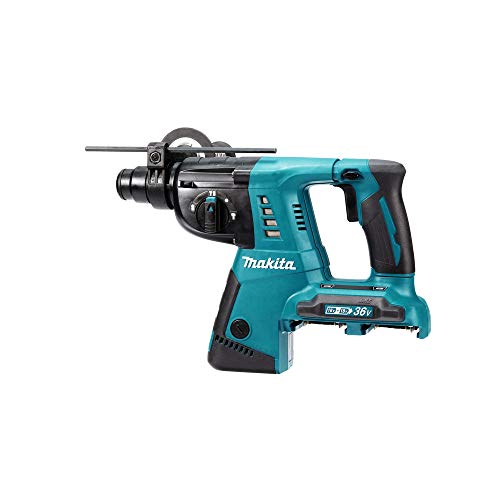
Makita XRH05Z 18V X2 LXT — Best High-Power
Price: Around $380 at time of writing (currently 43% off) | Rating: 4.6/5
The Makita XRH05Z runs on two 18V LXT batteries simultaneously — effectively a 36V equivalent output — and it shows in the extended run time on sustained concrete drilling. Where single-battery tools start voltage-sagging on long sessions drilling 3/4″ anchors into reinforced concrete slabs, the dual-battery setup maintains consistent power throughout. At 43% off (from $668 to $380), this is a genuinely strong deal on a professional-grade tool.
The 2.0 J impact energy at 1″ SDS+ positions it identically to the Milwaukee 2912-20 on paper, but the dual-battery run time advantage separates them on heavy production work. Electricians and plumbers rough-in work that requires drilling 50–100 anchor holes per day will notice the sustained performance difference. The Anti-Vibration Technology (AVT) system also helps on extended sessions — dampening vibration is the difference between a sore hand and a productive afternoon.
The limitation is battery management: running two 18V LXT batteries means you need four batteries to work uninterrupted (two sets). If you’re already deep in the Makita 18V LXT ecosystem, you probably already have them. If not, the two-battery requirement adds to the total investment.
Pros
- Dual 18V (36V effective) for sustained run time on heavy jobs
- Anti-Vibration Technology (AVT) for extended use comfort
- 43% off right now — $288 savings from regular price
- 3 modes including hammer-only for chiseling
- Compatible with all Makita 18V LXT batteries
Cons
- Requires two 18V batteries simultaneously — heavier and more batteries to manage
- 8.4 lbs — heaviest tool on this list
- Overkill for occasional-use or light masonry work
| Spec | Value |
|---|---|
| Voltage | 18V X2 LXT (36V equiv.) |
| Chuck Type | SDS Plus |
| Max Bit Diameter | 1 in. |
| Impact Energy | 2.0 J |
| Anti-Vibration | Yes (AVT) |
| Operating Modes | 3 (rotary, rotary hammer, hammer only) |
| Weight | 8.4 lbs (tool only) |
Bottom Line: Best choice for heavy-production concrete work where run time matters. The 43% deal makes it compelling even outside the Makita ecosystem — just budget for extra LXT batteries.
DeWalt DCH293B 20V MAX XR — Best Pro

Price: Around $434 at time of writing | Rating: 4.7/5
The DeWalt DCH293B exists for one application: structural anchor work. At 3.5 J of impact energy — the highest on this list — and a 1-1/8″ SDS+ chuck, it’s built for the Hilti anchors, threaded rod installations, and post-installed reinforcing bar that hold buildings together. The L-shape body positions the handle perpendicular to the drill axis, which is meaningfully better ergonomics when you’re drilling horizontal anchors into a foundation wall or column.
The 20V MAX XR brushless motor delivers consistent torque under the sustained load that 1-1/8″ bit drilling demands. SHOCKS Active Vibration Control, the E-Clutch anti-rotation system (activates when a bit binds), and the reinforced L-handle all signal a tool designed for professional structural work rather than occasional DIY use. At $434, it should be.
This is the tool for structural connection work on commercial projects — beam and column anchorage, rod hanging, seismic attachment points, steel stanchion mounting. For most residential DIYers, the DCH273B at 25% off is the smarter buy. The DCH293B is for contractors who know exactly why they need 3.5 J.
Pros
- 3.5 J impact energy — highest on this list, built for structural work
- 1-1/8″ SDS+ for larger anchor applications
- L-shape body — better ergonomics for horizontal drilling
- SHOCKS Active Vibration Control
- E-Clutch anti-rotation safety system
- 20V MAX XR brushless — runs on all DeWalt 20V batteries
Cons
- $434 — significant premium over the DCH273B
- Overkill for non-structural drilling applications
- Heavier and larger than most on this list
| Spec | Value |
|---|---|
| Voltage | 20V MAX XR |
| Chuck Type | SDS Plus |
| Max Bit Diameter | 1-1/8 in. |
| Impact Energy | 3.5 J |
| Anti-Vibration | SHOCKS Active Vibration Control |
| Safety System | E-Clutch Anti-Rotation |
| Operating Modes | 3 (rotary, rotary hammer, hammer only) |
Bottom Line: The pro pick for structural anchor installations. If you’re drilling for Hilti adhesive anchors, post-installed rebar, or seismic connections, the 3.5 J and 1-1/8″ chuck justify the price. For everything else, the DCH273B handles it for $170 less.
Rotary Hammer Buying Guide
Rotary Hammer vs Hammer Drill: What’s the Actual Difference?
A hammer drill uses a ratcheting mechanism to produce a rapid vibrating motion — it’s literally wobbling the chuck back and forth while it rotates. A rotary hammer uses a piston-driven mechanism that creates a true striking action, like a miniature jackhammer. The result: rotary hammers deliver 5–10× more impact energy per blow, use SDS+ bits that lock mechanically rather than relying on chuck friction, and can operate in hammer-only mode for chiseling.
Use a hammer drill for: small concrete anchor holes (under 1/4″), occasional masonry screws, mixing tasks. Use a rotary hammer for: anchor bolt installations, electrical conduit through concrete, tile removal, anything that requires consistent, repeated hole-drilling in concrete or masonry. If you’re working on a job site where concrete drilling is a regular task, a rotary hammer is a cost and time savings.
SDS+ vs SDS Max: Which Do You Need?
All six tools on this list use SDS+ (also written SDS-Plus). SDS Max is the larger format — bit shanks are 18mm vs 10mm for SDS+ — and found on large demolition hammers and heavy-core drilling equipment. For most residential, commercial renovation, and light industrial work, SDS+ is the right choice. SDS Max tools start at 5+ J of impact energy and are designed for breaking concrete and coring, not precision drilling.
If you’re a concrete professional doing large-diameter core drilling or heavy demolition, look at an SDS Max tool separately — that’s a different category. For the work most tradespeople do with a rotary hammer, SDS+ handles it.
How Much Impact Energy Do You Need?
- Under 1.5 J (Bosch GBH18V-21N at 1.7 J, Makita XRH06ZB at 0.9 J): Light masonry work, small anchors, electrical conduit mounting in CMU
- 1.5–2.5 J (DeWalt DCH273B at 2.1 J, Milwaukee 2912-20 and Makita XRH05Z at 2.0 J): Standard 1/2″–3/4″ anchor work, full-day concrete drilling, most commercial applications
- 3.0+ J (DeWalt DCH293B at 3.5 J): Structural anchors, 3/4″–1″ diameter holes, reinforced concrete, post-installed rebar
Battery Platform Considerations
A rotary hammer you’ll use regularly is worth buying within your existing platform — don’t introduce a second battery ecosystem for one tool. The exception: if you’re starting fresh, the DeWalt 20V MAX platform gives you the widest tool selection and most competitive pricing across drill, impact driver, circular saw, and rotary hammer. For a full platform comparison, see our battery platforms guide.
What to Buy and Skip
Buy the DeWalt DCH273B right now — it’s 25% off and covers 80% of use cases for under $265. The only reason to skip it: you’re already Milwaukee M18 (buy the 2912-20) or Makita LXT with heavy run-time needs (buy the XRH05Z while the 43% deal lasts).
Skip the Makita XRH05Z at full price — at $668 it’s hard to justify over the Milwaukee or DeWalt. At $380 (current deal), it’s a different conversation.
Skip the DeWalt DCH293B unless you specifically need 3.5 J and 1-1/8″ capacity for structural work. The $170 premium over the DCH273B is only worth it if the job genuinely requires it.
Frequently Asked Questions
What is a cordless rotary hammer used for?
A cordless rotary hammer is used for drilling holes in concrete, masonry, brick, and CMU block — and for chiseling and scaling in hammer-only mode. Common applications include anchor bolt installation, electrical conduit mounting through concrete, post-installed rebar, tile removal, and structural connections. It’s the right tool when you need clean, precise holes in hard masonry with consistent depth and no bit slippage.
What’s the difference between a rotary hammer and a hammer drill?
A hammer drill uses a ratcheting mechanism to vibrate the chuck, creating a relatively weak hammering action alongside rotation. A rotary hammer uses a piston-driven mechanism (electro-pneumatic) that delivers true striking force — 5–10× more impact energy than a hammer drill. Rotary hammers also use SDS+ bits that lock mechanically, eliminating bit slippage. For any regular or heavy-duty concrete drilling work, a rotary hammer is the correct tool.
What size rotary hammer do I need for anchor bolts?
For most standard residential and light commercial anchor work (1/4″–1/2″ anchors), any tool on this list with 1″ SDS+ capacity and 2.0+ J handles the job — the DeWalt DCH273B, Milwaukee 2912-20, or Makita XRH05Z. For larger anchors (5/8″–3/4″) in reinforced concrete, step up to the DeWalt DCH293B with 3.5 J and 1-1/8″ capacity. For anything requiring 1″ diameter holes or larger, look at SDS Max tools or corded rotary hammers in the 5+ J range.
Can I use regular SDS+ bits with any of these tools?
Yes. All six tools on this list use the standard SDS Plus bit shank — the same 10mm shank used across all major SDS+ tooling from Bosch, DeWalt, Makita, Milwaukee, and Hilti. Bits are interchangeable between brands. Chisel attachments (for hammer-only mode) also use the SDS+ shank and work in any 3-mode tool on this list.
Do cordless rotary hammers work as well as corded?
For most field work — yes. Modern cordless rotary hammers like the DeWalt DCH293B (3.5 J) match or exceed the impact energy of older corded models in the 2–4 J range. For continuous production work on a job site with power available (drilling 200+ anchor holes per day), a corded tool still has a run-time advantage. For the typical trades-person doing 10–50 holes per session, cordless is completely practical and eliminates the GFCI tripping, cord management, and access limitations that make corded tools frustrating in field conditions.
What batteries should I use with a rotary hammer?
Use a high-capacity battery — 4.0 Ah or higher — for rotary hammer work. Concrete drilling draws significant current, and a 2.0 Ah battery will run hot and deplete quickly under sustained load. A 5.0 or 6.0 Ah battery from the matching platform gives you the run time to complete a drilling session without interruption. See our battery platforms comparison for a full breakdown of which high-capacity batteries fit each system.
Power Tool Insider is reader-supported. When you buy through links on our site, we may earn an affiliate commission at no extra cost to you. This doesn’t affect our recommendations — we only recommend tools we’d actually use. Full disclosure.