Every saw blade has numbers stamped on it: 24T, 80T, 5/8 TPI, ATB, TCG. If those look like random codes, you’re not alone. But understanding what they mean is the difference between a clean cut and a splintered mess. Or worse, a dangerous kickback that sends a workpiece flying across your shop.
This guide breaks down every specification you’ll find on a saw blade package, from TPI and tooth count to hook angles and kerf width. We’ll cover circular saw blades, miter saw blades, table saw blades, reciprocating saw blades, jigsaw blades, band saw blades, and oscillating tool blades. By the end, you’ll be able to walk into any hardware store, pick up a blade, and know exactly what it will (and won’t) do well. If you’re looking for specific blade recommendations, check out our Best Saw Blades 2026 roundup after reading this.
Shopping for Oscillating Multi-Tool Blades?
Our in-depth guide compares carbide vs bi-metal blades across every brand and budget:
| Use Case | Best Blade Kit | Price | Rating | Why We Picked It | Buy |
|---|---|---|---|---|---|
| Demo & Rough Cuts | LENOX 5-Pack 9″ 14 TPI Recip Blades | ~$20 | 4.4★ | Bi-metal teeth cut through wood and nails without swapping blades | Buy Now |
| Fine Woodworking | DEWALT DWA4216 Oscillating Tool Kit, 5-Piece | ~$30 | N/A | Five blade shapes for flush cuts, plunge cuts, and grout removal | Buy Now |
| Metal Cutting | LENOX 20564 6″ 14 TPI Metal Blades | ~$6 | 4.6★ | Fine-tooth bi-metal for conduit, pipe, and sheet metal; 5-pack value | Buy Now |
The Numbers on Your Blade: Quick Decoder
Before we dive deep, here’s a cheat sheet for every spec you’ll encounter on a blade package. Bookmark this table. It’ll save you a lot of squinting at packaging in the blade aisle.
| Specification | What It Means | What It Affects | Example |
|---|---|---|---|
| Tooth Count (T) | Total number of teeth on the blade | Cut quality vs speed | 24T = fast/rough, 80T = slow/clean |
| TPI (Teeth Per Inch) | Teeth per inch of blade length | Cut quality, material suitability | 6 TPI = wood, 24 TPI = metal |
| Hook Angle | Forward/backward lean of teeth | Aggressiveness, safety | +20° = aggressive, -5° = controlled |
| Kerf | Width of the cut the blade makes | Material waste, power needed | Full kerf = 1/8″, thin kerf = 3/32″ |
| Tooth Grind | Shape of each tooth tip | Cut finish, material compatibility | ATB = crosscut, FTG = rip, TCG = laminate |
| Tooth Set | How teeth are offset from center | Kerf width, cut finish | Alternate = wide cut, wavy = smooth metal |
Tooth count (T) is used for circular, miter, and table saw blades. TPI is used for reciprocating, jigsaw, and band saw blades. Different measurement systems, same core concept.
TPI: The Most Important Number on Any Blade
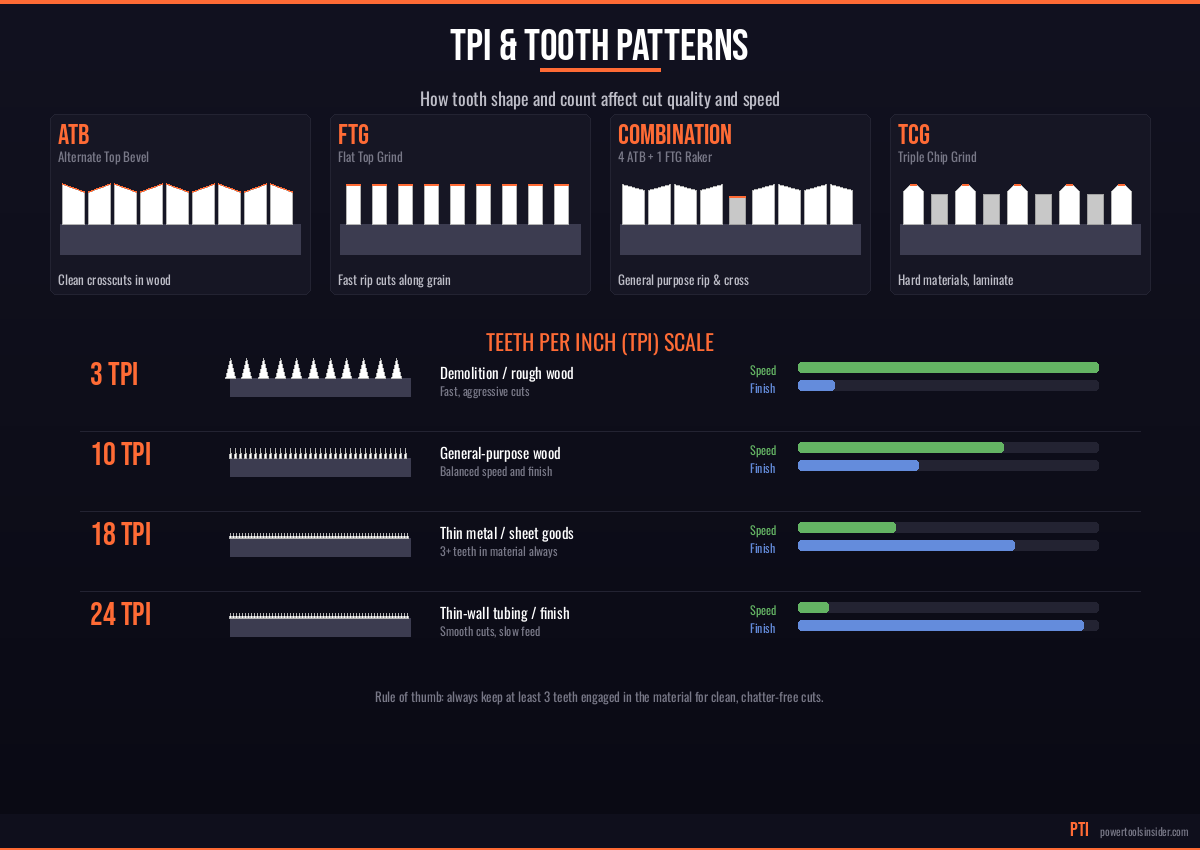
TPI (teeth per inch) is the single most important specification on any blade. It tells you one fundamental thing: how many teeth contact the material within each inch of blade travel. And from that single number, you can predict almost everything about the cut.
The Universal Rule
Fewer teeth means faster, rougher cuts. More teeth means slower, cleaner cuts. This applies to every saw blade ever made, from a 3 TPI demolition recip blade to an 80-tooth fine-finish miter saw blade. It’s the one rule that never changes.
Here’s why: each tooth removes a small chip of material. Fewer teeth means bigger chips, faster material removal, but a rougher surface. More teeth means smaller chips, a smoother surface, but slower cutting speed because the blade has to work harder to clear all those tiny chips.
TPI Ranges for Different Materials
| TPI Range | Best For | Cut Quality | Common Applications |
|---|---|---|---|
| 3-6 TPI | Thick wood, demolition | Very rough | Framing, pruning, demo with nails |
| 8-14 TPI | General purpose wood, thin metal | Moderate | Remodeling, general cutting, sheet metal |
| 18-24 TPI | Metal cutting, fine wood finish | Smooth | Metal pipe, conduit, tubing, hardwood trim |
| 24+ TPI | Thin sheet metal, precision cuts | Very smooth | Metal studs, thin-wall tubing, aluminum |
The key rule for metal: you always want at least 3 teeth in contact with the material at any time. That’s why thin metals need high TPI. If you use a 6 TPI blade on sheet metal, the teeth straddle the material and rip it instead of cutting it. For a full breakdown of which recip blades work best for metal demolition, see our Best Reciprocating Saw Blades 2026 guide.
For Circular, Miter, and Table Saws: Tooth Count, Not TPI
Here’s where it gets slightly different. Round blades (circular saws, miter saws, and table saws) use total tooth count instead of TPI. But the same principle applies: fewer teeth = faster and rougher, more teeth = slower and cleaner.
| Tooth Count | Blade Type | Best For | Cut Quality |
|---|---|---|---|
| 24T | Framing blade | Ripping through 2x4s, plywood sheathing | Rough, splinters on crosscuts |
| 40T | General purpose | The “one blade for everything” choice | Good enough for most DIY work |
| 60T | Fine crosscut | Clean cuts in plywood, hardwood, softwood | Smooth, minimal sanding needed |
| 80-100T | Ultra fine finish | Trim work, melamine, veneers, laminate | Near-polished, zero tearout |
Here’s the practical takeaway: if you own one circular saw and do general DIY work, a 40-tooth blade handles 90% of what you’ll throw at it. But when you’re cutting oak for a bookshelf project and need zero tearout, that’s when you swap to a 60T or 80T blade. The Diablo D0740A 40T general purpose blade (~$12) is the one I keep on my circular saw by default. It handles crosscuts, rip cuts, and plywood without complaint.
For framing and rough carpentry, the Diablo D0724A 24T framing blade (~$9) rips through dimensional lumber like butter. It’s thin-kerf, which means less drag on cordless saws, and that matters when you’re running a cordless circular saw on battery power.
When you need glass-smooth crosscuts for trim work, step up to the Diablo D1080X 10″ 80T Hi-ATB blade (~$38). This is the blade finish carpenters swear by for crown molding, baseboards, and veneer plywood. Put it on a quality miter saw and the cuts come out nearly polished.
Know Your TPI. Now Find the Right Blade
See our tested recip blade picks by job type (demo, metal, and wood), ranked by TPI and material:
Tooth Grind Types: ATB vs FTG vs TCG
Tooth count tells you how many teeth are on the blade. Tooth grind tells you what shape those teeth are. And the shape determines what materials the blade cuts well, and what it destroys.
ATB (Alternate Top Bevel)
The most common grind on woodworking blades. Each tooth is ground at an alternating angle: one leans left, the next leans right. This creates a shearing action that slices cleanly across wood fibers, which is why ATB blades excel at crosscutting. The bevel angle varies from 10° to 25°. Steeper angles give cleaner cuts but dull faster.
You’ll find ATB grinds on most 40T, 60T, and general-purpose blades. If a blade just says “crosscut” or “finish,” it’s almost certainly ATB.
FTG (Flat Top Grind)
Each tooth is flat across the top: no bevel, no angle. FTG teeth act like tiny chisels, scooping out material in a straight line. This makes them extremely efficient for ripping (cutting along the grain), because rip cuts don’t need the shearing action that crosscuts do.
The downside: FTG leaves a rougher surface than ATB because those flat teeth tear through fibers rather than slicing them. A 24T FTG rip blade will fly through a board lengthwise, but you’ll need to sand the edge afterward. That’s the trade-off: speed for finish.
TCG (Triple Chip Grind)
TCG alternates between two tooth shapes: a chamfered (trapezoid) tooth that scores the material, followed by a flat raker tooth that cleans out the kerf. This two-step cutting action is ideal for hard, abrasive, and brittle materials: MDF, melamine, laminate countertops, non-ferrous metals like aluminum and brass.
If you’re cutting a lot of laminate flooring or aluminum extrusions, TCG is the grind you want. It won’t chip the surface layer the way an ATB blade might, and the alternating tooth design handles the heat buildup that dense materials generate.
Hi-ATB (High Alternate Top Bevel)
Same concept as standard ATB, but with a much steeper bevel angle, typically 30° to 40° instead of the standard 15° to 20°. The steeper angle creates a razor-like slicing action that produces near-polished cuts in veneered plywood, melamine, and delicate hardwoods.
The trade-off: Hi-ATB teeth are more fragile and dull faster because there’s less carbide behind the cutting edge. These are specialty blades for finish work, not everyday use. The Diablo D1080X mentioned earlier uses a Hi-ATB grind. That’s why it produces such clean cuts in trim work.
Combo (4+1)
Combination blades group teeth in sets of five: four ATB teeth followed by one FTG raker tooth, separated by a deep gullet. The idea is a single blade that can both crosscut and rip without swapping. The ATB teeth handle crosscuts; the FTG raker cleans out rip cuts.
Does it work? Sort of. A combo blade does everything decently but nothing perfectly. If you’re a hobbyist with one table saw and you don’t want to swap blades constantly, a 50T combo blade is a reasonable compromise. But it won’t rip as fast as a dedicated 24T rip blade or crosscut as cleanly as a dedicated 80T finish blade.
When Each Grind Matters
| Grind Type | Best Application | Cut Quality | Durability | Common Tooth Counts |
|---|---|---|---|---|
| ATB | Crosscuts in solid wood, plywood | Clean | Good | 40T, 60T |
| FTG | Ripping along the grain | Rough | Excellent | 24T |
| TCG | Laminate, MDF, non-ferrous metal | Clean | Excellent | 60T, 80T |
| Hi-ATB | Veneered plywood, melamine, trim | Polished | Fair | 80T, 100T |
| Combo | General purpose (rip + crosscut) | Good | Good | 50T |
Hook Angle: Aggressive vs Controlled Cuts
Hook angle (also called rake angle) is the tilt of each tooth relative to the center of the blade. It’s measured in degrees, and it has a massive impact on how the blade behaves, and how safe it is to use.
Positive Hook Angle (15° to 22°)
A positive hook angle means the teeth lean forward, toward the direction of cut. This creates an aggressive, self-feeding action. The blade pulls the material into itself. Positive hook blades cut fast and require less pushing force from the operator.
This is standard on circular saw blades designed for handheld use. When you’re holding a circular saw and pushing it through a 2×4, you want the blade helping you feed the material. The Diablo 24T framing blade has a 15° positive hook for exactly this reason.
Zero Hook Angle (0°)
Zero hook is neutral. The teeth are straight up and down, neither pulling material in nor pushing it away. You’ll find this on radial arm saw blades and some general-purpose blades. It gives a controlled cut without any self-feeding tendency.
Negative Hook Angle (-2° to -6°)
A negative hook angle means the teeth lean backward, away from the cut direction. This creates a pushing action. The blade pushes the material away instead of pulling it in. This is standard on miter saw blades and sliding miter saw blades.
Why this matters for safety: On a miter saw, the blade comes down into the material. If you use a positive-hook blade, the teeth grab the workpiece and try to climb over it or throw it toward you. With a negative hook, the blade pushes the material down onto the table, keeping the cut controlled. Always check the hook angle when buying miter saw blades. For blade recommendations matched to specific miter saws, see our Best Miter Saws 2026 guide.
Matching Hook Angle to Your Saw
| Saw Type | Recommended Hook Angle | Why |
|---|---|---|
| Circular Saw (handheld) | +15° to +22° | Self-feeding assists manual push |
| Table Saw (ripping) | +15° to +20° | Aggressive feed for long rip cuts |
| Table Saw (crosscut) | +5° to +15° | Moderate feed, cleaner finish |
| Miter Saw | -2° to -6° | Prevents climbing and kickback |
| Sliding Miter Saw | -2° to -6° | Even more critical, blade travels forward |
| Radial Arm Saw | -5° to -10° | Blade moves toward operator; must resist self-feed |
Safety warning: Using a positive-hook circular saw blade on a miter saw is one of the most common (and most dangerous) mistakes DIYers make. The blade grabs the material and can throw it at you, or pull the saw forward violently. Always check the hook angle printed on the blade before mounting it.
Kerf Width: Full vs Thin
Kerf is the width of the slot the blade cuts into the material. It’s determined by how far the teeth are set (offset) from the blade body, or how wide the carbide tips are. And it matters more than most people think.
Full Kerf (~1/8″ or 3.2mm)
Full-kerf blades have a wider cut and stiffer blade body. The thicker plate resists deflection, which means straighter cuts and less wobble. But they also remove more material and require more power to spin through the cut.
Use full-kerf blades on powerful saws: cabinet table saws with 3+ HP motors, beefy corded miter saws, and contractor saws with enough torque to not bog down.
Thin Kerf (~3/32″ or 2.4mm)
Thin-kerf blades remove less material per cut, which means less resistance and less power needed. They’re the standard choice for cordless saws, benchtop table saws, and portable miter saws where motor power is limited.
The trade-off: a thinner blade plate is slightly more prone to vibration and deflection, especially in thick hardwoods. For most DIY work, you’ll never notice the difference. But a cabinet maker ripping 2″ oak all day will prefer the stability of a full-kerf blade.
When to Use Each
| Kerf Type | Thickness | Power Needed | Best For |
|---|---|---|---|
| Full Kerf | ~1/8″ (0.098″) | 3+ HP, 15A corded | Cabinet table saws, contractor miter saws |
| Thin Kerf | ~3/32″ (0.059″-0.071″) | Any power level | Cordless saws, benchtop saws, portable saws |
The DEWALT DWA271460 7-1/4″ 60T blade (~$24) is a 0.065″ thin-kerf design that’s specifically built for cordless circular saws. It delivers clean crosscuts without overtaxing your battery. Compare that to a full-kerf 60T blade on the same cordless saw, and you’ll notice the motor straining and the battery draining twice as fast. Kerf width matters.
Gullet Size: Why Chip Clearance Matters
The gullet is the valley between each tooth, the space where cut material (chips, sawdust, or metal shavings) sits before being ejected from the cut. Gullet size is directly related to tooth count: fewer teeth means bigger gullets, more teeth means smaller gullets.
This is why a 24T blade rips through 2x4s so fast. The massive gullets clear chips efficiently, preventing heat buildup. And it’s why trying to rip thick lumber with an 80T blade causes burning. The tiny gullets pack with sawdust, friction skyrockets, and the wood chars.
For deep cuts (anything over 2″ in wood), prioritize blades with larger gullets. For shallow, precise cuts in thin material, gullet size matters less. The combo (4+1) grind pattern uses oversized gullets between each group of 5 teeth specifically to aid chip clearance during rip cuts.
Tooth Set Patterns for Recip, Jigsaw, and Band Saw Blades
Circular saw blades are rigid discs; the carbide tips define the kerf. But reciprocating saw blades, jigsaw blades, and band saw blades are flexible strips of steel. They use a completely different system: tooth set, the way teeth are bent outward from the blade body, to create kerf and prevent binding.
Alternate Set
Each tooth is bent alternately left, then right. This creates the widest kerf of any set pattern and clears chips aggressively. Alternate set is the standard for wood-cutting recip and jigsaw blades. If you’re cutting framing lumber, nail-embedded wood, or tree branches, alternate set is what you want.
Wavy Set
Instead of individual teeth bending left/right, groups of teeth gradually undulate in a wave pattern. This creates a narrower, smoother kerf than alternate set. Wavy set is the go-to for cutting thin metals (conduit, sheet metal, metal studs) because it prevents the blade from grabbing and chattering on thin stock.
Raker Set
Three-tooth repeating pattern: one tooth bent left, one bent right, one straight (the raker). The raker tooth cleans out the kerf while the set teeth do the cutting. Raker set is designed for cutting thicker metals (structural steel, cast iron, heavy pipe) where chip clearance in dense material is critical.
TPI Guidelines for Recip and Jigsaw Blades
| TPI | Tooth Set | Material | Application |
|---|---|---|---|
| 3-5 TPI | Alternate | Thick wood, branches | Pruning, rough demo, timber |
| 6-8 TPI | Alternate | Wood with nails | Demolition, remodeling |
| 10-14 TPI | Alternate/Raker | Wood, thick metal | General purpose, heavy metal |
| 18-24 TPI | Wavy | Metal pipe, conduit | Plumbing, electrical, HVAC |
| 24+ TPI | Wavy | Thin sheet metal | Metal studs, flashing, ductwork |
For demolition work, the Diablo DS0612BW5 6″ 6/12 TPI recip blades (~$12 for 5-pack) are the demo crew favorite. The variable tooth design (alternating 6 and 12 TPI) handles nail-embedded wood without skipping a beat. For metal cutting, the LENOX 20564 6″ 14 TPI metal blades (~$10 for 5-pack) have been the industry standard for decades. The bi-metal construction handles heat buildup that kills cheaper blades.
For Milwaukee users, the Milwaukee SAWZALL 16-piece metal cutting set (~$25 at Home Depot) includes blades from 14 TPI to 24 TPI, covering everything from thick pipe to thin conduit in one kit.
On a budget? The HYCHIKA 32-piece recip blade set (~$20) gives you 22 wood blades and 10 metal blades with a storage case. They won’t last as long as Diablo or LENOX, but for occasional DIY use, they’re surprisingly capable. And the WORKPRO 25-piece jigsaw blade set (~$13) covers wood, metal, and plastic with HCS, HSS, and BIM blades, ideal for someone just getting started with a jigsaw.
Band Saw Blades
Band saws use the same TPI and tooth set concepts as recip blades, but with one big difference: blade width. Wider band saw blades (1/2″ to 1″) track straighter and handle resawing thick stock. Narrow blades (1/8″ to 1/4″) follow tight curves. The TPI principles stay the same: 3-6 TPI for thick wood, 14-24 TPI for metal.
Oscillating Tool Blades
Oscillating multi-tool blades are a different animal. They cut with a rapid side-to-side oscillation rather than spinning or reciprocating. TPI still matters (wood blades run 14-18 TPI, metal blades run 18-24+ TPI), but blade material and tooth design are equally important. For a complete breakdown, see our Best Oscillating Multi-Tool Blades 2026 guide.
Blade Selection Cheat Sheet
This is the table to save on your phone. Next time you’re standing in front of a wall of blades, pull this up and match your project to the right specs.
| Project | Tooth Count/TPI | Grind Type | Hook Angle | Kerf | Recommended Blade |
|---|---|---|---|---|---|
| Framing lumber (2×4, 2×6) | 24T | ATB or FTG | +15° to +20° | Thin | Buy Now |
| Plywood crosscut | 60T | ATB | +5° to +15° | Thin or Full | Buy Now |
| Hardwood rip cuts | 24-30T | FTG | +15° to +20° | Full | Dedicated FTG rip blade |
| Melamine/laminate | 80T | TCG or Hi-ATB | -2° to +10° | Full | Buy Now |
| Metal studs (recip) | 18-24 TPI | Wavy set | N/A | N/A | Buy Now |
| Deck boards (crosscut) | 40-60T | ATB | +10° to +15° | Thin | Buy Now |
| Trim/molding (miter saw) | 80-100T | Hi-ATB | -2° to -6° | Full | Buy Now |
| Demolition (wood + nails) | 6-10 TPI | Alternate set | N/A | N/A | Buy Now |
Prices approximate as of February 2026. T = tooth count for circular/miter/table saw blades. TPI = teeth per inch for recip/jigsaw/band saw blades.
Would rather order everything in one box instead of picking blades off a Home Depot shelf one at a time? The DEWALT DW3128P5 5-pack (~$80) bundles combination, ripping, and crosscut blades in one set, a reasonable Amazon alternative to buying single Diablo blades for each cut type.
Common Mistakes That Ruin Your Cuts
After 20+ years of replacing blades and fixing botched cuts, these are the mistakes I see over and over. Avoid them and your cuts improve overnight.
1. Using a 24T Framing Blade for Plywood
This is the most common one. You build your framing with a 24T blade (correct), then cut your plywood sheathing with the same blade (terrible idea). Those big, aggressive teeth tear through the thin veneer layers like a dog through wrapping paper. Swap to a 40T or 60T before cutting plywood. The 30 seconds it takes to change the blade saves you from splintered edges and wasted material.
2. Using a Positive-Hook Blade on a Miter Saw
We covered this above, but it bears repeating because it’s genuinely dangerous. A positive-hook circular saw blade will grab the material on a miter saw and can kick it back at you. Always use a negative-hook blade on a miter saw, period. Check the package or the blade printing for hook angle before installing.
3. Using a Fine-Tooth Metal Blade on Thick Wood
Putting an 18 TPI metal blade on your recip saw to cut lumber seems like it would give you a cleaner cut. What actually happens: the tiny teeth can’t clear chips fast enough, the blade overheats, the wood burns, and the blade dulls in minutes. Use 3-8 TPI for wood, 18+ TPI for metal. Don’t mix them up. If you need recommendations, our saw blade roundup has picks sorted by material.
4. Never Cleaning Resin and Pitch Off Your Blades
After cutting pine, pressure-treated wood, or any resinous species, pitch builds up on the blade teeth and body. This gunk increases friction, reduces cutting performance, and causes burning. A $5 bottle of blade cleaner (or even Simple Green) and an old toothbrush will restore a gummed-up blade to near-new performance. Clean your blades after every major project.
5. Running Full-Kerf Blades on Cordless Saws
Full-kerf blades demand more power than thin-kerf. If your cordless circular saw or battery-powered miter saw bogs down, strains, or drains batteries abnormally fast, check the kerf width. Most cordless circular saws are designed for thin-kerf blades. Running a full-kerf blade on them is like putting truck tires on a sedan.
6. Using the Same Jigsaw Blade for Everything
Jigsaw blades are cheap. There’s no reason to use the same 10 TPI blade for cutting plywood, metal conduit, and ceramic tile. Each material needs its own TPI and tooth design. A Bosch T5002 10-piece jigsaw blade set (~$12) gives you the right blade for wood, metal, and scrollwork. Keep it in your jigsaw case and swap blades for each material.
Why Carbide Matters: Understanding tooth geometry goes hand-in-hand with understanding the material. Our guide to carbide in saw blades and drill bits explains why tooth material determines lifespan as much as tooth count.
Find the Right Blade for Your Saw
Now that you can read a saw blade spec, see our top picks for every cut type and material:
Best Saw Blades 2026 → Circular, Miter & Reciprocating Blades Compared
Frequently Asked Questions
How many teeth do I need on a circular saw blade?
For general DIY work, a 40-tooth blade handles most tasks. Use 24 teeth for rough framing and demolition, 60 teeth for clean crosscuts in plywood and hardwood, and 80+ teeth for ultra-fine finish work in trim, melamine, and veneers. If you only own one blade, make it a 40T.
What TPI is best for cutting metal with a reciprocating saw?
For thick metal like pipe and structural steel, use 10-14 TPI. For medium metals like conduit and angle iron, use 18 TPI. For thin sheet metal and metal studs, use 24 TPI. The key rule: you want at least 3 teeth in contact with the material at all times. Thinner material needs higher TPI. Check our recip blade guide for specific product picks.
Can I use a miter saw blade on a table saw?
Sometimes, but check the hook angle first. Miter saw blades typically have a negative hook angle (-2 to -6 degrees) while table saw blades use positive hook angles (+15 to +20 degrees). Using a negative-hook blade on a table saw won’t be dangerous, but it will cut slower and require more push force because the teeth resist feeding. Going the other direction (using a positive-hook table saw blade on a miter saw) can be dangerous due to self-feeding and potential kickback.
Why does my saw blade burn the wood?
Four common causes: a dull blade creating excess friction, feeding too slowly which keeps the blade in contact too long, using too many teeth for rip cuts which clogs the gullets, or pitch and resin buildup on the teeth. Try cleaning the blade first (a soak in blade cleaner works wonders), then check if the teeth are still sharp. If the carbide tips are visibly rounded or chipped, it’s time for a new blade.
What’s the difference between a crosscut and rip blade?
A crosscut blade (typically 60-80 teeth, ATB grind) is designed to cut across the wood grain, producing a smooth edge. A rip blade (typically 24 teeth, FTG grind) is designed to cut along the grain, prioritizing speed and chip clearance over finish quality. The tooth grind is the key difference: ATB teeth shear across fibers cleanly, while FTG teeth chisel along the grain efficiently.
Do more teeth mean a better blade?
Not necessarily. More teeth mean a smoother cut, but also a slower cut that requires more power. An 80-tooth blade on a framing job would be painfully slow and drain cordless batteries in minutes. A 24-tooth blade on trim work would splinter the wood. The best blade is the one matched to your material and application. More teeth is only “better” when you need a finer finish.
Ready to Choose a Circular Saw?
Now that you can read blade specs, here are our top-tested cordless circular saws, with blade compatibility notes for each pick:
Power Tool Insider is reader-supported. When you buy through links on our site, we may earn an affiliate commission at no extra cost to you. This doesn’t affect our recommendations. We only recommend tools we’d actually use. Full disclosure.