Sawdust is not just a mess. It is a health hazard. Fine wood dust under 10 microns embeds in your lungs and stays there. OSHA classifies it as a carcinogen. And in a small shop, a one-car garage, a basement corner, a 200-square-foot shed, that dust has nowhere to go except into your respiratory system.
The good news: you do not need a $2,000 industrial system to breathe easy. Whether you are running a table saw on weekends or turning a small woodworking side hustle, there is a dust collection setup that fits your space and budget. This guide covers the best shop vacuums, cyclone separators, and dedicated dust collectors for small workshops in 2026, with real specs, honest trade-offs, and links to buy.
| Award | Model | Price | Rating | Why We Picked It | Buy |
|---|---|---|---|---|---|
| Best Shop Vac | DeWalt DXV10P | ~$130 | 4.6/5 | Quietest shop vac, 2-stage motor, 10 gal capacity | Buy Now |
| Best HD Exclusive | Ridgid HD1200 | ~$100 | 4.7/5 | 144 CFM suction, locking hose, lifetime warranty | Buy Now |
| Best Cyclone Separator | Oneida Dust Deputy 2.5 DIY | ~$40 | 4.7/5 | 99% separation, doubles shop vac life, made in USA | Buy Now |
| Best Budget Separator | Dustopper High Efficiency | ~$25 | 4.4/5 | Lowest entry price, snaps onto any 5-gal bucket | Buy Now |
| Best Dust Collector | WEN DC3474 | ~$160 | 4.2/5 | 600 CFM, quiet induction motor, rolls or wall-mounts | Buy Now |
| Best Budget Collector | VEVOR 1HP Wall Mount | ~$130 | 4.3/5 | 560 CFM, wall-mount saves floor space, 2.5-micron bag | Buy Now |
Shop Vac vs Dust Collector vs Cyclone Separator
Before you spend a dime, you need to understand the three approaches to dust collection, because each solves a different problem.
Shop Vacuums
A shop vac is what most people already own. It uses high static pressure (measured in inches of water lift) to pull debris through a narrow hose, typically 1.25 to 2.5 inches in diameter. That narrow hose means excellent pickup for hand tools like sanders, routers, and jigsaws. The downside: limited airflow (usually 60-150 CFM) and small filters that clog fast when dealing with fine dust. For a small shop where you are mainly using handheld power tools and doing general cleanup, a quality shop vac is a perfectly valid primary dust collection tool.
Dust Collectors
A dedicated dust collector moves high volumes of air, 500 to 1,200 CFM, through a 4-inch or larger port. That wide hose and high airflow is what you need for stationary tools: table saws, planers, jointers, and miter saws that produce mountains of chips. Even a small 1 HP dust collector dramatically outperforms a shop vac when connected to a table saw’s 4-inch dust port. The trade-off: they are larger, louder, and more expensive. But if you run any stationary woodworking tool, a dust collector is not optional, it is essential.
Cyclone Separators
A cyclone separator is not a standalone dust collection tool. It sits between your tool and your vacuum or collector, using centrifugal force to spin heavy particles into a bucket before they reach the filter. The result: 95-99% of debris never touches your filter, which means consistent suction, longer filter life, and less time emptying small vacuum canisters. A $30-40 cyclone separator is arguably the single highest-value upgrade you can make to any dust collection setup.
The Small Shop Strategy
For most small workshops, the winning combination is a good shop vac paired with a cyclone separator. This gives you strong suction for hand tools and cleanup, plus the separation efficiency to keep your filter clean. If you add a table saw or planer, step up to a dedicated 1 HP dust collector. In a tight space, you can run both systems, the shop vac for hand tools and a wall-mounted collector for the big machines.
Our Top Picks
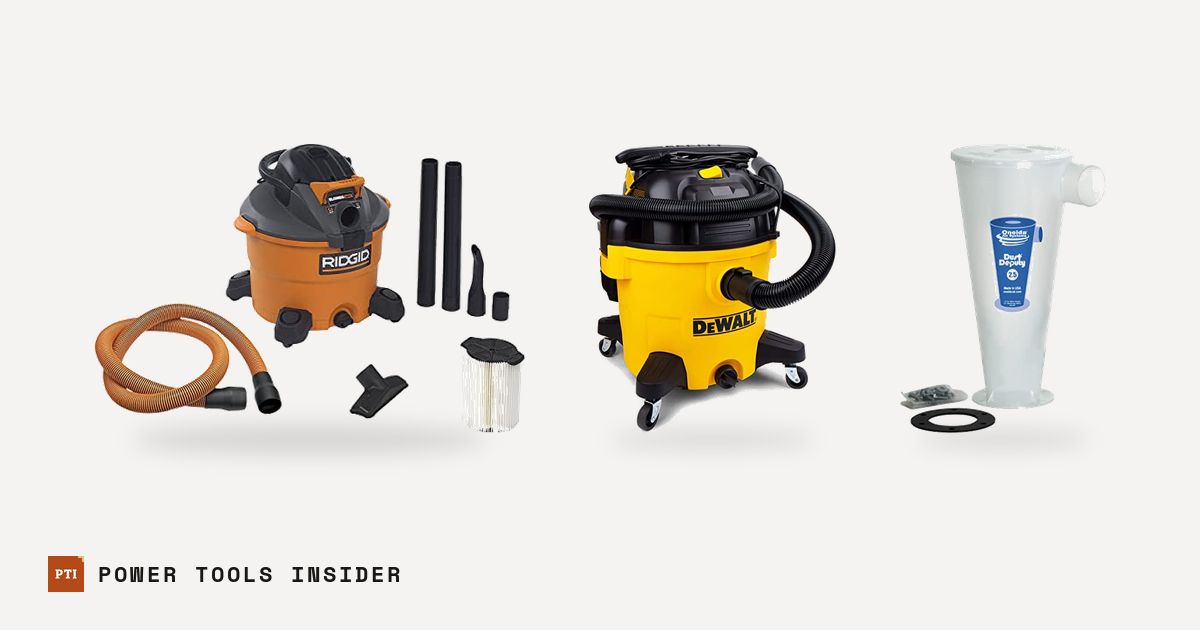
DeWalt DXV10P, Best Shop Vac for Small Shops
Price: ~$130 | Rating: 4.6/5
The DeWalt DXV10P is the shop vac I recommend to anyone setting up their first small workshop. The 2-stage motor is the key feature here, it runs roughly 50% quieter than single-stage shop vacs while delivering 5.5 peak HP and 90 CFM of suction. In a small enclosed shop, that noise reduction is not a luxury. It is the difference between wearing hearing protection for cleanup and having a normal conversation while vacuuming.
The 10-gallon poly tank hits the sweet spot for a home shop, big enough that you are not emptying it every session, small enough to tuck under a bench. The built-in drain makes wet pickup genuinely useful instead of a theoretical feature you never use. The 2.5-inch hose is compatible with most cyclone separators, and the washable cartridge filter keeps ongoing costs near zero.
Where it falls short: 90 CFM is not enough for a table saw’s 4-inch port. This is a hand-tool and cleanup machine. Pair it with a cyclone separator and you have a dust collection system that handles everything except the big stationary tools.
Pros
- 2-stage motor runs 50% quieter than typical shop vacs
- 5.5 peak HP with 90 CFM suction
- 10-gallon capacity with built-in tank drain
- Washable, reusable cartridge filter
- 10-foot power cord with onboard storage
Cons
- 90 CFM not sufficient for 4-inch dust ports
- Filter clogs quickly without a pre-separator
- Accessories are basic, upgrade hose for dust collection use
| Spec | Value |
|---|---|
| Motor | 5.5 Peak HP, 2-Stage |
| Airflow | 90 CFM |
| Tank Size | 10 Gallons |
| Hose Diameter | 2.5 inches |
| Cord Length | 10 feet |
| Noise Level | ~65 dB (rated quiet operation) |
| Weight | 22 lbs |
Bottom Line: The DXV10P is the quietest shop vac worth buying for dust collection. Pair it with a Dust Deputy and you have a capable two-stage system for under $175 total.
Ridgid HD1200 NXT, Best Home Depot Exclusive
Price: ~$100 | Rating: 4.7/5
The Ridgid HD1200 is the most popular shop vac in America for a reason. At around $100, you get 5.0 peak HP, 144 CFM of airflow, and a 12-gallon tank, plus Ridgid’s legendary lifetime warranty that actually gets honored at your local Home Depot. That 144 CFM rating is significantly higher than the DeWalt’s 90 CFM, which means noticeably better pickup when connected to larger tools.
The NXT locking hose system deserves special mention. The 2.5-inch hose and accessories click into place and stay put, no more fighting a loose hose that pops off mid-cut. The 7-foot hose with extension wands gives you a 17-foot reach, and the onboard accessory storage keeps everything organized. For a garage shop where the vac doubles as a car cleaner and general-purpose vacuum, the HD1200 is hard to beat.
The trade-off versus the DeWalt is noise. The HD1200 is not a quiet machine. In a small shop, you will want hearing protection when it is running. But if raw suction power and value matter more than noise, the Ridgid wins. Note: Ridgid is a Home Depot exclusive, do not buy third-party listings on Amazon at inflated prices.
Pros
- 144 CFM airflow, strongest suction in this class
- 12-gallon tank for extended use between empties
- Locking hose and accessory system
- Full lifetime warranty through Home Depot
- Excellent value at ~$100
Cons
- Louder than 2-stage competitors
- Only available at Home Depot
- Standard filter is not HEPA, upgrade filter sold separately
| Spec | Value |
|---|---|
| Motor | 5.0 Peak HP |
| Airflow | 144 CFM |
| Tank Size | 12 Gallons |
| Hose Diameter | 2.5 inches (locking) |
| Hose Length | 7 feet |
| Weight | 20 lbs |
| Warranty | Lifetime |
Bottom Line: Best bang-for-buck shop vac with the highest CFM in its class. The lifetime warranty seals the deal. Buy it at Home Depot, that is the only place to get it at the right price.
Oneida Dust Deputy 2.5 DIY, Best Cyclone Separator
Price: ~$40 (cyclone only) | Rating: 4.7/5
If you buy one thing from this guide, make it a cyclone separator. And the Oneida Dust Deputy 2.5 is the gold standard. This American-made cyclone uses centrifugal force to spin 99% of dust and debris into a collection bucket before it reaches your vacuum filter. The result is transformative: your shop vac maintains full suction indefinitely, your filter lasts months instead of weeks, and you spend less time fiddling with the vacuum and more time working.
The 2.5-inch version is specifically engineered for modern high-power shop vacuums. It delivers up to double the airflow of smaller cyclones and the older lid-style separators. The clear polypropylene body lets you see exactly how much debris has been captured, which is deeply satisfying when you dump a full bucket and your vacuum filter is still clean. The anti-static construction eliminates the shock hazard that plagues cheaper cyclone designs.
This is the DIY version, meaning you get the cyclone cone only. You will need a 5-gallon bucket and some basic plumbing to complete the setup. If you want everything in the box, Oneida sells deluxe kits with the bucket included for around $70. But the DIY approach is half the cost and takes about 15 minutes to set up.
Pros
- 99% dust and debris separation efficiency
- Doubles airflow versus lid-style separators
- Anti-static construction prevents shock and cling
- Clear body for visual monitoring
- Made in USA by Oneida Air Systems
Cons
- DIY version requires your own bucket and hose
- Takes up floor space next to your vacuum
- Fine dust under 1 micron still passes through
| Spec | Value |
|---|---|
| Separation Efficiency | 99% |
| Inlet/Outlet | 2.5-inch female ports |
| Cyclone Diameter | 7 inches |
| Material | Anti-static polypropylene |
| Compatible Buckets | Standard 5-gallon or larger |
| Made In | USA |
Bottom Line: The highest-value dust collection upgrade you can make. A $40 Dust Deputy turns a $100 shop vac into a legitimate two-stage dust collection system. Essential purchase for any small shop.
Dustopper High Efficiency Dust Separator, Best Budget Separator
Price: ~$25 | Rating: 4.4/5
The Dustopper takes a completely different approach to dust separation. Instead of a tall cyclone cone, it uses a low-profile 12-inch disc that snaps onto any standard 5-gallon bucket. The result is a separator that is roughly 4 inches tall instead of 18, a massive advantage if vertical space is limited in your shop. Setup time is under one minute: no drilling, no screws, no sealant. Pop it on a bucket, connect your hoses, and you are collecting dust.
In real-world use, the Dustopper captures the vast majority of dust and chips before they reach your vacuum filter. The manufacturer claims 99% efficiency, and for typical wood chips and coarse sawdust, that tracks. Where it struggles compared to a true cyclone like the Dust Deputy is with fine dust and long shavings. Planer chips and long slivers can jam in the slot openings, causing occasional clogs that need clearing. Independent testing shows the Dust Deputy handles these materials significantly better.
But here is the thing: at $25, the Dustopper is nearly half the price of the Dust Deputy. If you are on a tight budget, or if your primary concern is general shop cleanup rather than planer shavings, the Dustopper is a perfectly functional separator that dramatically extends your vacuum filter life. It is made in Michigan by a small American business, and the build quality reflects that.
Pros
- Low-profile design, only 4 inches tall
- Under $25, cheapest separator option
- No-tool setup in under 60 seconds
- Fits any standard 5-gallon bucket
- Made in USA (Michigan)
Cons
- Long shavings and planer chips can cause jams
- Less efficient than cyclone designs for fine dust
- Lower suction throughput than Dust Deputy
| Spec | Value |
|---|---|
| Diameter | 12 inches |
| Height | 4 inches |
| Hose Diameter | 2.5 inches |
| Hose Length | 36 inches |
| Compatible Buckets | Standard 5-gallon |
| Made In | USA |
Bottom Line: The cheapest way to add separation to any shop vac setup. Not as efficient as the Dust Deputy for fine dust, but at this price, it pays for itself in saved filters within weeks.
WEN DC3474, Best Dust Collector for Small Shops
Price: ~$160 | Rating: 4.2/5
When you graduate from a shop vac to a real dust collector, the WEN DC3474 is where to start. The 7.4-amp induction motor moves 600 CFM through a 4-inch port, a completely different level of airflow compared to any shop vac. Connected to a table saw, miter saw, or jointer, the difference is immediately obvious: chips get sucked away at the source instead of piling up around your feet.
The induction motor is the star of this design. Unlike the universal motors in shop vacs that scream at high RPMs, an induction motor runs cooler, quieter, and lasts significantly longer. The 9-inch impeller delivers that 600 CFM without the ear-splitting noise that makes dust collection feel like punishment. You can actually talk over this thing, which matters when you are running it for hours during a project.
Versatility is the other selling point. The DC3474 rolls on four swivel casters, so you can wheel it between tools. Or remove the casters and wall-mount it using the built-in brackets, a huge advantage in a small shop where every square foot of floor space counts. The 15-gallon 5-micron zippered bag is adequate for hobby use, though serious users will want to upgrade to a cartridge filter for better fine dust capture.
Pros
- 600 CFM through 4-inch port, real dust collection
- Quiet induction motor runs cooler and lasts longer
- Rolls on casters or wall-mounts, your choice
- Compact footprint for a dust collector
- 2-year warranty from WEN
Cons
- 5-micron bag misses finest dust particles
- Single 4-inch port, no splitter for multiple tools
- 15-gallon bag fills quickly with planer shavings
| Spec | Value |
|---|---|
| Motor | 7.4 Amp Induction |
| Airflow | 600 CFM |
| Dust Port | 4 inches |
| Bag Capacity | 15 Gallons |
| Filtration | 5 micron (bag) |
| Dimensions | 43.3 x 17.7 x 20.1 inches |
| Weight | 41.1 lbs |
Bottom Line: The entry point for real dust collection. The WEN DC3474 gives you 600 CFM in a compact, affordable package that rolls or wall-mounts. If you own a table saw, this is the upgrade that protects your lungs.
VEVOR 1HP Wall Mount Dust Collector, Best Budget Dust Collector
Price: ~$130 | Rating: 4.3/5
VEVOR has made a name for itself by delivering surprisingly capable tools at prices that make established brands nervous. This 1 HP wall-mount dust collector is a prime example: 560 CFM, a 2.5-micron collection bag, and a brushless induction motor, all for around $130. That is less than most name-brand shop vacs, and it moves four times the air.
The wall-mount design is what makes this collector stand out for small shops. Bolt it to a stud, run a 4-inch hose to your table saw, and you have reclaimed the floor space that a standing collector would eat. The 21-gallon non-woven bag has a bottom zipper for easy emptying, no wrestling the bag off the machine to dump it. The transparent inspection window lets you check fill level without opening anything.
At 90 dB under load, this is not a quiet machine. It is louder than the WEN, and in a small shop that volume fills the space fast. The 2.5-micron filtration is better than the WEN’s 5-micron bag, but still not fine enough for the sub-1-micron particles that do the most lung damage. For a small hobby shop on a budget, though, the VEVOR wall mount delivers legitimate dust collection performance at a price that is hard to argue with. This is an Amazon-native brand, so our affiliate links support this site directly.
Pros
- Wall-mount design saves valuable floor space
- 560 CFM with 1 HP brushless motor
- 2.5-micron filtration, better than many competitors
- 21-gallon bag with bottom-zipper emptying
- Outstanding price-to-performance ratio
Cons
- 90 dB operating noise, hearing protection recommended
- Limited track record versus established brands
- Instructions could be clearer for wall mounting
| Spec | Value |
|---|---|
| Motor | 1 HP Brushless Induction |
| Airflow | 560 CFM |
| Dust Port | 4 inches |
| Bag Capacity | 21 Gallons (80L) |
| Filtration | 2.5 micron |
| Noise Level | ~90 dB |
| Mounting | Wall mount |
Bottom Line: The VEVOR wall mount delivers real dust collection at shop-vac prices. If floor space is your biggest constraint, bolt this to the wall and free up room for actual woodworking.
Full Specs Comparison
| Model | Type | CFM | Port Size | Capacity | Filtration | Price |
|---|---|---|---|---|---|---|
| DeWalt DXV10P | Shop Vac | 90 | 2.5″ | 10 gal | Cartridge (washable) | ~$130 |
| Ridgid HD1200 | Shop Vac | 144 | 2.5″ | 12 gal | General debris filter | ~$100 |
| Oneida Dust Deputy 2.5 | Cyclone Separator | N/A (add-on) | 2.5″ | 5+ gal bucket | 99% pre-separation | ~$40 |
| Dustopper | Lid Separator | N/A (add-on) | 2.5″ | 5 gal bucket | 99% pre-separation | ~$25 |
| WEN DC3474 | Dust Collector | 600 | 4″ | 15 gal bag | 5 micron | ~$160 |
| VEVOR 1HP Wall Mount | Dust Collector | 560 | 4″ | 21 gal bag | 2.5 micron | ~$130 |
*Prices are approximate as of February 2026 and may vary by retailer. Cyclone separators require a separate vacuum or collector to operate.
Setting Up Dust Collection in a Small Shop
Having the right equipment is only half the battle. How you connect everything determines whether your dust collection system actually works or just makes noise while sawdust piles up.
Start With Your Biggest Dust Producer
In most small shops, that is the table saw or planer. These tools generate the highest volume of chips and the most dangerous fine dust. Connect your dust collector’s 4-inch port directly to your primary tool first. Get that working perfectly before you think about adding branches to other machines.
Use the Right Hose Diameter
For dust collectors, stick with 4-inch hose or ducting. Stepping down to 2.5 inches chokes airflow and defeats the purpose of having a high-CFM collector. For shop vacs, 2.5-inch hose is standard. The smaller diameter maintains the high velocity needed to keep debris moving through the system. Never mix diameters without a proper reducer fitting, a hose jammed inside another hose creates turbulence and drops suction.
Blast Gates Save CFM
If you are connecting multiple tools to one dust collector, blast gates are essential. A blast gate is a simple sliding valve installed at each tool connection. Open the gate at the tool you are using, close the rest. This concentrates all your collector’s suction at one point instead of splitting it across open ports. A basic 4-inch blast gate costs under $10 and installs in minutes. In a small shop with 2-3 tools on one collector, blast gates can effectively double your suction at each tool.
Keep Runs Short and Straight
Every foot of hose and every bend reduces suction. In a small shop, this is actually an advantage, you are probably within 10 feet of any tool. Keep hose runs as short and straight as possible. A 90-degree elbow costs roughly the same suction as 5 feet of straight hose. Use 45-degree fittings or sweeping curves wherever you can.
Do Not Forget the Air You Cannot See
Even the best dust collection system only captures about 90% of dust at the source. The finest particles, the ones under 2.5 microns that cause the most health damage, float in the air for hours. Consider adding a ceiling-mounted ambient air filter to catch what your dust collector misses. And wear a respirator when sanding or doing any operation that creates fine dust. Dust collection is your first line of defense, not your only one. Check out our hearing protection guide for more on workshop safety gear.
Frequently Asked Questions
Do I need a dust collector or is a shop vac enough?
For hand power tools like sanders, routers, and jigsaws, a shop vac with a cyclone separator is plenty. But if you run a table saw, planer, or jointer, you need a dedicated dust collector with a 4-inch port. Shop vacs simply cannot move enough air volume to capture the chips these stationary tools produce. Check out our miter saw guide for more on stationary tool setup.
What CFM do I need for a small workshop?
For a shop vac handling hand tools, 80-150 CFM is adequate. For a dust collector connected to stationary tools, aim for at least 400 CFM at the tool. A 1 HP collector rated at 500-650 CFM handles most single-tool connections in a small shop. If you plan to run two tools simultaneously, step up to 1.5-2 HP.
Is a cyclone separator worth the money?
Absolutely. A $30-40 cyclone separator is the single best upgrade for any shop vac dust collection setup. It captures 95-99% of debris before it reaches your vacuum filter, which means consistent suction, dramatically longer filter life, and less downtime emptying the vacuum canister. Most users recoup the cost in saved filters within a few months.
Can I connect multiple tools to one dust collector?
Yes, with blast gates. Install a blast gate at each tool connection and only open the gate for the tool you are actively using. This concentrates your collector’s full suction at one point. A 1 HP collector can handle 2-3 tools this way in a small shop, as long as runs are short and only one gate is open at a time.
What micron rating do I need for my dust collector filter?
The most dangerous wood dust particles are under 10 microns, small enough to penetrate deep into your lungs. A 5-micron bag filter captures most visible dust but misses the harmful fine particles. A 2.5-micron or 1-micron canister filter is significantly better. For the best protection, use a 1-micron or HEPA filter on your collector and add an ambient air cleaner to catch airborne fines.
How do I reduce dust collector noise in a small shop?
Choose a unit with an induction motor instead of a universal motor, induction motors run significantly quieter. Mount the collector on rubber anti-vibration pads. If possible, place the collector outside your shop or in an adjacent closet with the hose running through the wall. Adding sound-deadening material around the collector can also help. For shop vacs, a 2-stage motor like the DeWalt DXV10P runs roughly 50% quieter than standard models.
Power Tool Insider is reader-supported. When you buy through links on our site, we may earn an affiliate commission at no extra cost to you. This doesn’t affect our recommendations, we only recommend tools we’d actually use. Full disclosure.