Eye injuries are the single most preventable shop injury, yet thousands of woodworkers and DIYers end up in the ER every year because they skipped the safety glasses “just this once.” Flying chips from a router, sawdust from a miter saw, or a snapped drill bit can end your hobby permanently. The good news: a decent pair of safety glasses costs less than a single ER copay.
We researched the best safety glasses for woodworking and DIY work in 2026, focusing on anti-fog performance (because foggy lenses mean you take them off), ANSI Z87.1+ impact ratings, comfort for all-day wear, and whether they actually stay on your face when you look down at a table saw. Here are our six picks across every budget.
| Award | Model | Price | Rating | Why We Picked It | Buy |
|---|---|---|---|---|---|
| Best Overall | DEWALT DPG94 Dominator | ~$8 | 4.6/5 | Full-frame coverage, rubber grip, unbeatable price | Buy Now |
| Best for Pros | Milwaukee 48-73-2040 | ~$30 | 4.7/5 | Fog-free lenses, removable gasket, mil-spec rated | Buy Now |
| Best Anti-Fog | 3M Virtua CCS | ~$12 | 4.5/5 | Foam gasket + earplug system, excellent seal | Buy Now |
| Best Over-Glasses | NoCry OverSpecs | ~$13 | 4.4/5 | Fits over prescription frames up to 5.7 in. wide | Buy Now |
| Best Sealed Goggle | Pyramex I-Force Sporty | $18.19 | 4.5/5 | Dual-pane anti-fog, converts from glasses to goggles | Buy Now |
| Best Budget 3-Pack | WORKPRO 3-Pack Anti-Fog | ~$10 | 4.3/5 | Three pairs for the price of one, solid Z87.1+ rating | Buy Now |
Types of Safety Glasses for Woodworking
Before we get into individual picks, it helps to understand what you are choosing between. Not all safety eyewear is the same, and the right style depends on what tools you run and whether you wear prescription glasses.
Wraparound Safety Glasses
The most common style. A single polycarbonate lens curves around your face, blocking debris from the front and sides. Lightweight, comfortable for all-day wear, and they do not trap heat the way sealed goggles do. Best for: drilling, sanding, general bench work. Downside: they do not seal against fine dust.
Over-Glasses (OTG) Safety Glasses
Designed to fit over your prescription eyewear. Larger frames with extra clearance. If you wear glasses and skip safety eyewear because “it doesn’t fit,” this is your category. Look for adjustable temples so they do not squeeze your regular frames.
Sealed Goggles and Hybrid Styles
Foam gaskets or full-seal designs that block fine dust and debris from all angles. Essential for heavy routing, miter saw cross-cuts that throw chips, or any operation that creates airborne particles. The trade-off is heat buildup, which is why anti-fog coatings matter so much on sealed styles.
Understanding ANSI Z87.1+ Ratings
Every pair on this list meets ANSI Z87.1+, the American National Standards Institute standard for high-impact eye protection. The “+” means they passed the high-velocity impact test (a 1/4-inch steel ball fired at 150 feet per second). Regular Z87.1 (without the plus) only covers basic impact. For power tool work, always look for Z87.1+ on the frame or lens. Some Milwaukee models go further with MIL-PRF-32432 ballistic ratings.
Lens Tints and Coatings
Clear lenses are the default for indoor shop work. Amber/yellow tints boost contrast in low light (useful in garages). Smoke or gray tints reduce glare for outdoor work. Anti-fog coatings range from basic spray-on treatments to permanent dual-pane designs. Anti-scratch coatings are standard on quality glasses. UV400 protection blocks 99.9% of UV radiation, which matters if you work near windows or outdoors.
Our Top Picks
DEWALT DPG94-1D Dominator, Best Overall
Price: ~$8 | Rating: 4.6/5
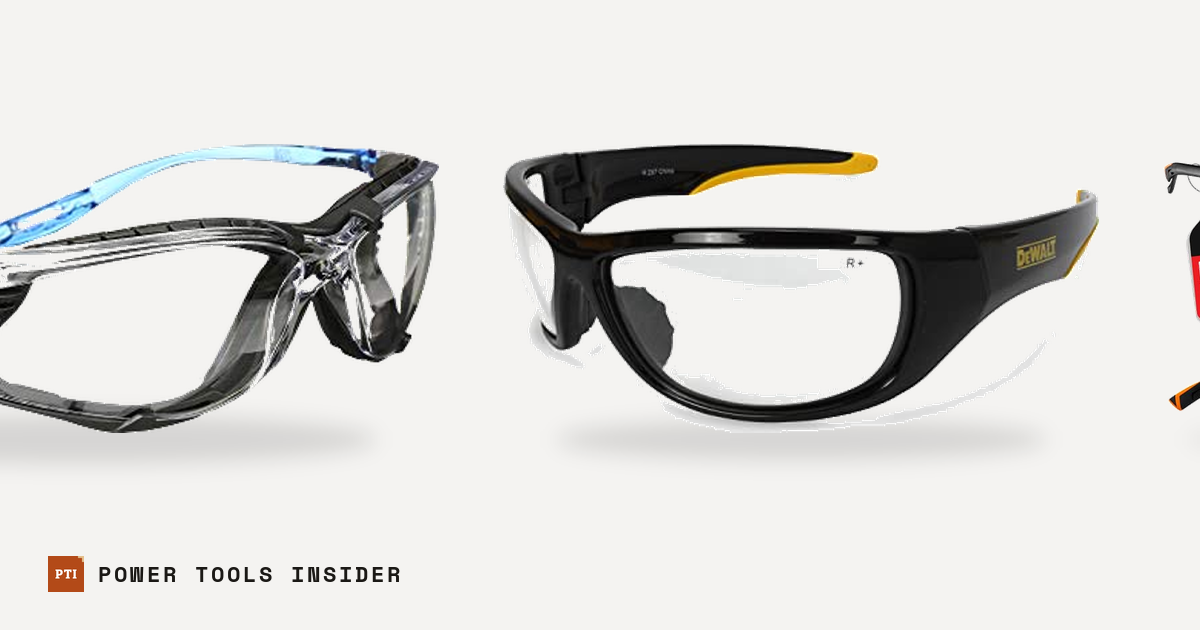
The DEWALT Dominator is the safety glasses equivalent of a reliable cordless drill: it does everything well, nothing flashy, and you can afford to keep a pair at every workstation. The full-frame wraparound design gives you noticeably more coverage than half-frame styles, and the expanded lens means less of that annoying frame-in-your-peripheral-vision problem.
Rubber-tipped temples and an integrated rubber nosepiece keep these locked on your face even when you are looking straight down at a circular saw cut. The polycarbonate lens provides 99% UV protection and meets ANSI Z87.1+ for high-impact resistance. At roughly eight dollars a pair, there is zero excuse not to have a few spares around the shop.
The one knock is no anti-fog coating. In a hot garage or during heavy exertion, you will get some fogging. For most general woodworking, this is not a deal-breaker. For heavy routing or dusty operations where you cannot afford to lift your glasses, consider the Milwaukee or 3M options below.
Pros
- Full-frame wraparound with expanded lens coverage
- Rubber temples and nosepiece prevent slipping
- ANSI Z87.1+ high-impact rated
- Under $10, buy multiples for every workstation
- Available in 6 lens tint options
Cons
- No anti-fog coating
- Not sealed, fine dust can enter from top and bottom
- Basic storage (no case included)
| Spec | Value |
|---|---|
| Lens Material | Polycarbonate |
| ANSI Rating | Z87.1+ |
| UV Protection | 99% UVA/UVB |
| Anti-Fog | No |
| Frame Style | Full-frame wraparound |
| Weight | 0.32 oz (lens and frame) |
Bottom Line: The Dominator is the best all-around safety glasses for woodworkers who want solid protection without overthinking it. At this price, you can stash a pair at every tool station.
Milwaukee 48-73-2040 Performance, Best for Pros
Price: ~$30 | Rating: 4.7/5
Milwaukee built these for job-site abuse, and it shows. The fog-free lenses actually work, they use a permanent anti-fog treatment that outlasts spray-on alternatives by months. The removable gasket converts these from standard safety glasses to sealed eyewear in seconds, which is a genuine game-changer when you switch between tasks that throw different amounts of debris.
These are tested to MIL-PRF-32432 ballistic fragmentation standards (Class 1), which is military-grade impact protection on top of the standard ANSI Z87.1+ certification. The anti-scratch coating holds up to pocket carry and shop-drawer abuse. If you use Milwaukee power tools, these complement the ecosystem nicely. They are a Home Depot exclusive, so you will not find them on Amazon.
The premium price is the main barrier. At roughly $30, you are paying four times what the DEWALT Dominator costs. But if you work in your shop daily and hate fogged lenses, the Milwaukee pays for itself in not-ripping-your-glasses-off frustration alone.
Pros
- Permanent fog-free lens coating that actually lasts
- Removable gasket for sealed or open wear
- MIL-PRF-32432 ballistic impact rated (beyond Z87.1+)
- Durable anti-scratch lenses
- Comfortable for all-day wear
Cons
- Premium price at ~$30
- Only available at Home Depot
- Gasket can feel warm in hot shops
| Spec | Value |
|---|---|
| Lens Material | Polycarbonate |
| ANSI Rating | Z87.1+ / CSA Z94.3 / MIL-PRF-32432 |
| UV Protection | 99% UVA/UVB |
| Anti-Fog | Yes, permanent fog-free coating |
| Frame Style | Wraparound with removable gasket |
| Gasket | Removable foam gasket |
Bottom Line: The Milwaukee 48-73-2040 is the safety glasses upgrade for daily shop users who are tired of fogging issues. The removable gasket and mil-spec rating justify the price for serious woodworkers.
3M Virtua CCS, Best Anti-Fog System
Price: ~$12 | Rating: 4.5/5
The 3M Virtua CCS does something clever that no other glasses on this list attempt: it integrates a corded earplug control system (CCS) right into the temples. The earplugs clip to the frame so they are always there when you need them and never tangled in a drawer. For woodworkers who bounce between noisy tools like miter saws and quiet hand work, that is a genuine quality-of-life improvement.
The removable foam gasket seals against fine dust and creates a microclimate that the anti-fog coating handles well. The polycarbonate lens absorbs 99.9% of UV and meets both ANSI Z87.1-2015 and CSA Z94.3-2007 standards. Lens dimensions (43mm height, 138mm width) provide solid coverage without the bulk of full goggles.
The frame feels lighter and less industrial than the Milwaukee, which some people prefer for comfort. But it also means the build quality is a step below. The earplug integration is the killer feature here, if you already wear hearing protection in your shop (and you should), this eliminates one more thing to track down before firing up the table saw.
Pros
- Built-in corded earplug system, always ready
- Removable foam gasket for dust sealing
- Anti-fog coating with vented gasket design
- 99.9% UV absorption
- Lightweight and comfortable
Cons
- Earplug system adds bulk to temples
- Foam gasket is not as robust as Milwaukee’s
- Limited lens tint options
| Spec | Value |
|---|---|
| Lens Material | Polycarbonate |
| ANSI Rating | Z87.1-2015 / CSA Z94.3-2007 |
| UV Protection | 99.9% UVA/UVB/UVC |
| Anti-Fog | Yes, anti-fog coating |
| Frame Style | Wraparound with removable foam gasket |
| Lens Dimensions | 43mm H x 138mm W, 127mm temple |
Bottom Line: The 3M Virtua CCS is the smartest buy for woodworkers who want eye and ear protection in one package. The foam gasket and anti-fog coating handle dusty shop environments well.
NoCry OverSpecs, Best Over-Glasses
Price: ~$13 | Rating: 4.4/5
If you wear prescription glasses and have been skipping safety eyewear because nothing fits comfortably over your frames, the NoCry OverSpecs solve that problem. They accommodate prescription frames up to 5.7 inches wide, 1.37 inches tall on the sides, and 1.77 inches tall in the center, which covers the vast majority of eyeglass frames on the market.
The wraparound design with reinforced side shields provides full peripheral coverage without the tunnel-vision feeling some OTG glasses create. Adjustable temples with soft, non-slip tips prevent the dreaded double-frame squeeze headache. The polycarbonate lenses carry UV400 protection and ANSI Z87.1 certification, plus they are treated with both anti-fog and anti-scratch coatings.
NoCry claims these are 5x more fog-resistant and 2x more scratch-resistant than average safety glasses. In practice, the anti-fog holds up well for moderate work but will struggle in very humid conditions. The fit over glasses is genuinely comfortable, most OTG options feel like wearing a fishbowl, but these manage a relatively normal profile. They also come with a limited lifetime warranty, which says something about the build quality at this price point.
Pros
- Fits over prescription frames up to 5.7 in. wide
- Anti-fog and anti-scratch coated lenses
- UV400 protection with ANSI Z87.1 rating
- Adjustable non-slip temples
- Limited lifetime warranty
Cons
- Larger profile than standard safety glasses
- Anti-fog can struggle in extreme humidity
- Side shields reduce airflow (contributes to fogging)
| Spec | Value |
|---|---|
| Lens Material | Polycarbonate |
| ANSI Rating | Z87.1 / OSHA Certified |
| UV Protection | UV400 (99.9%) |
| Anti-Fog | Yes, 5x standard coating |
| Frame Style | Over-glasses wraparound with side shields |
| Fits Frames Up To | 5.7 in. W x 1.77 in. H (center) |
Bottom Line: The NoCry OverSpecs are the go-to for prescription glasses wearers. Comfortable, well-built, and backed by a lifetime warranty. No more excuses to skip eye protection.
Pyramex I-Force Sporty, Best Sealed Goggle
Price: $18.19 | Rating: 4.5/5
The Pyramex I-Force is a hybrid: it ships with both removable temples and an elastic headstrap, so you can wear it as standard safety glasses or convert to full sealed goggles. That versatility makes it ideal for woodworkers who switch between light bench work and heavy dust-producing operations like routing, sanding, or running a table saw.
The standout feature is the dual-pane lens system. The outer polycarbonate lens handles impact protection, while the inner acetate lens prevents fogging. This is the same principle used in ski goggles, and it works dramatically better than any spray-on or single-layer anti-fog coating. In a hot, humid shop, the I-Force stays clear when single-pane glasses are completely fogged over.
The sealed design with the headstrap blocks fine dust from every angle, making this the best option for heavy sanding or working with MDF (which produces especially nasty fine particles). The frame is a bit bulkier than standard glasses, but the dual wear modes give you flexibility. At around $18.19, this is a lot of goggle for the money.
Pros
- Dual-pane lens virtually eliminates fogging
- Converts between glasses and sealed goggles
- Excellent dust sealing with headstrap mode
- ANSI Z87.1+ high-impact rated
- Great value at $18.19
Cons
- Bulkier than standard safety glasses
- Headstrap can interfere with hearing protection
- Can feel warm in sealed mode during long sessions
| Spec | Value |
|---|---|
| Lens Material | Polycarbonate (outer) / Acetate (inner) |
| ANSI Rating | Z87.1+ |
| UV Protection | 99% UVA/UVB/UVC |
| Anti-Fog | Yes, dual-pane thermal barrier |
| Frame Style | Hybrid glasses/goggles with temples + headstrap |
| Seal Type | Full foam seal (goggle mode) |
Bottom Line: The Pyramex I-Force is the best option for dusty operations like sanding and routing. The dual-pane anti-fog system outperforms every coating on the market, and the hybrid design gives you two tools in one.
WORKPRO 3-Pack Anti-Fog, Best Budget
Price: ~$10 (3-pack) | Rating: 4.3/5
Three pairs of ANSI Z87.1+ rated safety glasses for around ten dollars. That is the WORKPRO pitch, and honestly, it is hard to argue with. You get a set of three so you can keep a pair at the workbench, one in the garage, and one in the toolbox. When they get scratched up (and they will), you have backups ready.
The Vanguard Plus anti-fog coating is a nice surprise at this price point. It works well enough for moderate shop conditions, though it will not match the dual-pane system on the Pyramex. The adjustable frames and no-slip grip temples mean these fit a decent range of face shapes. Lens clarity is acceptable, no noticeable distortion, and the impact resistance meets the same Z87.1+ standard as glasses costing three times as much.
The trade-offs are exactly what you would expect at this price. The frame feels less substantial than the DEWALT or Milwaukee, the anti-fog coating wears off faster, and the nose bridge is less adjustable. But for casual DIYers, weekend warriors, or anyone who loses safety glasses faster than they wear them out, the WORKPRO 3-pack is the smart buy.
Pros
- Three pairs for around $10, best per-unit value
- ANSI Z87.1+ rated for high-impact protection
- Anti-fog coating included (Vanguard Plus)
- Adjustable frames with no-slip temples
- Decent optical clarity for the price
Cons
- Frame feels lighter/cheaper than premium options
- Anti-fog coating degrades faster
- Less adjustable nose bridge
- No case or accessories included
| Spec | Value |
|---|---|
| Lens Material | Polycarbonate |
| ANSI Rating | Z87.1+ |
| UV Protection | 99% UVA/UVB |
| Anti-Fog | Yes, Vanguard Plus coating |
| Frame Style | Wraparound with adjustable temples |
| Pack Size | 3 pairs |
Bottom Line: The WORKPRO 3-pack is the best value play. Three Z87.1+ rated pairs for the price of one premium pair means you will always have a clean pair ready. Perfect for the DIYer who wants protection everywhere without spending premium prices.
Full Specs Comparison
| Model | ANSI Rating | Anti-Fog | UV Protection | Seal/Gasket | Over-Glasses | Price |
|---|---|---|---|---|---|---|
| DEWALT DPG94 Dominator | Z87.1+ | No | 99% | No | No | ~$8 |
| Milwaukee 48-73-2040 | Z87.1+ / MIL-PRF-32432 | Permanent fog-free | 99% | Removable gasket | No | ~$30 |
| 3M Virtua CCS | Z87.1-2015 | Anti-fog coating | 99.9% | Removable foam gasket | No | ~$12 |
| NoCry OverSpecs | Z87.1 | 5x anti-fog coating | UV400 | Side shields only | Yes (up to 5.7 in.) | ~$13 |
| Pyramex I-Force | Z87.1+ | Dual-pane thermal | 99% | Full foam seal | No | ~$15 |
| WORKPRO 3-Pack | Z87.1+ | Vanguard Plus coating | 99% | No | No | ~$10 (3-pack) |
All prices are approximate as of February 2026 and may vary by retailer.
Safety Glasses Buying Guide for Woodworkers
Anti-Fog Coatings: Why They Matter More Than You Think
Fogged lenses are the number one reason woodworkers take off their safety glasses mid-cut. There are three tiers of anti-fog technology: spray-on treatments (reapply every few hours), permanent single-layer coatings (built into the lens, last months), and dual-pane thermal barriers (two lenses with an air gap, like ski goggles). If you work in a garage that swings between cold mornings and sweaty afternoons, spend the extra few dollars on real anti-fog.
Fit and Comfort for All-Day Wear
Safety glasses only work if you actually wear them. Look for: rubber or silicone nose pads (prevent sliding when you sweat), adjustable temples (accommodate different head sizes), and lightweight frames under 2 oz. If the glasses pinch your temples after 20 minutes, you will not wear them for a 4-hour project. Try multiple pairs if you can, face shapes vary wildly, and what fits your buddy perfectly might not work for you.
Wearing Safety Glasses with Hearing Protection
This is where most PPE setups fall apart. Over-ear muffs press against the temples of safety glasses, breaking the seal and creating pressure points. Solutions: use slim-temple glasses (like the DEWALT Dominator), switch to in-ear plugs when wearing sealed goggles, or get the 3M Virtua CCS with its integrated earplug system. The Pyramex I-Force headstrap also plays well with over-ear muffs since it eliminates the temple conflict entirely.
When to Choose Sealed vs. Open Glasses
Open glasses are fine for drilling, fastening, light sanding, and general assembly work. Switch to sealed eyewear (gasket or goggle) for: router work, heavy sanding, working with MDF or particle board, angle grinder operations, or any task that creates fine airborne particles. A good rule of thumb: if you can see dust floating in the air after the cut, you need sealed eye protection.
Lens Replacement and Maintenance
Replace safety glasses when the lens has visible scratches that affect your vision, the anti-fog coating has worn off, or the frame is bent or cracked. Clean lenses with lukewarm water and a microfiber cloth, never use paper towels (they scratch polycarbonate). Store glasses in a case or hang them lens-down to prevent surface scratches. At the prices on this list, there is no reason to push a worn-out pair past its useful life.
Frequently Asked Questions
Do I really need safety glasses for woodworking?
Yes. The Bureau of Labor Statistics reports that about 20,000 workplace eye injuries occur annually in the US, and woodworking is one of the highest-risk activities. Flying wood chips, sawdust, and broken bits can cause permanent eye damage. Safety glasses are the cheapest and most effective piece of PPE in your shop.
What does ANSI Z87.1+ mean on safety glasses?
ANSI Z87.1 is the American National Standards Institute standard for eye protection. The “+” indicates the glasses passed the high-velocity impact test, where a quarter-inch steel ball is fired at the lens at 150 feet per second. For power tool work, always choose Z87.1+ rated glasses. The rating should be marked on both the lens and the frame.
How do I stop my safety glasses from fogging up?
Three options, from least to most effective: apply anti-fog spray or wipes every few hours, buy glasses with a permanent anti-fog lens coating (like the Milwaukee 48-73-2040), or use dual-pane glasses like the Pyramex I-Force that have a thermal barrier between two lenses. Proper ventilation in your shop also helps, and avoid pushing glasses tight against your face as some airflow prevents fogging.
Can I wear safety glasses over my prescription glasses?
Yes, over-the-glasses (OTG) safety glasses like the NoCry OverSpecs are designed specifically for this. They have larger frames and extra clearance to fit over standard prescription eyewear. Look for adjustable temples to avoid the double-frame squeeze. Alternatively, you can get prescription safety glasses made with Z87.1 rated polycarbonate lenses from your optometrist.
How often should I replace my safety glasses?
Replace safety glasses when the lens has scratches that impair your vision, the anti-fog coating has worn off, or the frame is bent, cracked, or no longer fits snugly. After any direct impact (a flying wood chip hits the lens hard), replace them immediately even if they look fine, as micro-fractures can compromise impact resistance. For regular shop use, most woodworkers replace glasses every 6 to 12 months.
Are clear or tinted lenses better for shop work?
Clear lenses are the best default for indoor shop work because they provide maximum light transmission. Amber or yellow tinted lenses can improve contrast in dim garages or workshops with poor lighting. Smoke or gray tinted lenses are best for outdoor work where you need glare reduction. If you only buy one pair, go with clear. Many of the glasses on this list are available in multiple tint options.
Power Tool Insider is reader-supported. When you buy through links on our site, we may earn an affiliate commission at no extra cost to you. This doesn’t affect our recommendations, we only recommend tools we’d actually use. Full disclosure.