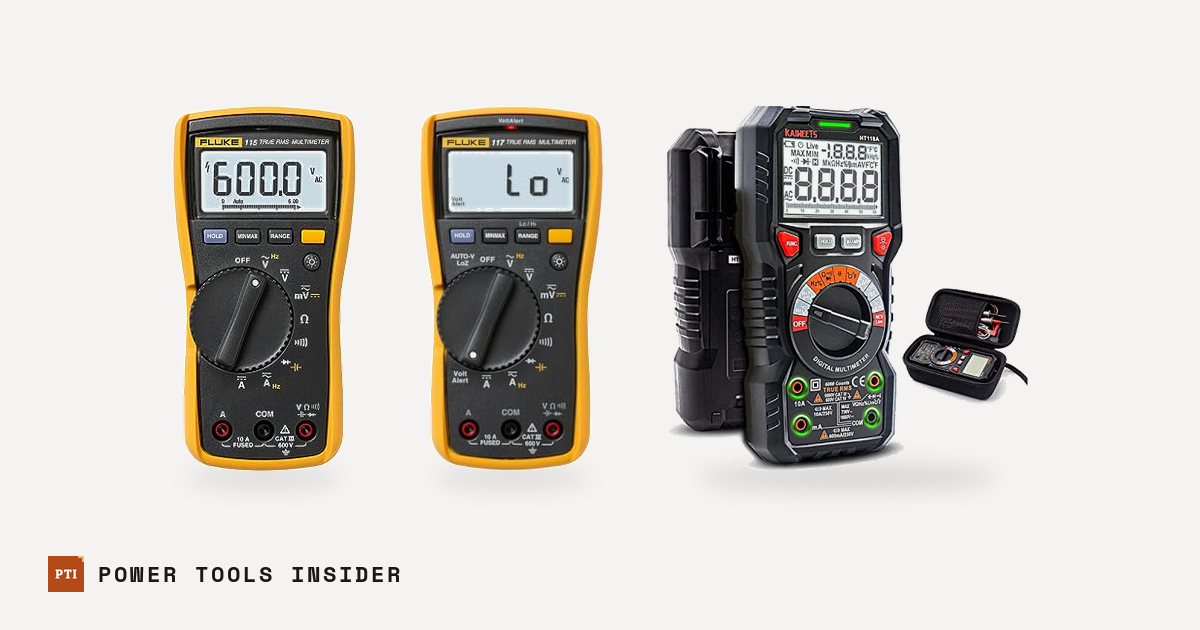
This guide cuts straight to the three multimeters that make sense for real electrical work in 2026, across skill levels. If you know you need Fluke, both options are below. If you want capable True RMS accuracy without spending $200, the KAIWEETS is it.
| Award | Model | Price | Best For | Buy |
|---|---|---|---|---|
| Best for Electricians | Fluke 117 | ~$252 | Electricians, HVAC, serious DIYers, LoZ ghost voltage detection, CAT IV rated | Buy Now |
| Best Mid-Range | Fluke 115 | ~$217 | Home repairs, appliance troubleshooting, serious DIYers, True RMS accuracy without the electrician premium | Buy Now |
| Best Budget Pick | KAIWEETS HT118A | ~$41 | Homeowners, occasional use, first multimeter, True RMS at a fraction of Fluke cost | Buy Now |
Most electricians and serious DIYers have two complaints about multimeters: the cheap ones lie to you, and the expensive ones are overkill for anything short of licensed electrical work. Both are true. A $15 meter from the hardware store will give you a ballpark voltage reading, but it can’t measure True RMS accurately on motors, dimmers, or HVAC equipment, which is exactly where you need the reading to be right. On the other end, a Fluke 87-V is a fine tool for journeymen, but nobody doing home renovations needs a $350 multimeter. This guide covers the three picks that actually make sense in 2026, across every skill level.
What to Look for in a Multimeter
True RMS vs Average-Responding
This is the spec that separates useful meters from misleading ones. Average-responding multimeters, which includes most cheap meters, are calibrated to measure pure sine wave AC. The problem is that real-world loads aren’t pure sine waves. Variable-speed motor drives, dimmers, LED drivers, and HVAC compressors produce non-sinusoidal waveforms. An average-responding meter reading a VFD output might show 118V when the actual RMS voltage is 132V. That’s not just inaccurate, it’s a diagnostic problem when you’re troubleshooting.
True RMS meters calculate the correct RMS value regardless of waveform shape. Every meter in this guide is True RMS. If a meter you’re looking at doesn’t explicitly say “True RMS,” assume it isn’t, and factor that into whether it’s actually useful for your work. For electronics repair and soldering work, accuracy matters just as much: see our best cordless soldering iron guide for context on what tolerances matter in electronics.
CAT Safety Ratings
CAT ratings tell you what environment a meter is designed to withstand safely. Higher CAT number = designed for higher-energy circuits. The four levels:
- CAT I: Protected electronic equipment (signal and control circuits)
- CAT II: Single-phase receptacle loads, appliances, outlets, portable equipment. Fine for home outlet testing.
- CAT III: Three-phase distribution, bus bars, panel feeders. Use this for panel work and commercial wiring.
- CAT IV: Origin of installation, service entrance, utility meter, outdoor conductors. Required for utility-level work.
For most DIY homeowners doing outlet checks and appliance troubleshooting, CAT II is technically sufficient. But CAT III at 600V is the standard recommendation for any work near a panel, the voltage on a 240V circuit can deliver a lethal arc flash that a CAT II meter isn’t designed to handle. Both Fluke models in this guide are rated CAT III 600V minimum, with the Fluke 117 adding CAT IV 300V on top. The KAIWEETS is CAT III 600V.
LoZ Mode (Low Impedance)
Ghost voltage is the bane of any electrician doing rough-in work. Standard multimeters have very high input impedance, which means they can register induced voltage on a wire that isn’t actually energized, picked up from adjacent live conductors through capacitive coupling. You’ll see 20, 30, sometimes 60 volts on a wire that’s switched off. That leads to mislabeled circuits, wasted time, and safety near-misses.
LoZ mode drops the meter’s input impedance, which pulls the ghost voltage down to near zero on truly de-energized wires. If there’s real voltage present, it still reads correctly. If it was just induced ghost voltage, the reading collapses. The Fluke 117 has a dedicated LoZ mode. The Fluke 115 and KAIWEETS do not, which is a genuine trade-off, not a minor omission, if you’re doing any rough-in electrical work.
Auto-Ranging vs Manual Ranging
Auto-ranging meters select the correct measurement range automatically. You dial to “ACV,” probe the outlet, and read 120V. Manual-ranging meters require you to pre-set the range, pick a range that’s too low and you get an overload reading; too high and you lose resolution. All three meters in this guide auto-range. There’s no reason to buy manual-ranging in 2026 unless you’re doing specialized work that requires a specific fixed range for speed.
Our Top Picks
Fluke 117, Best for Electricians (~$252)

Price: ~$252 | Buy Now on Amazon
The Fluke 117 is the meter Fluke designed specifically for licensed electricians working in commercial and residential environments. Two features set it apart from every other meter in this price range: LoZ mode and VoltAlert. LoZ mode handles ghost voltage, as described above, this alone makes the 117 worth the premium for anyone doing circuit tracing or rough-in work. VoltAlert is a built-in non-contact voltage detector: a small LED indicator on the top of the meter glows red when AC voltage is present near the probe tip. You get that confirmation before you even make contact with the circuit.
The AutoVolt feature automatically switches between AC and DC voltage measurement, which removes one dial rotation from every measurement. Small thing on paper, but if you’re doing service work and reading 50 circuits in a day, it adds up. The 400-hour battery life means you’re replacing the battery maybe twice a year in daily use. CAT III 600V / CAT IV 300V covers everything from outlet circuits to service entrances.
Pros
- LoZ mode eliminates ghost voltage misreads
- VoltAlert non-contact voltage indicator built in
- CAT IV 300V, safest rating tier for electrical work
- AutoVolt auto-switches AC/DC
- 400-hour battery life, white LED backlight
Cons
- No capacitance measurement
- No temperature measurement
- $50 more than the Fluke 115 for features most DIYers won’t use
Fluke 115, Best Compact Pick (~$204)

Price: ~$204 | Buy Now on Amazon
The Fluke 115 is the compact field technician version of the same True RMS platform. It measures voltage, current, resistance, continuity, frequency, and capacitance with the same accuracy as the 117, what it gives up is the LoZ mode and the VoltAlert non-contact detector. For a field technician troubleshooting equipment rather than wiring circuits, those omissions usually don’t matter. The 115 is also slightly more compact, which matters when you’re pulling it in and out of a tool bag all day.
The Min/Max/Average recording function is genuinely useful for catching intermittent faults, set it and walk away, come back to see the full range of readings over a period. CAT III 600V covers any work short of service entrance panels. If you’re a serious DIYer who’s upgraded past the basics and wants a meter that will outlast the house, the 115 is the right price-performance pick. Note the current Amazon price of ~$204 represents significant savings from the retail list price, check the live price before buying.
Pros
- True RMS accuracy at a lower price than the 117
- Min/Max/Average recording catches intermittent faults
- More compact form factor than the 117
- Includes capacitance and frequency measurement
- CAT III 600V, rated for panel work
Cons
- No LoZ mode, ghost voltage can be a problem on rough-in work
- No built-in non-contact voltage detector
- Still $160+ more than the KAIWEETS for occasional DIY use
KAIWEETS HT118A, Best Budget (~$41)

Price: ~$41 | Buy Now on Amazon
KAIWEETS is an Amazon-native brand, which means their products exist almost exclusively through Amazon with zero retail markup. The HT118A is a True RMS auto-ranging meter at a price point where most competing meters aren’t True RMS at all. It measures up to 1000V DC / 750V AC, 10A AC/DC current, up to 60MΩ resistance, temperature, capacitance, frequency, duty cycle, diode testing, and continuity, the full range of measurements you’d need for home electrical troubleshooting and automotive diagnostics.
The 6,000-count LCD display with backlight gives you better resolution than the standard 4,000-count found on many budget meters. Comes with a carrying case and a 36-month warranty. The CAT III 600V rating is solid for a $41 meter. The trade-offs are accuracy over time (Fluke meters are known to hold calibration for decades; Amazon-native brands have shorter track records) and no LoZ mode. For a homeowner checking outlets, testing a car battery, or verifying a circuit is dead before a repair, the KAIWEETS does that job at a fraction of the price. If you’re also doing MIG welding and want to check your welder’s voltage draw, this meter handles that; see our MIG welder guide for what to look for in a setup.
Pros
- True RMS at a sub-$50 price, uncommon at this tier
- 6,000-count display (higher resolution than most budget meters)
- Full measurement suite: voltage, current, resistance, temp, capacitance, frequency
- Includes carrying case
- 36-month warranty
Cons
- No LoZ mode
- Accuracy calibration longevity unproven vs Fluke’s decades-long track record
- Not appropriate for commercial electrical work or troubleshooting VFD systems
Fluke 115 vs Fluke 117: Which Should You Buy?
The honest answer depends on whether ghost voltage is a problem in your work. Here’s the decision tree:
- Licensed electrician doing rough-in, circuit tracing, or panel work Fluke 117. LoZ mode is not optional for this work. VoltAlert is a safety bonus.
- HVAC technician or field service tech Fluke 117. Variable-speed compressors and drives produce the non-sinusoidal waveforms where LoZ mode matters most.
- Serious DIYer doing their own panel upgrades and outlet work Fluke 115 is fine if you understand that ghost voltage can produce false readings, and you verify with a separate non-contact tester. The $50 savings is real.
- General hobbyist, homeowner, automotive DIYer KAIWEETS HT118A. The Fluke build quality is better, but the KAIWEETS True RMS accuracy is more than adequate for the vast majority of tasks.
Both Fluke models use the same measurement engine and carry the same brand reliability. If you’re on the fence between the 115 and 117 specifically because of the LoZ mode question, buy the 117, the $50 difference is small relative to the value of avoiding a ghost-voltage diagnostic error on a job. If you’ve been doing electrical work for years without a LoZ meter and haven’t had a problem, the 115 fits your workflow and saves you money. Either way, both are the same platform with the same long-term reliability you’d expect from Fluke.
If you’re building out a complete measurement toolkit, a multimeter pairs naturally with a quality laser level (for layout work) and a tape measure. See our best laser levels guide and best tape measures guide for the rest of the toolkit.
Frequently Asked Questions
What is True RMS and why does it matter for a multimeter?
True RMS (Root Mean Square) is the correct method for calculating the equivalent DC heating value of an AC waveform. Average-responding meters only measure accurately on pure sine waves, the type produced by utility power. Modern loads like variable-speed drives, inverters, dimmers, and switching power supplies produce non-sinusoidal waveforms. A non-True-RMS meter can be off by 10, 40% on these loads, which makes it useless for diagnosing real problems. Any meter you use for actual electrical work should be True RMS.
What CAT rating do I need for home electrical work?
CAT II is the minimum for outlet testing and appliance work. For anything involving your main panel, subpanels, or the wiring behind outlets and switches, use CAT III 600V or better. The Fluke 115 and 117 are both CAT III 600V minimum. The KAIWEETS HT118A is also CAT III 600V. CAT IV is only required for work at the utility meter or service entrance, most homeowners and electricians never need it, though the Fluke 117’s CAT IV 300V rating doesn’t hurt.
Can I use these multimeters to test a car battery?
Yes. All three meters can measure DC voltage, making them suitable for battery testing. A healthy 12V car battery should read 12.6V at rest (fully charged) and 13.7, 14.7V when the engine is running (charging voltage). All three meters handle this measurement without issue. The KAIWEETS HT118A includes temperature measurement, which can be useful for cold-start battery diagnostics.
Is the KAIWEETS HT118A accurate enough for real electrical work?
For home DIY tasks, outlet testing, checking if a circuit is live, measuring battery voltage, continuity checks, yes. The True RMS specification and 6,000-count display provide accuracy that exceeds most homeowner needs. Where we wouldn’t rely on it is in professional electrical or HVAC service work where calibration traceability matters, or in troubleshooting VFD and motor drive systems where LoZ mode is essential. It’s a solid meter for its price point, not a replacement for a Fluke if your livelihood depends on the reading.
What’s the difference between LoZ mode and a standard voltage measurement?
Standard multimeters have very high input impedance, typically 10MΩ, which minimizes the meter’s effect on the circuit being measured. That high impedance also allows the meter to pick up induced “ghost” voltages from adjacent live conductors through capacitive coupling. You can see 20, 80V on a completely de-energized wire in a multi-conductor conduit. LoZ mode drops the input impedance to roughly 3kΩ or less. This drains the ghost voltage to near zero on an open circuit, while still reading actual voltage correctly if a real source is present. It’s a simple, quick way to confirm whether a wire is actually energized before touching it, which is why it matters for electricians working in existing buildings with dense wiring.