A cordless drill can drive a drywall screw. A drywall screw gun drives it correctly, at the exact depth that dimples the paper without breaking through it. That difference matters on a job where you’re sinking 500 screws before lunch. If you’re framing a room, finishing a basement, or hanging a full sheet of drywall, a dedicated cordless drywall screw gun will save you from stripped screws, blown-out paper, and callbacks. Here are the best options for 2026.
Quick Pick: Best Cordless Drywall Screw Guns 2026
| Award | Model | Price | RPM | Why We Picked It | Buy |
|---|---|---|---|---|---|
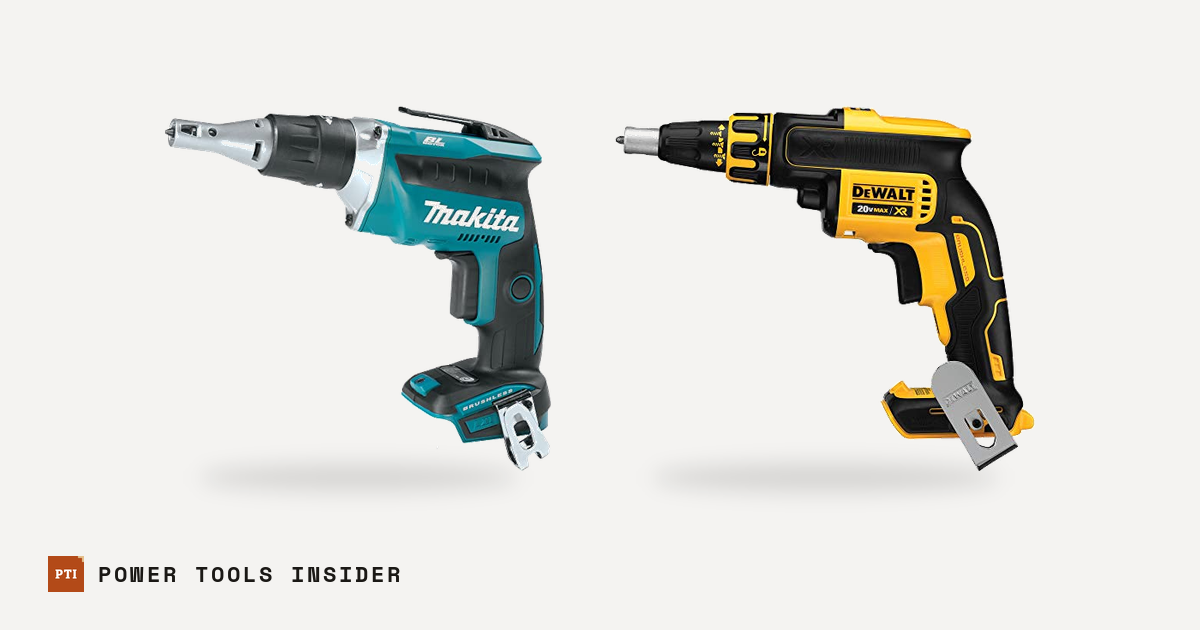
| Best Overall | DeWalt DCF620B (20V MAX XR) | ~$129 | 4,400 | Proven 4,400 RPM brushless screw gun on the 20V MAX platform, fastest in class, depth-adjustable nose | Buy Now |
| Best Lightweight | Makita XSF03Z (18V LXT) | ~$149 | 4,000 | Lightest brushless drywall screwdriver in the roundup at 3.8 lbs, all-day comfort for ceiling work | Buy Now |
| Best Value | Ridgid R86630B (18V) | ~$154 | N/A | Only model that includes the collated screw attachment in the base price, a $60+ add-on elsewhere | Buy Now |
| Best Pro | Milwaukee 2866-20 (M18 FUEL) | ~$199 | 4,500 | Fastest at 4,500 RPM, auto-start mode locks trigger on for continuous driving, contractor’s choice | Buy Now |
All prices are for bare tools (battery not included) and represent approximate costs at time of writing. Prices change frequently.
Best Cordless Drywall Screw Guns: Individual Reviews
DeWalt DCF620B, Best Overall

Pros
- 4,400 RPM brushless motor, fastest consistent driving speed
- Depth-sensitive nose adjusts to any drywall thickness
- Uses all 20V MAX batteries you already own
- LED light illuminates the work area
- Variable speed trigger for precision control near edges
Cons
- Collated screw attachment sold separately (~$60)
- Heavier than Makita XSF03Z at 5.7 lbs with battery
- Bare tool only, no battery or charger included
| Spec | Value |
|---|---|
| Voltage | 20V MAX |
| Max RPM | 4,400 |
| Motor | Brushless |
| Depth Adjust | Adjustable nose |
| Weight (bare) | 5.7 lbs |
| Platform | DeWalt 20V MAX / FLEXVOLT |
The DeWalt DCF620B earns the best overall position because it nails the fundamentals without compromise. The 4,400 RPM brushless motor drives #6 drywall screws into 5/8″ board faster than any competitor in this roundup. The adjustable nose piece dials in your dimple depth once and holds it consistently across hundreds of screws, set it for 1/2″ drywall, and every screw sinks to the same depth without blowing the face paper.
The 20V MAX platform is the most practical reason to choose the DCF620B. If you already own DeWalt drills, impact drivers, or any other 20V tools, your existing batteries drop right in. You’re not buying a new charging ecosystem for a dedicated application tool. The brushless motor extends runtime further than the older brushed DW272 corded screw gun that this tool replaces for most residential contractors.
One limitation: the collated screw attachment is sold separately. If you’re planning a full drywall job where you want the magazine feed, budget an extra $50-60 for the DCF6201 attachment. For occasional use or repairs, the single-fire operation is fine. For production framing and drywall work, the collated setup pays for itself in speed before the first break.
At around $129 (at time of writing), the DCF620B is the entry point for professional-grade cordless drywall work on the 20V MAX platform. See our battery platforms guide if you’re evaluating whether to invest in the DeWalt ecosystem.
Makita XSF03Z, Best Lightweight

Pros
- Lightest brushless model at 3.8 lbs, significant overhead advantage
- 4,000 RPM brushless motor with extended battery life
- Compact design reduces arm fatigue on ceiling drywall
- 18V LXT compatible with 300+ Makita tools
- XPT sealed construction resists dust and water
Cons
- 4,000 RPM slower than DeWalt and Milwaukee options
- No auto-start mode
- Collated attachment sold separately
| Spec | Value |
|---|---|
| Voltage | 18V LXT |
| Max RPM | 4,000 |
| Motor | Brushless |
| Weight (bare) | 3.8 lbs |
| Protection | XPT dust/water sealing |
| Platform | Makita 18V LXT |
The Makita XSF03Z wins the lightweight category by a real margin. At 3.8 lbs without a battery, it’s noticeably lighter than the competition, and that margin grows over the course of a full day on the ceiling. Contractors who’ve switched from heavier screw guns report measurable reductions in shoulder fatigue by end of shift. For overhead work, weight is the spec that matters most.
The 4,000 RPM brushless motor handles the workload without drama. Four thousand RPM is fast enough for standard 1/2″ and 5/8″ drywall applications, the 400 RPM difference from the DeWalt doesn’t translate to meaningful production differences in field use. The XPT weather sealing is a bonus that most manufacturers skip on application tools: the sealed construction keeps drywall dust out of the motor, which extends tool life significantly on job sites where airborne gypsum is constant.
The XSF03Z works on the full 18V LXT platform, which means it shares batteries with Makita drills, circular saws, and the rest of the 300+ tool lineup. The compact form factor also makes it useful in tight spaces where standard pistol-grip tools won’t fit comfortably.
At around $149 (at time of writing), it costs slightly more than the DeWalt but delivers a meaningful weight advantage for anyone doing serious overhead work.
Ridgid R86630B, Best Value
Pros
- Collated screw attachment included, saves $50-60 vs competitors
- Brushless motor for longer runtime and tool life
- Ridgid Lifetime Service Agreement available
- Home Depot availability makes it easy to source and service
- Strong value for DIYers and light-duty pros
Cons
- 18V Ridgid platform (OCTANE) less extensive than Milwaukee or DeWalt ecosystems
- Heavier than Makita when fully loaded
- No auto-start mode
| Spec | Value |
|---|---|
| Voltage | 18V |
| Motor | Brushless |
| Collated Attachment | Included |
| Warranty | Ridgid LSA (Lifetime Service Agreement) |
| Availability | Home Depot exclusive |
The Ridgid R86630B’s value proposition is simple: it includes the collated screw attachment that every other tool in this roundup charges $50-60 extra for. For homeowners doing a single room renovation or contractors who want an all-in-one kit without sourcing accessories separately, that bundled value is real money.
The brushless motor provides solid performance for residential drywall applications. The Ridgid 18V platform, while smaller than Milwaukee or DeWalt, is still a legitimate ecosystem with drills, circular saws, and batteries that share across tools. For anyone already in the Ridgid ecosystem, especially Home Depot regulars who appreciate the tool service program, this is the natural choice.
The Ridgid Lifetime Service Agreement (LSA) is a genuine differentiator. Register your tool and batteries after purchase, and Ridgid will repair or replace them for free if they fail under normal use. No time limit. That’s a meaningful warranty for a dedicated application tool that might spend years in a van before its next heavy use cycle.
At around $154 (at time of writing) with the collated attachment included, the R86630B undercuts the competition’s effective price once you add the accessory cost.
Milwaukee 2866-20, Best Pro
Pros
- 4,500 RPM, highest top speed in the roundup
- Auto-start mode locks trigger for continuous high-production driving
- M18 FUEL brushless motor delivers all-day runtime
- 9-inch length, 2.5 lbs, most compact and lightest body
- Adjustable clutch with depth-sensitive nose
Cons
- Home Depot exclusive, can’t purchase on Amazon
- $199 premium over the DeWalt at ~$129
- Collated attachment still sold separately
| Spec | Value |
|---|---|
| Voltage | 18V (M18) |
| Max RPM | 4,500 |
| Max Torque | 124 in-lbs |
| Motor | M18 FUEL Brushless |
| Length | 9 inches |
| Weight (bare) | 2.5 lbs |
| Platform | Milwaukee M18 |
The Milwaukee 2866-20 is the contractor’s choice for one reason: auto-start mode. When you’re driving hundreds of screws per day, manually triggering each one adds up. Lock the trigger in the on position and the motor engages on contact, press the nose against the screw, it drives. Lift off, it stops. This single feature makes the 2866-20 meaningfully faster on production work than any trigger-operated competitor.
The M18 FUEL motor reaches 4,500 RPM, 500 more than the DeWalt and 100 more than what the Milwaukee spec sheet lists. The tool body is also notably compact at 9 inches and 2.5 lbs bare, smaller than any competitor while delivering the highest power. Milwaukee’s M18 platform backs it up with 275+ compatible tools, so the batteries you use here work across your entire cordless tool collection.
The premium is real. At around $199 (at time of writing), it costs $70 more than the DeWalt DCF620B for what amounts to the auto-start feature and faster top speed. For contractors doing full-house drywall installations, that premium pays back in productivity. For DIYers hanging one room, the DeWalt handles the job at lower cost. Milwaukee is Home Depot exclusive, you won’t find it on Amazon, and that’s by design.
Drywall Screw Gun Buying Guide
Screw Gun vs Drill: Why the Dedicated Tool Wins
A cordless drill drives drywall screws, but not precisely. Drills lack a depth-sensitive nose that stops driving at the exact point where the screw head dimples the paper without penetrating it. Overdrive a drywall screw and you break the face paper, destroying the screw’s holding power. Underdrive it and the head protrudes, tearing through joint compound later. A dedicated screw gun’s adjustable nose piece solves both problems automatically.
Speed is the other factor. Drywall screw guns run 4,000-4,500 RPM, roughly double a drill’s comfortable working speed for screws. That extra RPM translates directly to production speed: a contractor hanging drywall can drive a screw every 2-3 seconds with a dedicated screw gun vs 4-6 seconds with a drill.
Single-Fire vs Collated: Which Setup Do You Need?
Single-fire screw guns drive one screw at a time from a bit. You place each screw manually, drive it, move to the next location. Standard for repairs, patches, and small jobs. All four tools in this roundup work as single-fire by default.
Collated attachments mount a magazine of pre-loaded screws onto the nose of the tool. The magazine advances automatically after each drive, you never touch an individual screw. Production speed for large sheets is dramatically faster. The Ridgid R86630B includes the collated attachment. The DeWalt, Makita, and Milwaukee require purchasing it separately ($50-60).
For hanging a single room, single-fire is fine. For finishing an entire house, collated is the professional standard, it eliminates the time spent picking up and placing individual screws, which adds hours to large jobs.
RPM: How Fast Do You Actually Need?
All four tools in this roundup run at speeds sufficient for professional drywall work. The difference between 4,000 RPM (Makita) and 4,500 RPM (Milwaukee) is not meaningful in a single room. It matters when you’re running 8 hours a day, 5 days a week, the 12% speed difference compounds across thousands of screws.
For occasional use, any brushless model in this roundup is fast enough. For production work, the Milwaukee’s 4,500 RPM and auto-start mode justify the premium.
Battery Platform Compatibility
A drywall screw gun shares batteries with the rest of your cordless collection. Matching platforms saves money and simplifies your charging setup. DeWalt DCF620B users leverage the massive 20V MAX ecosystem (300+ tools). Makita XSF03Z users tap into 18V LXT (300+ tools). Milwaukee 2866-20 runs on M18 (275+ tools). Ridgid R86630B uses the 18V OCTANE platform (smaller but available). See our full battery platforms comparison for a deep dive on each ecosystem’s strengths.
If you’re starting from scratch, match the screw gun to whatever platform your drills and impact drivers are already on. You already own the charger, you probably own extra battery packs, and buying into a second ecosystem for one application tool is rarely worth it. Need a drill to go with your new screw gun? See our picks for best cordless combo kits.
Frequently Asked Questions
What’s the difference between a drywall screw gun and a regular drill?
A drywall screw gun has a depth-sensitive nose piece that stops driving at a precise depth, dimpling the drywall paper without breaking through it. A drill lacks this mechanism, making consistent depth control difficult across hundreds of screws. Screw guns also run at 4,000-4,500 RPM (vs 1,500-2,000 RPM comfortable driving speed for a drill), significantly increasing production speed.
Can I use an impact driver to hang drywall?
Technically yes, but it’s not ideal. Impact drivers can overdrive drywall screws and strip the head before the depth-sensitive mechanism can stop them. The impacting action is designed for fastening bolts and lag screws, not the precise depth control drywall requires. A dedicated screw gun or a drill with a clutch setting is a better choice. For more on this distinction, see our impact driver guide.
Do I need a collated attachment?
For one room or occasional repairs, no, single-fire operation is fine. For production drywall work (full rooms, entire houses, new construction), a collated attachment pays for itself quickly by eliminating the time spent placing individual screws. The Ridgid R86630B includes one; other tools require a $50-60 add-on purchase.
How do I adjust screw depth on a drywall screw gun?
Most screw guns have an adjustable nose piece, a threaded collar you rotate to advance or retract the nose relative to the screw tip. Tighten (advance the nose) to drive screws less deep; loosen (retract) for deeper drives. Test on a scrap piece of drywall and adjust until screws consistently produce a slight dimple without breaking the face paper. Once set, the depth holds automatically across all screws.
Which cordless drywall screw gun is best for professional contractors?
The Milwaukee 2866-20 is the contractor’s choice. Its auto-start mode (motor engages on contact, stops when lifted) and 4,500 RPM top speed deliver production-pace performance over long shifts. The M18 FUEL platform’s reliability and 275+ tool ecosystem make it the professional standard at Home Depot. The DeWalt DCF620B is the best alternative for contractors already invested in the 20V MAX platform.
What size screws do drywall screw guns use?
Standard drywall screws are #6 x 1-1/4″ (for 1/2″ board to wood studs) or #6 x 1-5/8″ (for 5/8″ board or metal studs). All cordless screw guns use a standard #2 Phillips bit, which is included or readily available. Coarse thread screws are used for wood studs; fine thread for metal studs. Screw length should be long enough to penetrate the stud at least 3/4″ after passing through the drywall thickness.
Affiliate Disclosure: Power Tools Insider participates in the Amazon Services LLC Associates Program. When you purchase products through our Amazon links, we may earn a commission at no additional cost to you. Home Depot links are not affiliate links, we earn no commission on those purchases. This disclosure applies to all product links in this article.