You’ve narrowed it down to two of the most trusted cordless tool brands on the market. Now you need to pick one, because mixing platforms means buying twice as many batteries. This guide cuts through the marketing and gives you a straight answer: DeWalt or Makita?
The short version: DeWalt is the better choice for DIYers and contractors who want maximum power and a massive tool selection. Makita wins for tradespersons who prioritize compact size, precision, and a polished 18V ecosystem. Keep reading for the full breakdown.
DeWalt vs Makita at a Glance
| Feature | DeWalt | Makita |
|---|---|---|
| Main Platform | 20V MAX | 18V LXT |
| Pro Platform | 60V FLEXVOLT | 40V XGT |
| Battery Crossover | FLEXVOLT works in 20V tools (reduced power) | 18V LXT and 40V XGT are separate ecosystems |
| Tool Count (main line) | 200+ tools | 275+ tools |
| Warranty | 3-year limited | 3-year limited |
| Entry Combo Kit Price | ~$180 (DCK240C2) | ~$249 (XT281S) |
| Flagship Drill Price | $236 (DCD999B) | $169 (XFD131) |
| Best For | Power, versatility, big-box access | Precision trades, compact form factor |
| Main Retailers | Amazon, Home Depot, Lowe’s | Amazon, Home Depot |
Battery Platform: 20V MAX vs 18V LXT
The battery ecosystem is the most important decision you’ll make, it locks you into a brand for years. Here’s what each platform actually means in practice.
DeWalt 20V MAX uses 20 volts nominal (18V under load, like all lithium-ion tools). The platform covers everything from $99 drills to $600 table saws, and the FLEXVOLT system is genuinely clever: one FLEXVOLT 60V battery works in both 20V tools and dedicated 60V tools. If you ever need a 60V circular saw or miter saw, your existing batteries already work. DeWalt also offers the most interchangeable battery lineup of any brand, with POWERSTACK compact batteries, standard 5.0Ah packs, and high-capacity 9.0Ah options.
Makita 18V LXT is the most-copied battery platform in the industry, 275+ compatible tools, and every major trade has a dedicated LXT tool. Star Protection computer controls communicate between the battery and tool in real time to protect against overload, overheating, and over-discharge. Where Makita loses points: the 40V XGT platform (their professional high-power line) uses a completely different battery, so you can’t mix ecosystems. That’s not a problem unless you want to eventually upgrade to 40V outdoor power tools.
Bottom line on batteries: DeWalt’s FLEXVOLT crossover compatibility is a genuine advantage for users who want to grow into high-power corded-replacement tools. Makita’s Star Protection system offers better long-term battery health monitoring. Both use standard chargers that fully charge a 5.0Ah battery in about 45 minutes.
Drills Head-to-Head
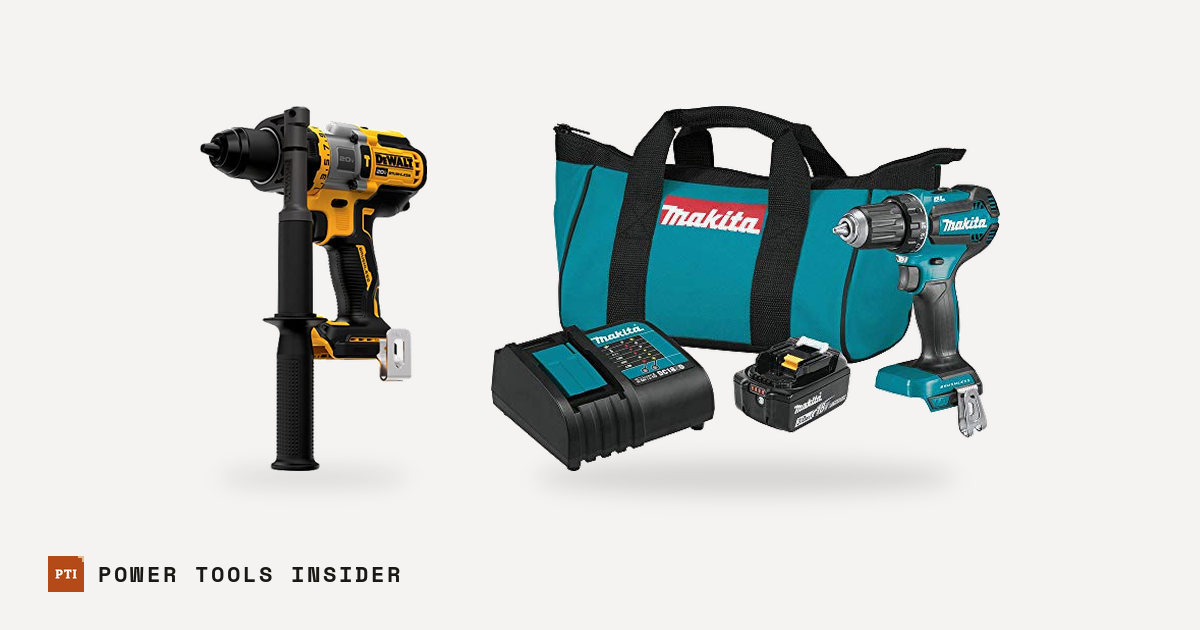
We compared the flagship brushless drills from each platform, the DeWalt DCD999B and the Makita XFD131. These are the drills serious users buy, not the budget kit tools.
DeWalt DCD999B, Best DeWalt Drill
Price: Around $236 at time of writing | Rating: 4.6/5 (Amazon)
The DCD999B is DeWalt’s current flagship, the FLEXVOLT ADVANTAGE hammer drill. It runs on standard 20V MAX batteries but gets a performance boost when paired with a 60V FLEXVOLT battery: up to 33% more torque, extended runtime, and faster motor speeds. Three speeds let you dial in the right power for drilling, driving, or hammer mode.
Pros
- FLEXVOLT ADVANTAGE, faster and more powerful with 60V batteries
- 3-speed gearbox for precise control across applications
- 22 clutch settings, fine-grained torque control for driving fasteners
- 3-mode LED illuminates workpiece from multiple angles
- Highest torque in class (107 ft-lbs)
Cons
- At 3.54 lbs bare, heavier than most compact drills
- Full FLEXVOLT benefit requires buying a 60V battery (~$80-$120 additional)
- Premium price, you’re paying for the FLEXVOLT compatibility
| Spec | Value |
|---|---|
| Voltage | 20V MAX (60V FLEXVOLT compatible) |
| Chuck | 1/2″ Ratcheting |
| Speed | 0-450 / 0-1,350 / 0-2,000 RPM (3-speed) |
| Max Torque | 107 ft-lbs |
| Clutch Settings | 22 |
| Weight (bare) | 3.54 lbs |
| Head Length | 4″ |
| Motor | Brushless |
Bottom Line: The DCD999B is the most powerful 20V MAX drill DeWalt makes. If you’re buying into the DeWalt platform, this is the drill to anchor it around, especially if you’ll eventually want 60V outdoor power tools or a FLEXVOLT table saw.
Makita XFD131, Best Makita Drill
Price: Around $169 at time of writing | Rating: 4.8/5 (Amazon)
The XFD131 is Makita’s best-selling 18V LXT brushless driver-drill, and that 4.8-star rating across thousands of reviews tells you everything. It’s lighter than the DCD999B, runs cooler thanks to Star Protection, and the compact head fits into tighter spaces. For finish work, trim carpentry, and general-purpose use, it’s hard to beat.
Pros
- Highest rating of any drill in this comparison, 4.8 stars
- Star Protection monitors battery and motor temperature in real time
- Compact 4.5″ head length for tight-access drilling
- Self-tightening chuck, doesn’t slip under repeated impact loads
- Lower price than the DeWalt flagship, $67 cheaper bare tool
Cons
- 2-speed only (vs DeWalt’s 3-speed), less granular speed control
- Lower max torque (530 in-lbs ≈ 44 ft-lbs) vs DeWalt’s 107 ft-lbs
- No future 40V XGT crossover, separate battery ecosystem if you upgrade
| Spec | Value |
|---|---|
| Voltage | 18V LXT |
| Chuck | 1/2″ Self-Tightening |
| Speed | 0-400 / 0-1,900 RPM (2-speed) |
| Max Torque | 530 in-lbs (~44 ft-lbs) |
| Clutch Settings | 21+1 |
| Weight (bare) | 3.75 lbs |
| Head Length | 4.5″ |
| Motor | Brushless |
Bottom Line: The XFD131 is the better drill for finish work and detail-oriented jobs where torque control and compact size matter more than raw power. The 4.8-star rating and lower price make it easy to recommend for anyone entering the Makita ecosystem.
Which Drill Wins?
DeWalt DCD999B wins on raw power, 107 ft-lbs vs 44 ft-lbs is not a close comparison. If you’re drilling large holes in hardwood, driving lag bolts, or using hole saws, DeWalt’s advantage is significant. Makita XFD131 wins on value and ratings, $67 cheaper, lighter, and rated higher by actual buyers. For everyday framing, drywall, and finish work, neither user will wish they had more torque.
Impact Drivers
Both brands make excellent cordless impact drivers. DeWalt’s lineup centers on the DCF887B (20V MAX XR, 3-speed, 1,825 in-lbs max torque), the gold standard for contractors. Makita’s answer is the XDT16Z (18V LXT, 4-speed, 1,590 in-lbs), slightly less torque but with four distinct speed modes for finer control over small fasteners.
For impact drivers, the platform choice matters more than brand preference: both drivers will handle any fastener you throw at them. Where DeWalt pulls ahead is the single-battery ecosystem, the DCF887B uses the same battery as your DCD999B drill, same charger, same platform. Same story on the Makita side.
See our full best cordless impact drivers guide for head-to-head testing data on both models.
Combo Kits
If you’re starting from scratch or gifting a complete setup, combo kits are where the real value comparison gets interesting. The DeWalt and Makita flagship 2-tool kits are $110 apart, but that gap is mostly explained by battery capacity.
DeWalt DCK2100P2, DeWalt Flagship Combo
Price: Around $358.99 at time of writing | Rating: 4.7/5 (Amazon)
The DCK2100P2 pairs the DCD999B FLEXVOLT ADVANTAGE drill with the DCF850 ATOMIC impact driver, two of DeWalt’s best 20V MAX brushless tools. It comes with two 5.0Ah batteries, which is a significant advantage over competitor kits that ship with 2.0Ah or 3.0Ah packs. More amp-hours = longer runtime between charges, especially on job sites without reliable power access.
Pros
- Two flagship brushless tools (DCD999B + DCF850), not budget kit versions
- Two 5.0Ah batteries, more runtime than most competing kits
- DCF850 ATOMIC: 1,825 in-lbs torque, 3-speed, compact at 2.8 lbs
- FLEXVOLT ADVANTAGE drill grows with your tool collection
- 4.7-star rating on thousands of reviews
Cons
- $358.99 is the highest price in this comparison
- Kit box is large, heavier and bulkier than Makita’s equivalent
- No circular saw or additional tools included
| Spec | Value |
|---|---|
| Includes | DCD999B hammer drill + DCF850 impact driver |
| Batteries | 2× 5.0Ah 20V MAX |
| Charger | DCB115 included |
| Drill Max Torque | 107 ft-lbs |
| Impact Max Torque | 1,825 in-lbs |
| Impact Speeds | 3 (0-1,000/0-2,800/0-3,250 RPM) |
| Kit Weight | 12 lbs |
Bottom Line: Best combo kit in this comparison if runtime is a priority. The 5.0Ah batteries alone justify part of the price premium over the Makita XT281S. If you’re on a job site all day without access to charging, the extra amp-hours make a real difference.
Makita XT281S, Makita Flagship Combo
Price: Around $249 at time of writing | Rating: 4.7/5 (Amazon)
The XT281S is a tight, professional 18V LXT 2-tool kit pairing a brushless drill with an impact driver. At $249, it’s $110 cheaper than the DeWalt DCK2100P2. The trade-off: two 3.0Ah batteries (vs DeWalt’s 5.0Ah). For lighter use, finish carpentry, cabinet installation, electrical work, 3.0Ah is plenty. For heavy all-day use, you’ll charge more often.
Pros
- $110 cheaper than the comparable DeWalt combo kit
- Both tools are brushless, no budget motor compromise
- Makita’s compact form factor shines in tight spaces
- Strong 4.7-star rating
- Compatible with 275+ 18V LXT tools
Cons
- Smaller 3.0Ah batteries (vs DeWalt’s 5.0Ah)
- No FLEXVOLT-style high-power upgrade path within 18V platform
- Impact driver torque is lower than DeWalt DCF850
| Spec | Value |
|---|---|
| Includes | XFD13 brushless drill + XDT131 impact driver |
| Batteries | 2× 3.0Ah 18V LXT |
| Charger | DC18RC included |
| Drill Max Torque | 530 in-lbs (~44 ft-lbs) |
| Impact Max Torque | 1,400 in-lbs |
| Kit Weight | 11 lbs |
Bottom Line: The XT281S is the better buy for anyone who wants a premium Makita kit without the premium DeWalt price. The 3.0Ah batteries handle light-to-medium workloads comfortably. Add a second pair of 5.0Ah batteries later if you need more runtime.
Which Combo Kit Wins?
DeWalt DCK2100P2 wins on value-per-amp-hour, two 5.0Ah batteries retail for ~$180 on their own, so you’re effectively getting the tool pair for ~$180. Makita XT281S wins on entry price, $110 less up front is meaningful. Choose DeWalt if you’ll be working full days without charging access. Choose Makita if you’re doing weekend projects or finish work where 3.0Ah is plenty.
Price and Value
Looking at the platforms holistically:
- Entry-level single drill: DeWalt ~$100 (DCD771C2 kit) vs Makita ~$169 (XFD131 bare). DeWalt wins on entry price.
- Mid-range combo kit: DeWalt ~$180 (DCK240C2) vs Makita ~$249 (XT281S). DeWalt wins on entry.
- Flagship drill bare tool: DeWalt $236 (DCD999B) vs Makita $169 (XFD131). Makita wins on flagship price.
- Replacement 5.0Ah battery: DeWalt DCB205 ~$60-80 vs Makita BL1850B ~$87. Similar.
- Replacement 6.0Ah battery: DeWalt DCB206 ~$100 vs Makita BL1860B ~$119. Similar.
Overall, DeWalt has more entry-level price points and better promotional kit deals (especially through Home Depot). Makita’s individual tools often carry lower MSRPs but the platform has fewer budget entry points. See our complete battery platform comparison for detailed cost-of-ownership analysis.
Who Should Buy DeWalt vs Makita?
Choose DeWalt if you:
- Want the largest cordless tool selection in one platform
- Are a contractor needing maximum torque for heavy drilling and fastening
- Plan to eventually add 60V FLEXVOLT high-power tools (table saws, outdoor power)
- Shop primarily at Home Depot where DeWalt promotions run frequently
- Want the most powerful entry combo kit at a lower starting price
Choose Makita if you:
- Work in finish trades (cabinet, trim, flooring) where compact size and precision matter
- Already own Makita batteries or chargers (the ecosystem lock-in is real)
- Need the widest selection of specialty tradespeople tools (Makita’s 275+ LXT tools covers every trade)
- Want the drill with the best customer ratings in the category (XFD131 at 4.8)
- Prefer the Star Protection battery monitoring system for battery longevity
For a broader comparison that adds Milwaukee to the mix, see our Milwaukee vs DeWalt drill comparison and our guide to best cordless drills of 2026.
The Verdict
There’s no wrong choice here, both brands make professional-grade tools that will last a decade with normal maintenance. But there’s a right choice for your work:
DeWalt wins for contractors and power users. The DCD999B’s 107 ft-lbs of torque, the FLEXVOLT upgrade path, and the DCK2100P2’s 5.0Ah batteries make DeWalt the platform for people who push their tools hard every day.
Makita wins for tradespersons and value-focused buyers. The XFD131’s 4.8-star rating, compact form factor, and $67 lower price make it the smarter buy for finish work and lighter-duty professional applications. The XT281S combo kit at $249 is the best value among these options.
If you’re still deciding between multiple brands, read our best cordless combo kits guide, it compares DeWalt, Makita, Milwaukee, and Ryobi in a single shootout.
Frequently Asked Questions
Is DeWalt or Makita better in 2026?
DeWalt is better for contractors who need maximum power and FLEXVOLT high-voltage upgrade compatibility. Makita is better for finish tradespersons who want compact tools, the highest customer ratings, and a massive 275+ tool ecosystem. Both offer 3-year warranties and comparable battery life.
Are DeWalt and Makita batteries interchangeable?
No. DeWalt 20V MAX batteries are not compatible with Makita 18V LXT tools, and vice versa. Each brand uses a proprietary battery connector. Third-party adapter batteries exist but are not recommended, they can void warranties and pose safety risks.
Which brand is more expensive, DeWalt or Makita?
It depends on the tool tier. DeWalt has more budget entry points (starter kits from ~$100). Makita’s flagship tools often carry lower individual prices, the XFD131 drill is $67 cheaper than the DCD999B. For combo kits, Makita’s XT281S ($249) is $110 less than DeWalt’s DCK2100P2 ($358.99), but DeWalt includes larger 5.0Ah batteries.
Which brand lasts longer, DeWalt or Makita?
Both brands offer 3-year limited warranties on tools. Makita’s Star Protection system actively monitors battery temperature and load to prevent premature failure, which gives it an edge on battery longevity. DeWalt tools are well-regarded for durability in contractor environments. Either brand will last 10+ years with proper maintenance.
Can I mix DeWalt and Makita tools on the same job?
You can own tools from both brands, but you’ll need two separate battery sets and two chargers, one per platform. Most professionals who own both recommend picking a primary platform for your most-used tools (drill, impact driver, saw) and only buying the other brand for specialty tools that don’t have an equivalent in your main platform.
Power Tool Insider is reader-supported. When you buy through links on our site, we may earn an affiliate commission at no extra cost to you. This doesn’t affect our recommendations, we only recommend tools we’d actually use. Full disclosure.