Nothing kills momentum like a dead battery at the worst possible moment. Here’s how to never be that guy again.
Quick Picks: Best Batteries by Platform
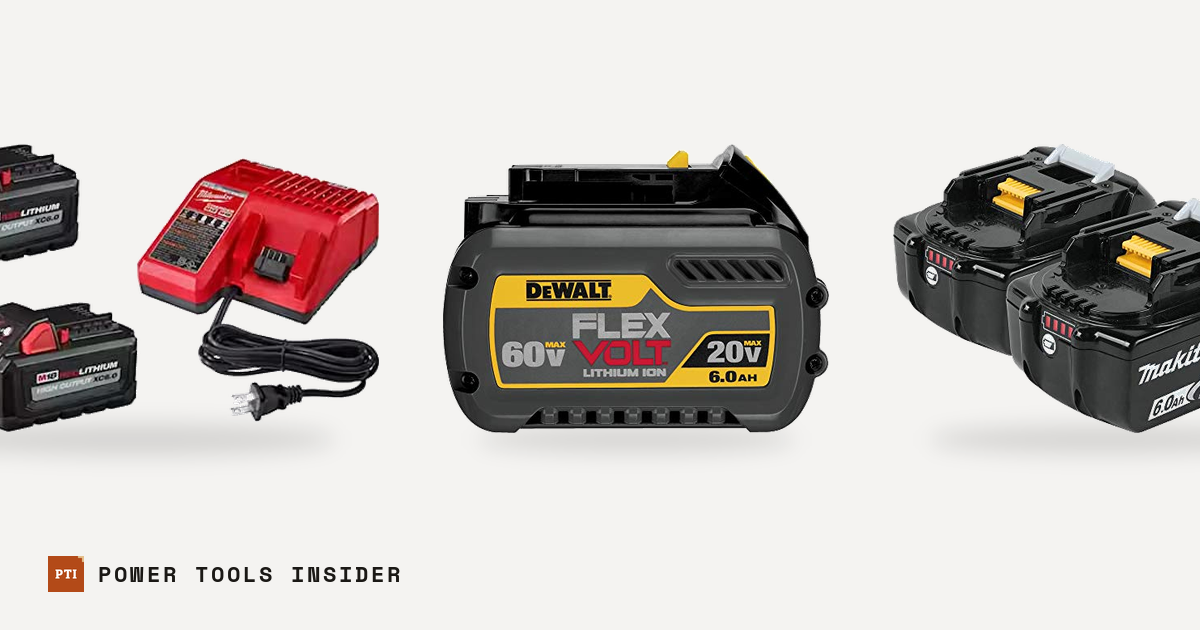
For Milwaukee Users: Milwaukee M18 HIGH OUTPUT XC6.0 (48-11-1865), $199
The workhorse. Best-in-class power delivery, 1-hour charge, works in sub-zero temps.
For DeWalt Users: DeWalt FLEXVOLT DCB606, $179
The Swiss Army knife. One battery for 20V, 60V, and 120V tools. Stop buying multiples.
For Makita Users: Makita BL1860B, $149
55-minute charge time is industry-leading. Lightweight at 1.5 lbs. Reliable as a Toyota.
Best Budget/DIY Pick: Ryobi ONE+ HP PBP007, $99-$119
You’re using this twice a month. Don’t overpay. This is the value king.
How Much Battery Do You Actually Need?
Let’s talk amp-hours (Ah) without the engineering degree.
Ah = how long the battery lasts. That’s it. Higher number = longer runtime.
- 2.0Ah-3.0Ah: Compact. Light. Great for drills, drivers, and quick jobs. Dies fast on saws and grinders.
- 4.0Ah-6.0Ah: The sweet spot for most DIYers. Handles 90% of what you’ll throw at it.
- 8.0Ah-12.0Ah: Overkill for homeowners. These are for contractors running circular saws all day.
Here’s the real talk: If you’re a weekend warrior using tools a couple times a month, a 6.0Ah battery is more than enough. Don’t let marketing convince you to drop $279 on a 12Ah monster you’ll never drain.
The math is simple: two 6.0Ah batteries beat one 12.0Ah battery every time. One’s always charging while you work.
Platform Compatibility: The Ecosystem Lock-In
Let’s be honest about what’s really going on here: every brand wants to lock you into their ecosystem. Once you own three Milwaukee tools, you’re not switching to DeWalt, and they know it.
| Platform | Compatible Tools | Battery Flexibility |
|---|---|---|
| Milwaukee M18 | 250+ tools | All M18 batteries work. HIGH OUTPUT gives more power but isn’t required. |
| DeWalt 20V MAX | 200+ tools | FLEXVOLT batteries work in 20V tools AND 60V tools. Best flexibility. |
| Makita 18V LXT | 275+ tools | All LXT batteries are cross-compatible. No voltage confusion. |
| Ryobi ONE+ | 300+ tools | Everything since 1996 works. Yes, your dad’s old drill takes the new battery. |
DeWalt’s FLEXVOLT is the smartest system. One DCB606 battery automatically switches between 20V (6.0Ah) and 60V (2.0Ah) depending on the tool. If you own both platforms, you only need one type of battery.
Ryobi’s backward compatibility is insane. They’ve maintained ONE+ compatibility for nearly 30 years. Your 2026 HP battery works in a dusty Ryobi from 2003. Respect.
Battery Mini-Reviews
Milwaukee M18 HIGH OUTPUT XC6.0 (48-11-1865)
$199 | 6.0Ah | 2.3 lbs | 5/5 (4.8/5, 17,900+ reviews)
This is Milwaukee’s bread and butter. The HIGH OUTPUT cells deliver 50% more power than standard XC batteries and run 50% cooler, which means longer life and better performance in demanding applications.
Cold weather performance is exceptional. This thing works below 0°F when other batteries are paperweights. One-hour full charge. Fade-free power delivery until the last few percent.
The verdict: If you’re Milwaukee-invested, this is the battery. Period. The 12Ah is overkill for 99% of DIY use.
Best for: All-day projects, power-hungry tools (grinders, circular saws), cold weather work.
Milwaukee M18 HIGH OUTPUT CP3.0 (48-11-1835)
$129 | 3.0Ah | 1.33 lbs | 5/5 (4.8/5, 11,700+ reviews)
Don’t sleep on compact batteries. This 3.0Ah pack delivers XC-level power in a CP-sized body. That’s 50% more power than a standard compact battery while weighing a third less than the XC6.0.
Perfect for overhead work, tight spaces, and tools where weight matters (impact drivers, drills). It’s not an all-day battery, but as a second battery in your rotation? Chef’s kiss.
The verdict: The best lightweight option for Milwaukee users who hate arm fatigue.
Best for: Overhead work, compact tools, weight-conscious users.
DeWalt FLEXVOLT DCB606
$179 | 6.0Ah (20V) / 2.0Ah (60V) | 2.55 lbs | 5/5 (4.8/5, 25,700+ reviews)
Here’s where DeWalt got clever. The FLEXVOLT automatically switches voltage based on the tool you attach it to. Snap it into your 20V drill, it’s a 6.0Ah 20V battery. Snap it into your 60V circular saw, it’s a 2.0Ah 60V battery.
One battery type for (almost) everything. That’s not marketing fluff, it’s genuinely useful if you own tools across both platforms.
The 90-minute charge time is slower than Milwaukee, and it’s the heaviest option here at 2.55 lbs. But the versatility makes up for it.
The verdict: The smartest buy for DeWalt users with both 20V and 60V tools.
Best for: Users with mixed 20V/60V tool collections.
DeWalt 20V MAX XR DCB208
$169 | 8.0Ah | 2.0 lbs | 4/5 (4.7/5, 9,700+ reviews)
DeWalt’s largest 20V-only battery packs 8.0Ah into the same footprint as their 6.0Ah. That’s 33% more runtime with no size penalty. The newer 21700 cells run cooler than the older 18650-based packs too.
This doesn’t have FLEXVOLT’s voltage-switching trick, so it’s strictly 20V tools only. But if you don’t own any 60V equipment, that’s not a problem, and you save $10 over the DCB606.
The verdict: Maximum runtime for 20V-only users.
Best for: 20V MAX users who want maximum runtime without switching to FLEXVOLT.
Makita BL1860B
$149 | 6.0Ah | 1.5 lbs | 5/5 (4.8/5, 28,500+ reviews)
Makita’s flagship battery wins on two fronts: charge time and weight. The 55-minute full charge is the fastest here by a mile, and 1.5 lbs is noticeably lighter than the competition.
The trade-off? No “HIGH OUTPUT” version. Power delivery is solid but doesn’t match Milwaukee’s peak performance in demanding applications. For most DIY work, you won’t notice.
Star Protection tech monitors the battery during use to prevent overheating, over-discharge, and damage. It’s less aggressive marketing, more quiet reliability.
The verdict: The best balance of charge time, weight, and value for Makita users.
Best for: Users who prioritize fast charging and lightweight design.
Ryobi ONE+ HP PBP007
$99-$119 | 6.0Ah | 1.69 lbs | 4/5 (4.7/5, 12,700+ reviews)
Okay, real talk: Ryobi isn’t a pro brand. If you’re framing houses for a living, go Milwaukee or DeWalt. But if you’re a homeowner with a garage full of ONE+ tools you use a couple times a month? This is the move.
The ONE+ HP batteries deliver 30% more power than standard Ryobi batteries while matching the competition on capacity. Compatible with all 300+ ONE+ tools ever made. And at $99-$119 (catch it at Direct Tools Outlet for the lower price), the value is absurd.
You’re paying $16-$20 per amp-hour. Milwaukee’s XC6.0 is $33/Ah. Makita is $25/Ah. Do the math.
The verdict: The DIY value king. Don’t overspend on batteries you’ll use twice a month.
Best for: Budget-conscious DIYers, homeowners, Ryobi ecosystem users.
Battery Comparison Table
| Battery | Capacity | Weight | Price | $/Ah | Charge Time | Rating | Buy |
|---|---|---|---|---|---|---|---|
| Milwaukee 48-11-1865 | 6.0Ah | 2.3 lbs | $199 | $33.17 | 60 min | 4.8 | Buy Now |
| Milwaukee 48-11-1835 | 3.0Ah | 1.33 lbs | $129 | $43.00 | ~35 min | 4.8 | Buy Now at Home Depot |
| DeWalt DCB606 | 6.0Ah* | 2.55 lbs | $179 | $29.83 | 90 min | 4.8 | Buy Now on Amazon |
| DeWalt DCB208 | 8.0Ah | 2.0 lbs | $169 | $21.13 | ~60 min | 4.7 | Buy Now on Amazon |
| Makita BL1860B | 6.0Ah | 1.5 lbs | $149 | $24.83 | 55 min | 4.8 | Buy Now on Amazon |
| Ryobi PBP007 | 6.0Ah | 1.69 lbs | $99-119 | $16.50-$19.83 | ~90 min | 4.7 | Buy Now at Home Depot |
*DCB606 is 6.0Ah at 20V or 2.0Ah at 60V
Best $/Ah: Ryobi PBP007
Lightest: Milwaukee 48-11-1835 (compact) or Makita BL1860B (high-capacity)
Fastest charge: Makita BL1860B
Most versatile: DeWalt DCB606
Fast Charger Recommendations
Batteries are only half the equation. A good charger pays for itself in time saved.
Milwaukee M18 Dual Bay Super Charger (48-59-1815)
$279-$348 | 5/5 (4.8/5, 2,750+ reviews)
The fastest charger I’ve tested. 80% charge on a 6.0Ah battery in 15 minutes. Dual bay simultaneous charging means two batteries charge at full speed at once, no sequential nonsense.
COOL-CYCLE tech actively cools batteries during charging, which extends lifespan. Wall-mountable. It’s expensive, but if time is money, this pays for itself fast.
Best for: Professionals who can’t wait. Milwaukee users with multiple batteries in rotation.
DeWalt DCB1112 12A Fast Charger
$99 | 4/5 (4.7/5, 6,600+ reviews)
DeWalt’s fastest charger is also their best value. 12-amp output gets a 9.0Ah FLEXVOLT to 80% in 45 minutes. Fan-assisted cooling prevents overheating. Travel latch for portability.
Single bay only, so you’re charging one at a time. But at $99, a third the price of Milwaukee’s super charger, it’s hard to complain.
Best for: DeWalt users who want fast charging without the premium price tag.
Should You Buy OEM or Third-Party Batteries?
Here’s where I’ll probably upset some people. Let’s be real.
The Case for OEM (Original Manufacturer)
- Warranty protected: Third-party batteries can void your tool warranty if they cause damage
- Consistent quality: Cell quality, BMS protection, and build quality are reliable
- Communication: OEM batteries talk to tools properly (fuel gauges, overload protection)
- Longevity: Better cells = more charge cycles before degradation
The Case for Third-Party
- Half the price (or less): A 6.0Ah “compatible” battery runs $40-$60
- Same cells (sometimes): Some knockoffs use the same Samsung/LG cells as OEM
- Disposable mindset: If it dies in a year, you buy another and still save money
My Honest Take
For your primary batteries: buy OEM. The reliability, warranty protection, and lifespan make it worth the premium. These are the batteries that live in your tools.
For backup batteries you rarely use: third-party is fine. That emergency battery in your truck? The one sitting in a drawer “just in case”? A $50 knockoff works.
Never buy third-party for high-drain tools. Circular saws, grinders, rotary hammers, these demand peak current that cheap BMS circuits can’t safely deliver. It’s not worth the fire risk.
Watch out for fakes sold as OEM. Amazon and eBay are flooded with counterfeit Milwaukee and DeWalt batteries at “too good to be true” prices. If it’s $89 for what should be a $199 battery, it’s fake. Buy from authorized dealers.
FAQ
How many batteries do I actually need?
Two is the minimum. One in the tool, one on the charger. Three is ideal, one working, one charged and ready, one charging.
Do higher Ah batteries damage tools?
No. Tools draw only what they need. A 6.0Ah battery in a drill doesn’t deliver more power than a 2.0Ah, it just lasts longer.
Should I drain batteries completely before charging?
No. Lithium-ion doesn’t have “memory effect” like old NiCad batteries. Charge whenever convenient. Shallow discharges (using 20-30% then recharging) actually extend lifespan.
How long do lithium-ion batteries last?
3-5 years or 1,000+ charge cycles for quality OEM batteries with proper care. Heat is the enemy, don’t leave them in hot cars or direct sun.
Can I use Milwaukee batteries in DeWalt tools?
No. Each platform is proprietary. There are third-party adapters, but they’re sketchy and can damage tools. Don’t.
Is FLEXVOLT worth it if I only have 20V tools?
Not yet. FLEXVOLT batteries work in 20V tools, but you’re paying a premium for 60V capability you won’t use. Stick with standard 20V MAX batteries until you buy a 60V tool.
Why is Ryobi so much cheaper?
Two reasons: simpler battery management systems and massive production scale. They sell more batteries than any other brand, which drives unit costs down. The trade-off is slightly less durability and power output, fine for DIY, not for professional abuse.
Final Thoughts
Stop overthinking this. Here’s what you need:
1. Two 6.0Ah batteries for your platform
2. One fast charger (or just use the kit charger and be patient)
3. Maybe one compact battery if you do a lot of overhead work
If you’re on a budget, the Ryobi PBP007 at $99 is the best value in power tool batteries, full stop. You’re not a contractor. You don’t need to pay contractor prices.
If you want the best regardless of price, Milwaukee’s HIGH OUTPUT XC6.0 with a Dual Bay Super Charger is the setup that pros swear by.
Now go finish that project.
Last updated: February 2026
Prices verified at time of publication. We may earn a commission from affiliate links at no cost to you.
Related Articles:
Power Tool Insider is reader-supported. When you buy through links on our site, we may earn an affiliate commission at no extra cost to you. This doesn’t affect our recommendations, we only recommend tools we’d actually use. Full disclosure.