Stop guessing. Stop splitting wood. Stop snapping screw heads off flush with the surface because you tried to drive a #10 into oak without drilling first.
Tools You Need for Pilot Holes
- Countersink Bit Set: DeWalt DWA1184, around $14.79 on Amazon
- Impact Bit Set: Milwaukee SHOCKWAVE 40-Piece Set, around $24.97 at Home Depot
- Impact Driver: DeWalt DCF850B 20V MAX, around $114.98 on Amazon
This is the pilot hole reference you print out and tape to the shop wall. Every wood screw size, every lag bolt, metric fasteners, tap drills for metal, all in one place. Bookmark it. You’ll be back.
Ready to Drill?
Best Drill Bit Sets 2026
Before you drill a single pilot hole, make sure you have the right bits. We compared 12 sets on materials, coatings, price, and verified-buyer feedback, from budget black oxide to pro cobalt, so you can skip the trial and error.
See Best Drill Bit Sets 2026Why Pilot Holes Matter
A pilot hole does four things that make your work stronger and cleaner:
- Prevents splitting: especially critical near board edges, end grain, and in hardwoods like oak and maple. Without a pilot hole, the screw acts as a wedge and the wood has nowhere to go but apart.
- Ensures proper thread grip: the pilot removes just enough material for the screw body while leaving enough wood for the threads to bite. Too large a pilot and the screw pulls out. No pilot and the wood fibers crush rather than grip.
- Reduces driving torque: less resistance means less cam-out, fewer stripped heads, and less wear on your drill and bits.
- Prevents fastener failure: small screws (#4 and under) will snap if you try to force them into hardwood without a pilot. The torsional stress exceeds what the fastener can handle.
The rule is simple: when in doubt, drill a pilot hole. The 15 seconds it takes will save you from splitting a board you already cut, measured, and dry-fit.
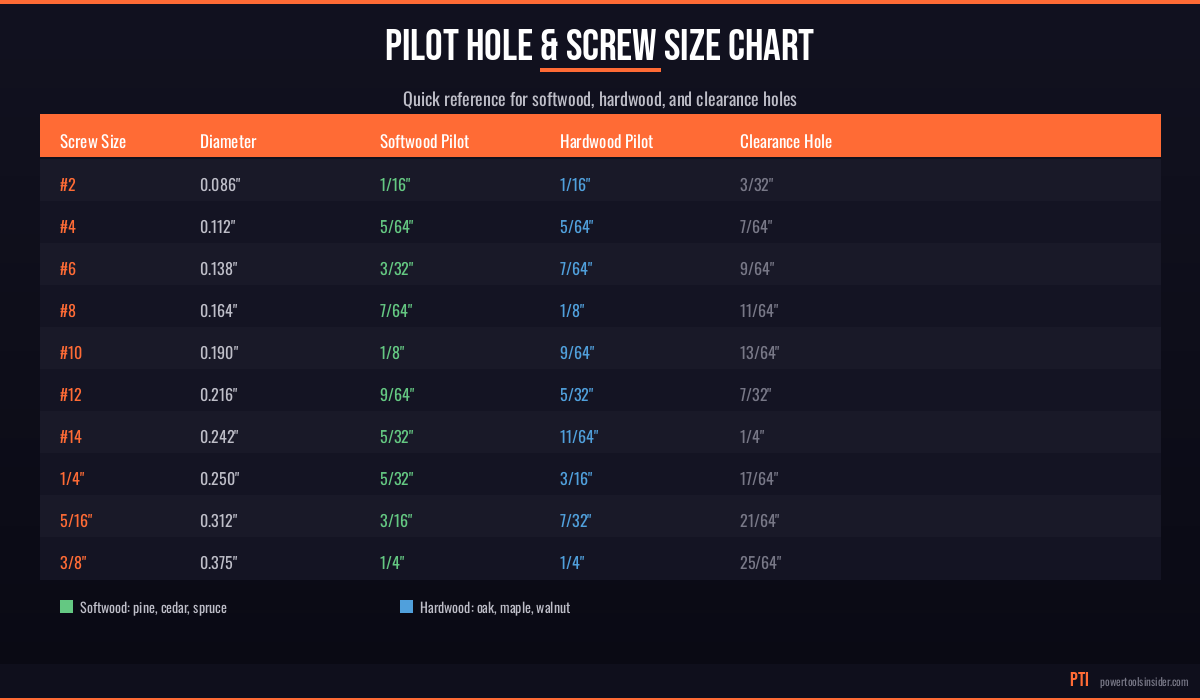
Wood Screw Pilot Hole Chart
This is the chart you’ll use most. Covers standard wood screws from #2 through #14. Softwood sizes assume pine, cedar, spruce, or fir. Hardwood sizes assume oak, maple, cherry, or walnut.
| Screw Size | Screw Diameter (in) | Softwood Pilot Hole | Hardwood Pilot Hole | Clearance Hole (Shank) |
|---|---|---|---|---|
| #2 | 0.086″ | 1/16″ (0.063″) | 5/64″ (0.078″) | 3/32″ (0.094″) |
| #3 | 0.099″ | 1/16″ (0.063″) | 5/64″ (0.078″) | 7/64″ (0.109″) |
| #4 | 0.112″ | 5/64″ (0.078″) | 3/32″ (0.094″) | 7/64″ (0.109″) |
| #5 | 0.125″ | 5/64″ (0.078″) | 3/32″ (0.094″) | 1/8″ (0.125″) |
| #6 | 0.138″ | 3/32″ (0.094″) | 7/64″ (0.109″) | 9/64″ (0.141″) |
| #7 | 0.151″ | 3/32″ (0.094″) | 7/64″ (0.109″) | 5/32″ (0.156″) |
| #8 | 0.164″ | 7/64″ (0.109″) | 1/8″ (0.125″) | 11/64″ (0.172″) |
| #9 | 0.177″ | 1/8″ (0.125″) | 9/64″ (0.141″) | 3/16″ (0.188″) |
| #10 | 0.190″ | 1/8″ (0.125″) | 9/64″ (0.141″) | 3/16″ (0.188″) |
| #12 | 0.216″ | 9/64″ (0.141″) | 5/32″ (0.156″) | 7/32″ (0.219″) |
| #14 | 0.242″ | 5/32″ (0.156″) | 11/64″ (0.172″) | 1/4″ (0.250″) |
Recommended Drill Bits for Pilot Holes
Once you know your pilot hole size, you need sharp bits that drill clean. Our top picks:
- DeWalt DW1361 Titanium Pilot Point 21-Piece Set: around $27 at time of writing, 4.8★ (28,000+ reviews), currently 18% off. Best for everyday drilling, since the pilot-point tip prevents bit walking. Buy Now on Amazon
- DeWalt Connectable Bit & Drill Bit Storage Set: around $66, 4.7★ (9,000+ reviews). Bit-bar organizer that keeps drill bits, Torx, Phillips, square, and slotted driver bits in one connectable ToughCase. Good pick once you’re tired of digging through a junk drawer for the right size. Buy Now on Amazon
See all our picks: Best Drill Bit Sets 2026
How to read this chart: Find your screw size in the left column. Match the pilot hole column to your material. Always drill the clearance hole through the top piece when joining two boards. This lets the screw pull the pieces tight together (more on this below).
Quick memory trick: For softwood, the pilot is roughly 60-70% of the screw diameter. For hardwood, it’s about 75-85%. The clearance hole matches the full shank diameter.
Need a Drill?
Best Cordless Drills 2026
Not all drills handle hardwood equally. Our top picks for DIYers and homeowners, including the best value under $100 and the top pro pick that won’t quit on you.
See Best Cordless Drills 2026Lag Bolt Pilot Hole Chart
Lag bolts (lag screws) are the heavy lifters: deck posts, ledger boards, structural connections. They always need pilot holes, and they always need a wrench or socket to drive.
| Lag Bolt Size | Softwood Pilot Hole | Hardwood Pilot Hole | Clearance Hole | Washer Required? |
|---|---|---|---|---|
| 1/4″ | 5/32″ | 3/16″ | 1/4″ | Yes |
| 5/16″ | 3/16″ | 7/32″ | 5/16″ | Yes |
| 3/8″ | 1/4″ | 5/16″ | 3/8″ | Yes |
| 7/16″ | 5/16″ | 3/8″ | 7/16″ | Yes |
| 1/2″ | 3/8″ | 7/16″ | 1/2″ | Yes |
| 5/8″ | 7/16″ | 1/2″ | 5/8″ | Yes |
| 3/4″ | 1/2″ | 5/8″ | 3/4″ | Yes |
Always use a washer with lag bolts. The large head will crush into the wood without one, reducing clamping force and weakening the joint over time. For pressure-treated lumber, use hot-dip galvanized or stainless steel washers.
Metric Screw Pilot Hole Chart
Working with European hardware, flat-pack furniture, or metric fasteners? Here are the pilot hole sizes for metric wood screws from M3 through M12.
| Metric Size | Screw Diameter (mm) | Softwood Pilot Hole | Hardwood Pilot Hole | Clearance Hole |
|---|---|---|---|---|
| M3 | 3.0 mm | 2.0 mm | 2.5 mm | 3.2 mm |
| M3.5 | 3.5 mm | 2.5 mm | 3.0 mm | 3.6 mm |
| M4 | 4.0 mm | 2.5 mm | 3.0 mm | 4.2 mm |
| M5 | 5.0 mm | 3.0 mm | 3.5 mm | 5.3 mm |
| M6 | 6.0 mm | 3.5 mm | 4.5 mm | 6.4 mm |
| M8 | 8.0 mm | 5.0 mm | 6.0 mm | 8.4 mm |
| M10 | 10.0 mm | 6.0 mm | 7.5 mm | 10.5 mm |
| M12 | 12.0 mm | 7.0 mm | 9.0 mm | 13.0 mm |
Cross-reference tip: If you only have imperial drill bits, a 5/64″ bit is close to 2.0 mm, 3/32″ is close to 2.4 mm, and 1/8″ is close to 3.2 mm. A good drill bit set with both metric and imperial sizes eliminates the guesswork.
Machine Screw Tap Drill Chart
When you’re cutting threads in metal, whether for a jig, a repair, or a custom bracket, you need the right tap drill size. Too small and you’ll break the tap. Too large and the threads won’t hold.
Imperial Tap Drill Sizes
| Screw Size & Thread | Tap Drill Size | Decimal Equivalent | Thread Type |
|---|---|---|---|
| #4-40 | #43 (3/32″) | 0.089″ | UNC (Coarse) |
| #6-32 | #36 (7/64″) | 0.107″ | UNC (Coarse) |
| #8-32 | #29 (9/64″) | 0.136″ | UNC (Coarse) |
| #10-24 | #25 (5/32″) | 0.150″ | UNC (Coarse) |
| #10-32 | #21 (5/32″) | 0.159″ | UNF (Fine) |
| 1/4″-20 | #7 (13/64″) | 0.201″ | UNC (Coarse) |
| 1/4″-28 | #3 (7/32″) | 0.213″ | UNF (Fine) |
| 5/16″-18 | F (17/64″) | 0.257″ | UNC (Coarse) |
| 5/16″-24 | I (9/32″) | 0.272″ | UNF (Fine) |
| 3/8″-16 | 5/16″ | 0.313″ | UNC (Coarse) |
| 3/8″-24 | Q (21/64″) | 0.332″ | UNF (Fine) |
| 1/2″-13 | 27/64″ | 0.422″ | UNC (Coarse) |
| 1/2″-20 | 29/64″ | 0.453″ | UNF (Fine) |
Metric Tap Drill Sizes
| Metric Thread | Tap Drill Size | Decimal Equivalent |
|---|---|---|
| M3 x 0.5 | 2.5 mm | 0.098″ |
| M4 x 0.7 | 3.3 mm | 0.130″ |
| M5 x 0.8 | 4.2 mm | 0.165″ |
| M6 x 1.0 | 5.0 mm | 0.197″ |
| M8 x 1.25 | 6.8 mm | 0.268″ |
| M10 x 1.5 | 8.5 mm | 0.335″ |
| M12 x 1.75 | 10.2 mm | 0.402″ |
The formula: Tap drill size = Major diameter minus the thread pitch. For M8 x 1.25: 8.0 – 1.25 = 6.75 mm, rounded up to 6.8 mm. This gives approximately 75% thread engagement, which is the sweet spot for strength without excessive tapping effort.
Clearance Holes vs. Pilot Holes: What’s the Difference?
This is one of the most misunderstood concepts in fastening, and getting it wrong is why joints feel loose or boards don’t pull tight.
A pilot hole is drilled into the piece receiving the screw threads. It’s smaller than the screw, just large enough to let the threads bite without splitting the wood.
A clearance hole is drilled through the top piece (the one closest to the screw head). It’s the same diameter as the screw shank, so the screw slides freely through it.
Why This Matters
When you’re joining two boards face-to-face, here’s what happens without a clearance hole: the screw threads grip both pieces. The top board can’t move toward the bottom board because the threads are holding it in place. You end up with a gap between the boards that no amount of driving force will close.
With a clearance hole in the top piece: the screw slides freely through the first board, threads bite only into the second board, and the screw head pulls the top piece tight against the bottom. Flush, gap-free joint every time.
When to use a clearance hole:
- Joining two pieces face-to-face (tabletops, panels, face frames)
- Attaching hardware where clamping force matters
- Any joint where you need the pieces pulled tightly together
When you can skip the clearance hole:
- Attaching thin material (under 1/4″) to thicker stock
- Drywall to studs (the drywall is soft enough that threads don’t grip it meaningfully)
- Using self-drilling screws designed to clear their own path
Material-Specific Pilot Hole Guidelines
Softwood (Pine, Cedar, Spruce, Fir)
The most forgiving material. For screws #8 and smaller, you can often skip the pilot hole if you’re well away from edges and end grain. But if you’re within 2 inches of an edge or working with cedar (which splits easily despite being soft), always pilot.
Use the softwood column in the charts above. If the screw drives with moderate resistance and the wood doesn’t deform around the head, your pilot size is right.
Hardwood (Oak, Maple, Cherry, Walnut)
Always drill a pilot hole in hardwood. No exceptions. Even a #6 screw will split oak near an edge. Use the hardwood column, and if you’re working with extremely dense species like ipe or jatoba, go one drill bit size larger than listed.
Wax the screw threads before driving into hardwood. A quick rub across a candle or beeswax block reduces driving torque significantly and prevents screw breakage.
Plywood
Plywood is more forgiving than solid wood because the cross-grain layers resist splitting. Pilot holes are most important near edges (within 1 inch) and in thin plywood (1/4″ and under). In the field area of 3/4″ plywood, small screws (#6 and under) usually drive fine without a pilot.
Use the softwood pilot sizes for plywood. The alternating grain layers make it behave more like softwood than hardwood in terms of splitting resistance.
MDF (Medium-Density Fiberboard)
Always pilot in MDF. This material has no grain structure to resist splitting. It cracks in unpredictable patterns. Use the hardwood pilot sizes, and always drill a countersink. MDF mushrooms badly around the screw head if you try to drive it flush without one.
Consider using coarse-thread drywall screws or specialty MDF screws with aggressive threads for the best holding power. Standard wood screws don’t grip MDF as well.
Metal
Always drill before screwing or tapping into metal. Use a center punch first to prevent the bit from walking. Start with a smaller pilot drill for holes over 1/4″, then step up to the final size. Use cutting fluid (even WD-40 works in a pinch) to extend bit life and improve hole quality.
For sheet metal under 18 gauge, self-drilling TEK screws can skip the pilot step. For thicker material, reference the tap drill chart above. A good set of cobalt or titanium-coated bits makes all the difference in metal drilling.
If you’re drilling a lot of sheet metal or angle iron, keep a titanium-coated set on hand instead of running everything through your general-purpose index. The Bosch TI21A 21-Piece Titanium Drill Bit Set (around $43, 4.6★) holds an edge longer than plain black-oxide bits and covers most sheet-metal jobs. It’s a general-purpose formulation rather than a dedicated heavy-metal set, so budget for shorter bit life on hardened steel or repeated heavy-gauge work.
Our Top Pick: DeWalt DWA1181 21-Piece Drill Bit Set
Black oxide coating, 135° split-point tips (no walking on hard surfaces), sizes cover #2 through 1/2″. 4.8 stars, 5,600+ reviews. Covers every size in the charts above. $24.97 (11% off)
Masonry (Concrete, Brick, Block)
Masonry requires a completely different approach. You’ll need a carbide-tipped masonry bit and a hammer drill (rotary hammer for anything over 1/2″). Drill to the depth of your anchor, vacuum out the dust, then set the anchor before driving the screw or bolt.
The pilot hole size for masonry depends entirely on the anchor system: Tapcon screws, sleeve anchors, and wedge anchors each have specific drill sizes printed on their packaging. Follow the manufacturer’s recommendation for your specific anchor.
Self-Drilling Screws: When You Can Skip the Pilot Hole
Self-drilling screws have a built-in drill point that cuts its own hole as you drive. They save time on repetitive fastening, but they’re not universal. Here’s when they work and when they don’t.
Self-drilling screws work well for:
- Sheet metal to metal: TEK screws are the standard for HVAC ductwork, metal framing, and steel roofing
- Drywall to metal studs: fine-thread drywall screws with a self-drilling point
- Composite decking: manufacturer-specific screws (like those from Trex or TimberTech) are designed to self-drill and countersink in one step
- Light-gauge steel: framing screws for steel stud walls
Self-drilling screws do NOT replace pilot holes for:
- Hardwood: the self-drilling point can’t handle the density, and you’ll snap the screw or split the wood
- Structural connections: lag bolts and structural screws always need pilot holes for proper thread engagement
- Near edges in any material: even in softwood, a self-drilling screw near an edge will split the board
- Thick metal (over 12 gauge): the self-drilling point can’t cut fast enough and overheats
Pro Tips for Better Pilot Holes
Recommended Tools for Pilot Holes and Countersinking
The right tools turn a guessing game into a repeatable process.
- DeWalt DWA1184 4-Piece Countersink Drill Bit Set: around $15. Drills the pilot hole and countersink in one pass: no bit swap, no proud screw heads. Covers #6 through #12 screws. 4.8★ on Amazon. Buy Now on Amazon
- DeWalt ATOMIC DCF850B 20V MAX Impact Driver: around $115. Drill the pilot hole first, then switch to this for driving the screw home. 3-speed brushless, 0-3,200 RPM, compact enough for tight spots. 4.6★. Buy Now on Amazon | see all tested impact drivers | best bits for it
Mark Your Drilling Depth
Wrap a piece of painter’s tape around your drill bit at the desired depth. When the tape touches the surface, stop drilling. This is faster and cheaper than a depth stop collar, and just as accurate for woodworking. For production work, a proper depth stop or adjustable-depth bit is worth the investment.
The “Push and Twist” Test
Not sure if your pilot hole is the right size? Push the screw into the hole and twist it by hand. If it goes in with firm hand pressure for the first few turns, the pilot is correct. If it won’t start by hand at all, the pilot is too small. If it drops in without resistance, the pilot is too large.
Countersink Angles
Standard wood screws use an 82-degree countersink. Machine screws typically use a 90-degree countersink. Using the wrong angle leaves the head sitting proud or recessed unevenly. Most combination countersink/pilot bits are set for 82 degrees, which covers the majority of woodworking applications.
Step Drilling for Large Holes
For pilot holes larger than 1/4″, drill a smaller pilot first (1/8″ works for most situations), then open it up to the final size. This reduces wander, gives the larger bit a center point to track on, and puts less stress on both the bit and your drill.
Drill Bit Selection Matters
Brad-point bits give the cleanest pilot holes in wood: the center spur prevents walking, and the outer spurs score the grain before the flutes cut. For metal, use HSS or cobalt bits. For masonry, nothing but carbide-tipped masonry bits. Check our drill bit coatings guide for a deeper breakdown of what coating works best for each material.
Lubricate When Needed
Wax on screw threads for hardwood. Cutting oil for metal. A few drops of water for masonry (keeps dust down and cools the bit). Never use lubricant in softwood. It’s unnecessary and can stain the surface.
FAQ
What if I don’t have the exact drill bit size?
Go one size smaller rather than one size larger. A slightly too-small pilot hole means more driving effort but a tighter grip. A slightly too-large pilot hole means the screw won’t hold as well and could work loose over time. When in doubt, test on a scrap piece first.
Should I drill pilot holes for drywall screws?
Not when driving into wood studs. Drywall screws are designed to self-start in softwood framing. But if you’re driving into metal studs, use fine-thread drywall screws with a self-drilling point, or pre-drill with a 1/8″ bit. For high-volume drywall work, a dedicated cordless drywall screw gun drives every screw to the exact same depth automatically: no overdriving, no blown face paper.
Do pocket hole screws need pilot holes?
The pocket hole jig itself creates the angled pilot hole. That’s the whole point. You don’t need an additional pilot in the receiving piece for softwood. For hardwood-to-hardwood pocket hole joints, drilling a small pilot (1/16″ to 5/64″) in the receiving piece can help, especially near edges.
What about deck screws?
For pressure-treated lumber, pilot holes are strongly recommended. The treatment process makes the wood denser and more prone to splitting, especially at board ends. For composite decking, check the manufacturer. Most have approved self-drilling screws designed for their specific material.
Does screw length change the pilot hole size?
No. The pilot hole diameter is determined by the screw gauge (thickness), not the length. A 1-inch #8 screw uses the same pilot hole as a 3-inch #8 screw. However, you do need to drill the pilot hole deep enough, at least 2/3 the length of the screw in the receiving piece.
Can I use a nail as a pilot hole?
In a pinch, driving and removing a finish nail can create a crude pilot hole in softwood. It’s not precise and doesn’t remove material (it just displaces fibers), but it can prevent splitting when you don’t have a drill handy. This trick doesn’t work in hardwood.
Shopping for Drill Bits or a New Drill?
The DeWalt DWA1181 21-piece set ($24.97 on Amazon) covers every gauge in the charts above: 135° split-point tips, black oxide coating, 4.8 stars from 5,600+ reviews. Buy on Amazon →
See all tested drill bit sets | Best Cordless Drills 2026 | Best Impact Drivers 2026 | Father’s Day Tool Gifts 2026
Garden and Yard Tip
Turn Your Drill Into a Planting Tool
The K-Brands Auger 4-Pack (around $30) gives you 3/4", 1", 1.5", and 2" auger bits for bulbs, seedlings, and soil plugs. Fits any 3/8" hex chuck, no special drill needed. Useful for spring seedlings, summer containers, and fall bulbs like tulips, daffodils, and garlic.
Buy Now on Amazon See all tested auger bits →Just Starting Out?
Best Beginner Woodworking Tools 2026
If you’re drilling your first pilot holes, you’re probably setting up a new shop. Our beginner guide cuts through the noise: exactly what to buy first, what to skip, and what to wait on.
See Best Beginner Woodworking Tools 2026Bottom Line
A pilot hole takes 15 seconds to drill. Splitting a board, snapping a screw, or stripping a head costs you a lot more than that. Keep this chart handy, match your drill bit to your screw and material, and you’ll never have to wonder again.
Need to stock up on the right bits? Our best drill bit sets guide covers every budget and use case. And if you keep breaking bits, that’s a separate problem worth solving.
Related guides: Drill Bit Coatings Decoded: Titanium vs Cobalt vs Black Oxide · Understanding Carbide: Why Your Saw Blades and Drill Bits Live or Die by This Material · Best Power Tool Brands 2026 · Impact Driver vs Drill · Battery Platforms Compared 2026
Spring tree work? See our guide to the best cordless pole saws, the highest-dwell guide on PTI.