You’re staring at two tools that look almost identical on the shelf. Same battery, roughly the same size, similar price. But pick the wrong one for your project, and you’ll either strip every screw head in sight or spend twenty minutes on a task that should take two.
The drill/driver and impact driver are the most commonly confused power tools, and for good reason. They overlap in some jobs. But they work in fundamentally different ways, and understanding that difference is the key to choosing the right tool.
And it doesn’t stop there. Throw in the hammer drill and impact wrench, and you’ve got four tools that sound related but serve very different purposes. This guide covers all of them, how they work, which jobs each one handles best, and when you actually need more than one.
| What You’re Doing | Get This | Skip This | Why |
|---|---|---|---|
| Deck screws, framing screws, lag bolts | Impact driver | Drill/driver stalls on long fasteners | Concussive torque drives without cam-out, and it won’t twist your wrist |
| Holes in wood, metal, or plastic plus general screw driving | Drill/driver | Impact driver can’t hold round-shank bits | Chuck fits every bit you own, clutch stops you from snapping small screws. Drilling hardwood? See the Pilot Hole and Screw Size Chart |
| Concrete, brick, block | Hammer drill | Anything else burns up bits | Percussion chips masonry while it spins, roughly 10x faster than a plain drill |
| Lug nuts, suspension bolts, anything threaded M10 and up | Impact wrench | Impact driver won’t budge them | 1,000+ ft-lbs breakaway torque through a socket drive |
| You build things weekly and can only buy once | Combo kit | Neither tool alone | Drill for holes, driver for screws. That pairing covers 95% of jobs. See Best Cordless Combo Kits 2026 |
Impact Driver vs Drill: Quick Answer
Just driving screws into wood? Get an impact driver. It’s faster, more powerful, and won’t tire out your wrist.
Drilling holes and driving screws? Get a drill/driver. It does both jobs with adjustable speed and torque control.
Drilling into concrete, brick, or stone? You need a hammer drill. Nothing else will get through masonry efficiently.
Working on cars or heavy equipment? An impact wrench handles lug nuts and large bolts that no other tool can budge.
Doing regular construction, remodeling, or serious DIY? Get a combo kit with both a drill/driver and an impact driver. You’ll use both constantly.
Ready to buy? Our picks in each category:
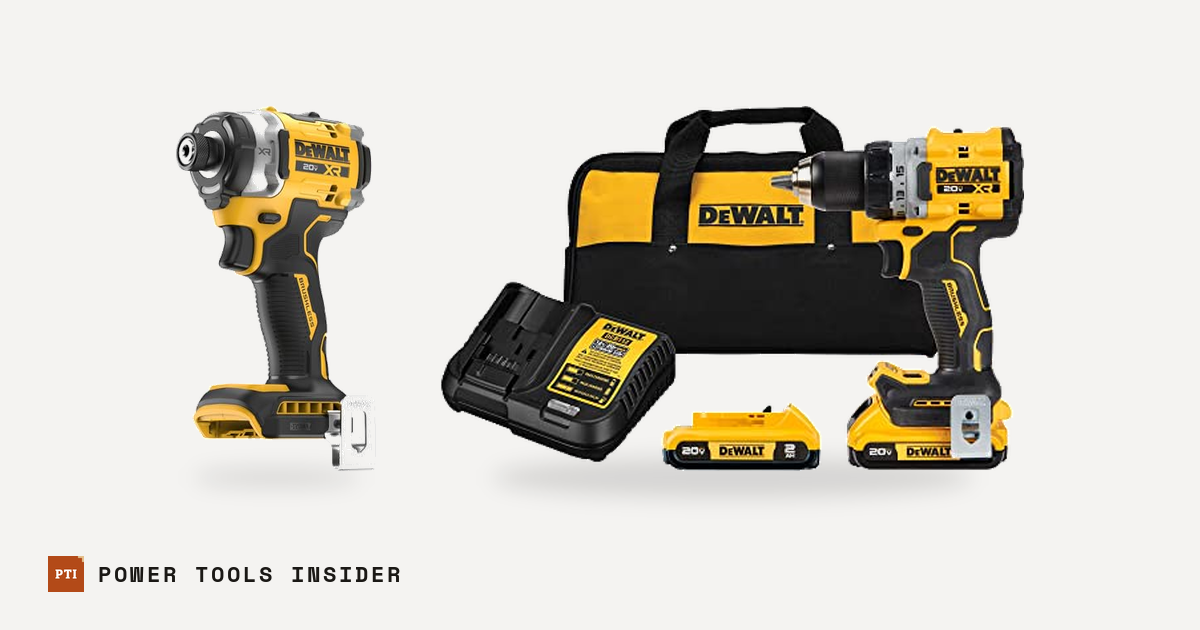
- Best impact driver (driving screws) DeWalt DCF860B 20V MAX XR 3-Speed, around $134 at time of writing, Buy Now on Amazon
- Best drill/driver (drilling plus driving) DeWalt DCD801B 20V MAX XR brushless, around $109 at time of writing, Buy Now on Amazon
- Best budget pick (batteries included) DeWalt DCD771C2 kit, around $119 at time of writing, Buy Now on Amazon
- Want both tools? See Best Cordless Combo Kits 2026
How Each Tool Actually Works
The mechanical differences between these tools explain everything about when to use each one. This isn’t just trivia, understanding the mechanism tells you why certain tools excel at certain jobs.
Drill/Driver: The Versatile All-Rounder
A drill/driver uses a simple motor-to-chuck connection with an adjustable clutch. The chuck (usually 3/8″ or 1/2″ keyed or keyless) holds round-shank bits. The clutch has numbered settings, when the resistance hits the set threshold, the clutch disengages and the chuck stops spinning. This prevents you from overdriving screws or snapping small bits.
Variable speed trigger gives you precise control from 0 to max RPM. Two-speed gearbox on most models: low gear for high-torque driving, high gear for drilling. It’s the most controllable of all four tools.
Impact Driver: The Screw-Driving Specialist
An impact driver uses a completely different mechanism. When it meets resistance, an internal hammer and anvil mechanism kicks in, delivering rapid rotational impacts, typically 3,000 to 4,000 impacts per minute (IPM). Each impact is a quick burst of concussive rotational force.
This does two important things. First, it generates massive torque without transferring that force to your wrist. Second, the pulsing action prevents cam-out (bit slipping) because the bit briefly disengages between impacts, reseating itself in the fastener head.
Impact drivers use a 1/4″ hex collet instead of a chuck, accepting only hex-shank bits. They’re smaller and lighter than drills, and they absolutely demolish long screws and lag bolts.
Hammer Drill: The Masonry Tool
A hammer drill adds a percussive forward hammering action to the standard rotation. Two toothed discs inside the tool click against each other as the bit spins, creating thousands of small forward impacts per minute. This chipping action is what breaks through concrete, brick, mortar, and stone.
Most cordless hammer drills are combo tools, they have a hammer mode for masonry and a standard drill/driver mode for everything else. They use a standard chuck and accept round-shank bits, including masonry bits.
For serious concrete work (anchors into foundation walls, core drilling), you’d step up to an SDS rotary hammer, which is a different class of tool entirely. But for drilling into brick, block, or thin concrete, a cordless hammer drill handles it fine.
Impact Wrench: The Bolt Breaker
An impact wrench works on the same concussive principle as an impact driver, but it’s built for sockets and large fasteners. It uses a 1/2″ or 3/8″ square drive (same as your socket set) and delivers dramatically more torque, often 1,000+ ft-lbs of breakaway torque.
Impact wrenches are purpose-built for automotive work, heavy equipment, structural bolting, and any application involving nuts and bolts. They’re overkill for screws and useless for drilling, but nothing else touches them for their intended job.
Key Specs Compared
| Spec | Drill/Driver | Impact Driver | Hammer Drill | Impact Wrench |
|---|---|---|---|---|
| Max Torque | 400-750 in-lbs | 1,500-2,300 in-lbs | 500-1,200 in-lbs | 300-1,400 ft-lbs |
| RPM Range | 0-500 / 0-2,000 | 0-2,800-3,600 | 0-550 / 0-2,000 | 0-1,900-2,500 |
| IPM / BPM | N/A | 3,000-4,400 IPM | 25,000-34,000 BPM | 2,400-3,400 IPM |
| Chuck / Drive | 1/2″ or 3/8″ keyless | 1/4″ hex collet | 1/2″ keyless | 1/2″ or 3/8″ square |
| Weight (bare) | 3.0-4.0 lbs | 2.0-3.5 lbs | 3.5-5.0 lbs | 4.5-7.0 lbs |
| Noise Level | Moderate | Loud (wear protection) | Loud | Very loud |
| Bit Type | Round shank (any) | 1/4″ hex shank only | Round shank (any) | Sockets (square drive) |
| Price Range (cordless) | $50-$180 | $80-$200 | $90-$220 | $120-$350 |
The Job Decision Matrix: 25 Real Scenarios
This is the table you’ll come back to. For each job, we list the best tool and why. Bold = strong recommendation. Italic = it’ll work but isn’t ideal.
| Job / Task | Best Tool | Why |
|---|---|---|
| Driving 3″ deck screws (hundreds of them) | Impact Driver | High torque, no wrist fatigue, won’t cam out. This is what impact drivers were born for. |
| Assembling IKEA or flat-pack furniture | Drill/Driver | Clutch control prevents overdriving into particleboard. Impact driver will blow right through it. |
| Hanging drywall (driving drywall screws) | Drill/Driver | Clutch setting lets you sink screws just below the surface without popping the paper. Dedicated drywall screwguns are even better. |
| Drilling holes in wood (general) | Drill/Driver | Standard chuck fits all drill bits, variable speed for clean holes. |
| Drilling large holes (hole saws, Forstner bits) | Drill/Driver | Needs a chuck for round-shank bits and speed control to avoid grabbing. Impact driver can’t hold these bits. |
| Drilling into concrete or brick | Hammer Drill | Percussive action is required for masonry. Regular drill will burn through bits and take forever. |
| Installing Tapcon concrete screws | Hammer Drill (pilot hole) + Impact Driver (driving) | Drill the hole with a hammer drill, then switch to impact driver to drive the Tapcon. |
| Driving lag bolts / lag screws | Impact Driver | Massive torque drives lag bolts through framing lumber effortlessly. A drill/driver will stall out or burn up. |
| Framing (structural screws, LedgerLok, etc.) | Impact Driver | Long structural screws need high torque and sustained driving force. Impact driver handles them easily. |
| Installing cabinet hinges and hardware | Drill/Driver | Precision work, clutch control prevents splitting the face frame or overdriving small screws. |
| Building a fence (driving fence screws) | Impact Driver | Same as deck screws, high volume, long fasteners, treated lumber. Impact driver all the way. |
| Finish trim and molding (brad point, small screws) | Drill/Driver | Delicate work near visible surfaces. Clutch control and low torque prevent splitting and overdriving. |
| Drilling into metal / steel | Drill/Driver | Low speed, consistent pressure, cobalt or HSS bit. Impact driver’s hammering action is counterproductive in metal. |
| Drilling into tile or porcelain | Drill/Driver (with carbide/diamond bit) | Low RPM, no hammer, steady pressure. Any impact or hammering cracks tile. |
| Removing rusted or stuck screws | Impact Driver | Concussive impacts break rust bonds that a drill/driver can’t overcome. This is where the impact mechanism really shines. |
| Automotive, removing/installing lug nuts | Impact Wrench | Purpose-built for this. Nothing else generates enough torque for lug nuts. |
| Automotive, suspension, axle nuts, etc. | Impact Wrench | Large fasteners under tension need the breakaway torque only an impact wrench provides. |
| Installing electrical boxes and conduit | Impact Driver | Quick screw driving into studs, self-tapping screws into metal boxes. Fast and efficient. |
| Plumbing (pipe straps, hangers, clips) | Impact Driver | Driving screws into studs and joists in tight spaces. Compact size helps in cramped areas. |
| Drilling pocket holes (Kreg jig) | Drill/Driver (drilling) + Impact Driver (driving) | Drill the pocket hole with a standard bit, then drive the pocket screw with an impact driver. |
| Installing a TV mount | Hammer Drill (concrete) or Drill/Driver (wood stud) | Depends on your wall. Concrete or brick needs hammer drill. Wood studs need just a drill/driver. |
| Sheet metal screws (HVAC, ductwork) | Impact Driver | Self-tapping screws into sheet metal is fast with an impact driver. Compact size works in tight mechanical rooms. |
| Mixing paint or thinset | Drill/Driver | Low RPM, high sustained torque. Use a mixing paddle in the chuck. Don’t use an impact driver for this. |
| Removing car battery terminals | Drill/Driver or ratchet | Small bolts that don’t need impact force. A drill/driver on low torque or even a hand ratchet works fine. |
| Building raised garden beds | Impact Driver | Long screws through thick lumber, often treated wood. Same use case as deck building. |
Impact Driver vs Drill: The Head-to-Head Breakdown
Since this is the most common comparison, let’s go deeper on exactly where each tool wins and loses.
Where the Impact Driver Wins
- Long screws (2.5″ and up): The impact mechanism delivers torque in bursts that keep the fastener moving without stalling. A drill/driver bogs down on long screws, especially in hard or treated wood.
- High-volume screw driving: Less wrist fatigue because the rotational force stays in the tool, not your hand. You can drive hundreds of deck screws without your wrist giving out.
- Stuck fasteners: Concussive impacts break rust bonds and loosen seized screws that a drill/driver simply can’t move.
- Compact size: Most impact drivers are shorter and lighter than drills, which matters in tight spaces between joists or inside cabinets.
- One-handed use: The hex collet makes bit changes quick and tool-free. Pop in a bit, pull the collet, done.
Where the Drill/Driver Wins
- Drilling holes: A chuck accepts round-shank twist bits, spade bits, hole saws, Forstner bits, and step bits. The hex collet on an impact driver limits you to hex-shank bits only.
- Precision and control: The adjustable clutch prevents overdriving. Critical for drywall, cabinetry, hinges, and anything where screw depth matters.
- Delicate materials: Particleboard, MDF, softwoods, and thin materials can split or strip with an impact driver. The clutch on a drill/driver lets you set a torque limit.
- Metal drilling: Consistent low-speed rotation with steady pressure is what cuts clean holes in steel. Impact drivers make metal drilling harder, not easier.
- Quiet operation: Impact drivers are noticeably louder. If you’re working indoors, early morning, or near people, the drill/driver is much more neighbor-friendly.
When You Need Both: The Case for a Combo Kit
If you do any amount of construction, remodeling, or serious DIY, you’ll end up with both tools eventually. Here’s why: on almost every project, you drill a hole with one tool and drive a screw with the other. Switching bits constantly on a single tool wastes time.
The sweet spot is a cordless combo kit, a drill/driver and impact driver that share the same battery platform. Most major brands offer these kits at a significant discount over buying the tools separately.
A typical combo kit from DeWalt, Makita, or Bosch runs $150-$250 and includes both tools plus two batteries and a charger. That’s the single best value in power tools for anyone who works with fasteners regularly.
Check out our full roundup: Best Cordless Combo Kits 2026.
The Workflow in Practice
Here’s how a two-tool setup works on real projects:
- Deck building: Drill pilot holes with the drill/driver, drive 3″ deck screws with the impact driver.
- Cabinet installation: Drill through the cabinet back with the drill/driver, drive structural screws into studs with the impact driver.
- Shelving: Drill shelf pin holes with the drill/driver (clutch set for consistent depth), drive mounting screws with the impact driver.
- Fence building: Pre-drill through pickets with the drill/driver, drive long screws through rails with the impact driver.
Once you work with both tools side by side, you’ll wonder how you ever managed with just one.
Do You Need a Hammer Drill?
If you never drill into concrete, brick, or stone, no. Most homeowners and woodworkers don’t need one.
But if you occasionally mount something on a brick wall, install anchors in a concrete floor, or work on exterior masonry, a hammer drill saves you from the misery of trying to push a regular drill through concrete. It’s the difference between a 30-second hole and five minutes of grinding.
The good news: many cordless drills include a hammer drill mode as a bonus feature. You get a standard drill/driver plus the ability to handle occasional masonry work. Look for “hammer drill/driver” in the product name, it means you get both modes in one tool. It’s a practical upgrade for about $20-$40 more than a standard drill/driver.
What About an Impact Wrench?
Impact wrenches are specialty tools. If you work on cars, trucks, heavy equipment, or structural steel, you know you need one. If you don’t do any of those things, you don’t need one.
The crossover with impact drivers is minimal. An impact wrench uses a square socket drive, not a hex collet. You could technically use a hex-to-square adapter on an impact driver for light automotive work, but for any serious bolt work, the torque difference is massive, a mid-range impact wrench delivers 3-5x the torque of an impact driver.
Choosing the Right Tool: Decision Flowchart
- Are you only driving screws into wood? Get an impact driver. DeWalt DCF860B, around $134, or see the full roundup: Best Impact Drivers 2026.
- Are you only drilling holes? Get a drill/driver. DeWalt DCD801B, around $109, or see Best Cordless Drills 2026.
- Working on cars? Skip both and get an impact wrench. See Best Cordless Impact Wrenches 2026.
- Are you doing both? Get a combo kit. Check Best Cordless Combo Kits 2026.
- Do you drill into masonry even occasionally? Get a hammer drill/driver instead of a standard drill/driver.
- Do you work on cars? Add an impact wrench to the lineup. Buy it from the same battery platform to share batteries.
Bit Compatibility: What Goes Where
One of the most common sources of confusion is which bits work in which tools.
- Drill/driver (chuck): Accepts any round-shank or hex-shank bit. Twist bits, spade bits, hole saws, Forstner bits, step bits, driver bits, everything fits in the chuck.
- Impact driver (1/4″ hex collet): Only accepts 1/4″ hex-shank bits. This includes most driver bits, impact-rated drill bits (hex shank), and hex-shank accessories. Standard round-shank drill bits won’t fit.
- Hammer drill (chuck): Same as a drill/driver, any round or hex shank bit. Use masonry bits for hammer mode.
- Impact wrench (square drive): Only accepts sockets and square-drive accessories. Adapters exist for hex bits, but it’s not the intended use.
Important: If you’re using an impact driver, invest in impact-rated bits. Standard driver bits and drill bits will shatter under the concussive force. Impact-rated bits are made from tougher steel with more flex to absorb the impacts. See our guide: Impact Driver Bits That Don’t Strip.
Frequently Asked Questions
Can an impact driver drill holes?
Yes, with hex-shank drill bits. Most impact drivers can drill holes in wood and soft metals just fine. But you lose the speed control and precision of a drill/driver. For quick, rough holes, totally fine. For clean, precise holes, use a drill/driver.
Will an impact driver strip screws?
Less than a drill/driver, actually. The impact mechanism reseats the bit between impacts, which resists cam-out. The bigger risk is overdriving, sinking the screw too deep or blowing through thin material. Impact drivers don’t have clutch settings, so you need to rely on trigger control and, on newer models, electronic speed/torque modes.
Can I use regular bits in an impact driver?
Regular hex-shank bits will physically fit, but they’re likely to snap. The concussive impacts stress the bit differently than smooth rotation. Always use bits rated for impact use. They’re labeled “impact” or “impact-rated” and are usually black or dark-colored (torsion zone steel).
Do I need a hammer drill for all concrete work?
For drilling holes into concrete, block, or brick, yes. A standard drill will technically work on softer masonry like old mortar, but it’s painfully slow and hard on the bit. For anything harder than that, you need the hammer action. For heavy concrete work (deep holes, large diameters), step up to an SDS rotary hammer.
What about an impact wrench vs impact driver?
Different tools for different fasteners. Impact drivers drive screws (hex collet, 1/4″ bits). Impact wrenches drive nuts and bolts (square drive, sockets). There’s almost no overlap in their real-world use. If someone says “impact,” ask whether they mean screws or bolts, that tells you which tool they’re talking about.
Can I use an impact driver for automotive work?
For light-duty tasks like interior trim screws, license plate bolts, or small panel fasteners, sure. For anything under real torque (lug nuts, suspension bolts, exhaust components), no. An impact driver doesn’t generate enough torque, and the hex collet to square-drive adapter adds a failure point. Use the right tool: an impact wrench.
When should I use a cordless ratchet wrench?
Cordless ratchet wrenches handle medium-torque automotive and assembly work in tight spaces where an impact wrench is too large. Think: transmission bolts, small engine work, appliance repair. See our Best Cordless Ratchet Wrench 2026 guide for top picks.
Which should I buy first if I can only get one tool?
A drill/driver. It’s more versatile. It drills holes (which an impact driver does poorly), it drives screws (slower than an impact driver, but adequate), and the clutch gives you precision control for delicate work. If you know you’ll mostly be driving screws into wood and rarely drilling holes, an impact driver is a strong first choice too, but the drill/driver covers more bases.
Do brushless models matter for these tools?
Yes. Brushless motors deliver more power per battery charge, run cooler, and last significantly longer than brushed motors. The price premium is typically $20-$40, and it’s worth it, especially for impact drivers and drills you’ll use regularly. Every serious cordless tool line is brushless now, and the price gap is shrinking every year.