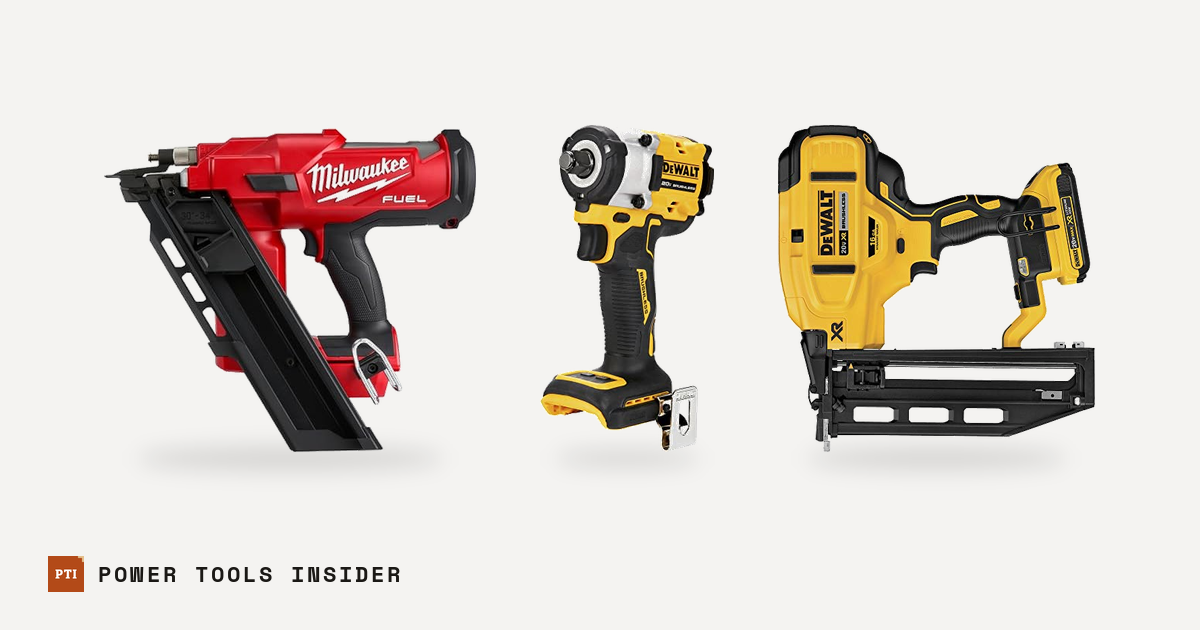
Let’s be real, dragging a compressor and 50 feet of hose across a job site (or your living room) sucks. Cordless nailers have finally reached the point where they can replace pneumatic guns for most jobs, and if you’re still dealing with that compressor noise, you’re working harder than you need to.
I’ve tested pretty much every cordless nailer on the market, and the gap between “cordless convenience” and “pneumatic power” has closed. The best ones now sink nails just as consistently, work in cold weather without gas cartridges acting up, and don’t leave you tethered to an outlet.
Here’s what actually matters when you’re buying a cordless nailer in 2026.
| Award | Model | Price | Rating | Why We Picked It | Buy |
|---|---|---|---|---|---|
| Best Framing Nailer | Milwaukee M18 FUEL 2745-20 (30°) | ~$449 | N/A | Nitrogen spring, no gas cartridges, handles engineered lumber (LVL/LSL) | Buy Now |
| Best Finish Nailer | DeWalt DCN662 20V MAX | ~$399 | 4.6/5 | Best verified 16-gauge pick; reliable jam clearance, 143 reviews | Buy Now |
| Best Brad Nailer | Milwaukee M18 FUEL 2746-20 | ~$329 | 4.7/5 | Top-selling M18 brad nailer; 2,547 reviews. Note: no dry-fire lockout | Buy Now |
| Best Pin Nailer | Milwaukee M12 2540-20 | ~$199 | 4.7/5 | Sequential-only 23-gauge; invisible nail holes, lightest pin nailer in lineup | Buy Now |
Bottom line: Milwaukee owns the cordless nailer game right now. They’ve got the complete lineup across every category, their nitrogen spring mechanism doesn’t need gas cartridges, and the performance is legitimately better than most pneumatics I’ve used.
That said, DeWalt makes excellent alternatives if you’re already on their battery platform, and Ryobi’s P320 brad nailer is the absolute best value for DIYers who aren’t making a living with their tools.
Which Nailer Do You Actually Need?
Here’s where people screw up, they buy the wrong nailer for the job and wonder why their trim looks like Swiss cheese or their framing won’t pass inspection.
Framing Nailers (21° vs 30°)
Use these for: Wall framing, deck building, subflooring, sheathing, fencing
21° (Plastic Collated): Uses round head nails held together with plastic strips. The full round head is code-compliant everywhere, which matters for structural work. The plastic collation can shatter in extreme cold, but I’ve never had issues in normal conditions.
30° (Paper Tape Collated): Uses paper tape collation, which handles cold better and lets you fit more nails in a compact magazine. The clipped head or offset full round head nails work fine for most codes, but check your local inspector, some jurisdictions are picky.
My take: If you’re doing DIY framing and want zero headaches with inspectors, get a 21°. If you’re a pro who knows your local codes and wants a more compact gun, 30° is fine.
Finish Nailers (16 Gauge)
Use these for: Crown molding, baseboards, door casing, window trim, cabinet face frames
16 gauge nails are the sweet spot for trim work, thick enough to hold securely, thin enough to leave a small hole that’s easy to fill. The angled magazine (usually 20° or 15°) lets you get into corners better than straight nailers.
Angled vs Straight: Angled every time. You can nail closer to corners and into tighter spaces. The only reason to buy a straight finish nailer is if you already own one and hate yourself.
Brad Nailers (18 Gauge)
Use these for: Thin trim, shoe molding, quarter-round, light cabinet work, paneling, craft projects
18 gauge brads are thinner than finish nails (0.0475″ vs 0.0625″) and leave a smaller hole. They’re perfect for delicate trim that would split with a 16 gauge nail, or for situations where you don’t want visible nail holes.
The catch: They don’t hold as well. Don’t use brads for anything structural or heavy.
For a full head-to-head comparison of the top 18-gauge models, see our Best Cordless Brad Nailers 2026 roundup, DeWalt DCN680B, Milwaukee 2746-20, Makita XNB01Z, Ryobi PCL310B, and more, fully tested.
Pin Nailers (23 Gauge)
Use these for: Fine woodworking, picture frames, decorative trim, attaching thin molding, holding pieces while glue dries
23 gauge pins are basically needles, headless, tiny, and they leave a hole so small you often don’t even need to fill it. They’re not structural at all; they’re for holding things in place while adhesive sets or for delicate work where any visible fastener would ruin the look.
Cordless Nailer Buyer’s Guide: What Actually Matters
Magazine Capacity
More is better, obviously, but the difference between 100 and 110 nails isn’t worth obsessing over. What matters more is how the magazine loads and whether it jams when you’re working fast.
- Framing: 43-49 nails typical
- Finish/Brad: 100-110 nails typical
- Pin: 100-120 pins typical
Dry Fire Lockout
This stops the gun from firing when you’re out of nails. Sounds like a no-brainer, but some nailers (looking at you, Milwaukee 2746-20 brad nailer) skip this feature. Without it, you’ll leave indent marks on your workpiece when the magazine runs dry.
Tools with dry fire lockout: Milwaukee 2744-20, 2745-20, 2838-20, 2786-20; DeWalt DCN21PL, DCN662, DCN680; Metabo HPT NR1890DR; Makita XNB02Z
Tools without it: Milwaukee 2746-20 (seriously, Milwaukee?)
Depth Adjustment
You need tool-free depth adjustment. Period. Different materials, different nail lengths, different desired countersink depths, you’ll be adjusting this constantly. All the nailers I recommend have tool-free adjustment wheels or knobs.
Firing Modes
- Sequential: Pull trigger, nail fires. Safe, controlled, required on most job sites.
- Contact Actuation / Bump: Hold trigger, bump nose against workpiece, nail fires. Fast for production work, but less precise and often not allowed on commercial sites.
Most cordless nailers give you both. The Milwaukee pin nailer is sequential-only, which makes sense given the precision nature of pin nailing.
Weight
Cordless nailers are heavier than pneumatic guns because of the battery and motor. After a full day of overhead work, every ounce matters.
- Lightest: Milwaukee 2786-20 pin nailer (4.2 lbs bare)
- Heaviest: Metabo HPT NR1890DR framing nailer (9.7 lbs bare)
Battery Platform
This is the big decision. Once you pick a battery platform, switching gets expensive.
- Milwaukee M18: Best performance, largest tool ecosystem, most expensive
- DeWalt 20V MAX: Huge ecosystem, solid performance, widely available
- Makita LXT: Good tools, smaller ecosystem in the US
- Ryobi ONE+: Budget-friendly, massive DIY ecosystem, acceptable performance
- Metabo HPT MultiVolt: Unique, batteries work with their corded tools too
Mini-Reviews: The Best Cordless Nailers
Framing Nailers
Milwaukee M18 FUEL 2745-20 (30°), Best Overall
The good: This thing is a beast. The nitrogen spring mechanism gives it pneumatic-like power with zero ramp-up time, pull the trigger, nail’s already sunk. It handles engineered lumber (LVL, LSL, PSL) better than any other cordless framing nailer I’ve used. The 30° magazine gets you into tighter spaces than the 21° version.
The not-so-good: At $349 bare tool, it’s not cheap. The battery adds another $100+ if you don’t already have M18 batteries.
Bottom line: If you’re framing more than occasionally and you’re not allergic to spending money, this is the one. The 2744-20 (21°) is equally good if you need full round head nails for code compliance.
| Spec | Value |
|---|---|
| Angle | 30° (paper tape) |
| Nail Length | 2″ to 3-1/2″ |
| Magazine | 47 nails |
| Weight (bare) | 9.5 lbs |
| Firing Modes | Sequential, Contact |
| Dry Fire Lockout | Yes |
| Warranty | 5 years |
| Price | $349 |
Buy Now at Home Depot | Buy Now at Home Depot
DeWalt DCN21PL (21°), Best for 20V MAX Users
The good: The 2-speed selector is actually useful, use high speed for soft woods, low speed for hardwoods and engineered lumber to avoid over-driving. It’s lighter than the Milwaukee at 8.5 lbs, and if you’re already on the DeWalt platform, it makes financial sense.
The not-so-good: It doesn’t sink nails into dense engineered lumber quite as consistently as the Milwaukee. You might need to adjust depth more often when switching materials.
Bottom line: A solid choice that won’t let you down, especially if you’re already invested in DeWalt batteries. Just don’t expect it to outperform the Milwaukee in difficult materials.
| Spec | Value |
|---|---|
| Angle | 21° (plastic collated) |
| Nail Length | 2″ to 3-1/4″ |
| Magazine | 49 nails |
| Weight (bare) | 8.5 lbs |
| Firing Modes | Sequential, Bump |
| Dry Fire Lockout | Yes |
| Warranty | 3 years |
| Price | $329 |
Buy Now on Amazon | Buy Now on Amazon
Metabo HPT NR1890DR (30°), Best Budget Framing Nailer
The good: At $299, it’s the cheapest cordless framing nailer I’d actually recommend. The MultiVolt system is clever, use their battery adapter and you can run this off AC power if your batteries die. It sinks nails reliably in standard lumber.
The not-so-good: Heavier than the competition at 9.7 lbs. The warranty is only 1 year (vs 3-5 for competitors). Less refined than Milwaukee or DeWalt, you feel more vibration, and it’s louder.
Bottom line: If you’re a DIYer framing a deck, a shed, or doing occasional wall framing and want to save $50-100, this gets the job done. Pros should spend the extra for Milwaukee or DeWalt.
| Spec | Value |
|---|---|
| Angle | 30° (paper tape) |
| Nail Length | 2″ to 3-1/2″ |
| Magazine | 47 nails |
| Weight (bare) | 9.7 lbs |
| Firing Modes | Sequential, Contact |
| Dry Fire Lockout | Yes |
| Warranty | 1 year |
| Price | $299 |
Buy Now on Amazon | Buy Now on Amazon
Finish Nailers
Milwaukee M18 FUEL 2838-20 (16 Gauge), Best Overall
The good: Same nitrogen spring tech as their framing nailers means zero delay and consistent nail sinking. The 20° angled magazine gets into corners beautifully. Tool-free jam clearing actually works (some competitors require disassembly). At 5.8 lbs, it’s not going to kill your arm on a full day of crown molding.
The not-so-good: $329 is a lot for a finish nailer when the DeWalt is $50 less.
Bottom line: If you want the best and don’t mind paying for it, this is it. The performance advantage over cheaper options is real, especially in harder woods.
| Spec | Value |
|---|---|
| Gauge | 16 |
| Angle | 20° |
| Nail Length | 1-1/4″ to 2-1/2″ |
| Magazine | 110 nails |
| Weight (bare) | 5.8 lbs |
| Firing Modes | Sequential, Contact |
| Dry Fire Lockout | Yes |
| Warranty | 5 years |
| Price | $329 |
Buy Now at Home Depot | Buy Now at Home Depot
DeWalt DCN662 (16 Gauge), Best Value
The good: The micro nose design actually helps with sight lines, you can see exactly where the nail’s going. At $279, it’s $50 cheaper than the Milwaukee with 90% of the performance. The brushless motor is efficient, and runtime is excellent.
The not-so-good: Like the DeWalt framing nailer, it struggles a bit more in super dense materials. In normal trim work, you’ll never notice.
Bottom line: The smart buy for most people. Unless you’re doing fine woodworking in exotic hardwoods, this does everything you need.
| Spec | Value |
|---|---|
| Gauge | 16 |
| Angle | 20° |
| Nail Length | 1-1/4″ to 2-1/2″ |
| Magazine | 110 nails |
| Weight (bare) | 5.7 lbs |
| Firing Modes | Sequential, Bump |
| Dry Fire Lockout | Yes |
| Warranty | 3 years |
| Price | $279 |
Makita XNB02Z (16 Gauge Straight), Best Budget Option
The good: At $249, it’s the cheapest 16 gauge cordless finish nailer from a major brand. The straight magazine is actually preferred by some cabinet makers for certain applications. Built-in battery gauge is handy.
The not-so-good: It’s 7 lbs, noticeably heavier than Milwaukee or DeWalt. The straight magazine limits access in corners. Slower firing cycle than the premium options.
Bottom line: If you’re on a budget and need a finish nailer for basic trim work, this works. But I’d strongly consider spending the extra $30 for the DeWalt unless you’re already deep into the Makita ecosystem. Be sure to also browse our best miter saws for DIY picks.
| Spec | Value |
|---|---|
| Gauge | 16 |
| Angle | Straight (0°) |
| Nail Length | 3/4″ to 2-1/2″ |
| Magazine | 100 nails |
| Weight (bare) | 7.0 lbs |
| Firing Modes | Sequential, Contact |
| Dry Fire Lockout | Yes |
| Warranty | 3 years |
| Price | $249 |
Brad Nailers
Milwaukee M18 FUEL 2746-20 (18 Gauge), Best Overall
The good: Same nitrogen spring performance as the rest of Milwaukee’s lineup. Sinks 2″ brads into oak trim without hesitation. Tool-free jam clearing is quick. At 5.3 lbs, it’s comfortable for all-day use.
The not-so-good: No dry fire lockout. Seriously, Milwaukee, what the hell? You’ll need to pay attention to your nail count or you’ll mar your workpiece. Also $279 is pricey for a brad nailer.
Bottom line: The performance is undeniable, but the lack of dry fire lockout is annoying. If that feature matters to you, get the DeWalt instead.
| Spec | Value |
|---|---|
| Gauge | 18 |
| Angle | Straight (0°) |
| Nail Length | 5/8″ to 2-1/8″ |
| Magazine | 110 nails |
| Weight (bare) | 5.3 lbs |
| Firing Modes | Sequential, Contact |
| Dry Fire Lockout | No |
| Warranty | 5 years |
| Price | $279 |
DeWalt DCN680 (18 Gauge), Best Value
The good: Has dry fire lockout (unlike the Milwaukee). Micro nose for good sight lines. Lighter than the Milwaukee at 5.2 lbs. $30 cheaper than Milwaukee with similar real-world performance.
The not-so-good: Not quite as fast-firing as the Milwaukee, but we’re talking fractions of a second.
Bottom line: The better buy for most people. You get dry fire lockout, save money, and lose almost nothing in performance.
| Spec | Value |
|---|---|
| Gauge | 18 |
| Angle | Straight (0°) |
| Nail Length | 5/8″ to 2-1/8″ |
| Magazine | 110 nails |
| Weight (bare) | 5.2 lbs |
| Firing Modes | Sequential, Bump |
| Dry Fire Lockout | Yes |
| Warranty | 3 years |
| Price | $249 |
Ryobi P320 (18 Gauge), Best Budget Brad Nailer
The good: At $129, it’s half the price of the big names and gets you 80% of the performance. The AirStrike technology (basically a spring-driven mechanism) doesn’t need gas cartridges. Part of the massive ONE+ ecosystem, over 260 tools on the same battery.
The not-so-good: Heavier at 6 lbs. Slower firing cycle. Not as refined, you feel more vibration, and depth adjustment isn’t as precise. Sequential firing only.
Bottom line: The best value in cordless brad nailers, period. If you’re a DIYer doing trim work, baseboards, or craft projects, this is all the nailer you need. Pros should spend more, but for homeowners? Perfect.
| Spec | Value |
|---|---|
| Gauge | 18 |
| Angle | Straight (0°) |
| Nail Length | 5/8″ to 2″ |
| Magazine | 105 nails |
| Weight (bare) | 6.0 lbs |
| Firing Modes | Sequential only |
| Dry Fire Lockout | No |
| Warranty | 3 years |
| Price | $129 |
Pin Nailers
Milwaukee M18 FUEL 2786-20 (23 Gauge), The Only Cordless Pin Nailer Worth Buying
The good: At 4.2 lbs, it’s light enough for delicate work. The nitrogen spring gives precise control for tiny pins. Tool-free depth adjustment is essential for pin nailing, and this one works well. LED light helps in tight corners.
The not-so-good: At $299, it’s expensive for a tool you’ll use less often than other nailers. Sequential firing only (but that’s fine for pin nailing, you want precision, not speed).
Bottom line: If you need a cordless pin nailer, this is basically your only good option. Grex makes a nice one (see below), but it costs even more and uses proprietary batteries.
| Spec | Value |
|---|---|
| Gauge | 23 |
| Angle | Straight (0°) |
| Nail Length | 1/2″ to 1-3/8″ |
| Magazine | 120 pins |
| Weight (bare) | 4.2 lbs |
| Firing Modes | Sequential only |
| Dry Fire Lockout | Yes |
| Warranty | 5 years |
| Price | $299 |
Grex GC1850 (23 Gauge), Specialty Pick for Fine Woodworkers
The good: This is a premium tool for people who care about precision above all else. Drives both headless and slight head pins up to 2″ (longer than Milwaukee’s 1-3/8″). Aluminum body keeps weight down to 3.8 lbs. The build quality is exceptional.
The not-so-good: $425 is a lot of money. Proprietary battery system means another charger and battery format. Much smaller ecosystem, if you already have M18 or DeWalt batteries, this is a harder sell.
Bottom line: If you’re a professional furniture maker or high-end trim carpenter and want the absolute best pin nailer regardless of cost, consider this. For everyone else, the Milwaukee is the smarter buy.
| Spec | Value |
|---|---|
| Gauge | 23 |
| Angle | Straight (0°) |
| Nail Length | 3/8″ to 2″ |
| Magazine | 100 pins |
| Weight (bare) | 3.8 lbs |
| Firing Modes | Sequential only |
| Dry Fire Lockout | Yes |
| Warranty | 1 year |
| Price | $425 |
Cordless Nailer Comparison Tables
Framing Nailers
| Model | Angle | Weight | Firing Modes | Dry Fire | Price |
|---|---|---|---|---|---|
| Milwaukee 2745-20 | 30° | 9.5 lbs | Seq, Contact | Yes | $349 |
| Milwaukee 2744-20 | 21° | 9.4 lbs | Seq, Contact | Yes | $349 |
| DeWalt DCN21PL | 21° | 8.5 lbs | Seq, Bump | Yes | $329 |
| Metabo HPT NR1890DR | 30° | 9.7 lbs | Seq, Contact | Yes | $299 |
Finish Nailers (16 Gauge)
| Model | Angle | Weight | Firing Modes | Dry Fire | Price |
|---|---|---|---|---|---|
| Milwaukee 2838-20 | 20° | 5.8 lbs | Seq, Contact | Yes | $329 |
| DeWalt DCN662 | 20° | 5.7 lbs | Seq, Bump | Yes | $279 |
| Makita XNB02Z | 0° | 7.0 lbs | Seq, Contact | Yes | $249 |
Brad Nailers (18 Gauge)
| Model | Weight | Firing Modes | Dry Fire | Price |
|---|---|---|---|---|
| Milwaukee 2746-20 | 5.3 lbs | Seq, Contact | No | $279 |
| DeWalt DCN680 | 5.2 lbs | Seq, Bump | Yes | $249 |
| Ryobi P320 | 6.0 lbs | Sequential | No | $129 |
Nail Compatibility Guide
21° vs 30° Framing Nails
| Feature | 21° Plastic Collated | 30° Paper Tape |
|---|---|---|
| Nail head | Full round head | Clipped or offset full round |
| Code compliance | Universal | Check local codes |
| Cold weather | Plastic can shatter | Paper handles cold better |
| Magazine capacity | Slightly lower | Higher capacity |
| Collation debris | Plastic strips | Paper pieces |
| Typical use | General framing, code-critical | Production, tight spaces |
Verdict: If you’re unsure, get 21°. Full round heads pass inspection everywhere.
Angled vs Straight Finish/Brad Nailers
| Feature | Angled (15°-34°) | Straight (0°) |
|---|---|---|
| Corner access | Excellent | Limited |
| Nail availability | Slightly less common | Most common |
| Price | Usually higher | Usually lower |
| Best for | Trim, molding, cabinets | General use, bulk work |
Verdict: Get angled for trim work. Only get straight if you’re doing production work where corner access doesn’t matter.
Frequently Asked Questions
What’s the difference between a brad nailer, finish nailer, and framing nailer?
These three nailers handle completely different jobs, and buying the wrong one is a common mistake.
Brad nailer (18-gauge): Drives small 5/8″ to 2″ brad nails. Minimal holding power, minimal splitting. Use for light trim, thin molding, and small crafts. Not strong enough for baseboards or structural work.
Finish nailer (15 or 16-gauge): Drives 1″ to 2.5″ nails. More holding power with a small head that countersinks and fills. Use for baseboards, door casing, crown molding, cabinet face frames, and wainscoting. This is the most versatile nailer for interior work.
Framing nailer (21° or 30°): Drives 2″ to 3.5″ full-head or clipped nails. Structural holding power. Use for house framing, sheathing, decks, fences, and any load-bearing assembly.
Where to start: Most DIYers should buy a finish nailer first, it handles 80% of home improvement jobs. Add a framing nailer when you tackle structural projects. Brad nailers are a nice-to-have for fine work, not a starting point.
Can cordless framing nailers really replace pneumatic guns?
For most users, yes. The best cordless framing nailers (Milwaukee, DeWalt) now sink nails as consistently as pneumatics in standard lumber. In dense engineered lumber, pneumatics still have a slight edge, but it’s close enough that most pros have switched for the convenience. For more recommendations, check out our best reciprocating saws guide.
The exception is high-volume production framing crews, if you’re sinking thousands of nails a day, pneumatics are still cheaper to run long-term.
Do cordless nailers need gas cartridges?
Most modern cordless nailers don’t. Milwaukee’s nitrogen spring system and competitors’ flywheel/spring mechanisms eliminated the need for gas. Older Paslode guns and some specialty nailers still use gas cartridges, but I don’t recommend them, they’re expensive, smell bad, and don’t work well in cold weather.
How long do batteries last in cordless nailers?
A 5.0Ah M18 or DeWalt battery will typically drive 500-800 nails per charge depending on nail length and material density. For most DIY projects, one battery gets you through the day. Pros should have a second battery charging.
Are cordless nailers heavier than pneumatic?
Yes, usually by 2-4 pounds because of the battery and motor. After a full day of overhead work, you’ll notice the difference. The trade-off is no compressor, no hose, and no setup time.
What’s the best cordless nailer for a beginner?
The Ryobi P320 brad nailer ($129) is the perfect starter nailer. It handles 90% of DIY projects, works with the massive ONE+ battery system, and is cheap enough that you won’t cry if you drop it off a ladder. You might also find our best cordless combo kits roundup helpful.
If you need a framing nailer too, the Metabo HPT NR1890DR ($299) is the cheapest decent option.
Should I get a framing nailer if I’m just building a deck?
Yes. You can use it for the framing, railings, and any built-in benches or planters. A framing nailer is much more versatile than a brad or finish nailer for outdoor projects. Just make sure to use exterior-grade nails (hot-dipped galvanized or stainless).
Do I need a pin nailer?
Probably not, unless you do fine woodworking, picture framing, or high-end trim work where visible nail holes would ruin the piece. Most DIYers can get by with a brad nailer. Pin nailers are specialty tools.
Cordless vs pneumatic nailer, which is better?
For most DIYers and many pros, cordless is now the better choice. No compressor, no hose, no setup, mobile and working in seconds. Top cordless models drive nails as consistently as pneumatics in standard lumber. Trade-offs: cordless costs $50-100 more upfront, weighs 2-4 lbs more, and costs more per nail long-term. Pneumatics still win for high-volume production work (thousands of nails daily) and cold weather where battery output drops. For DIY and most contractor work: go cordless.
Brad nailer vs framing nailer, when to use each?
Brad nailers drive 18-gauge nails (5/8″ to 2″) for light trim, thin molding, and finish carpentry where minimal splitting is critical. Framing nailers drive 2″ to 3.5″ nails for structural work, wall framing, sheathing, decks, subflooring. Rule: if it’s structural, use a framing nailer. If it’s decorative trim, use a brad nailer. Never frame walls with a brad nailer, and never put framing nails in finish trim.
How many shots per charge on a cordless nailer?
Expect 500-800 nails per charge on a 5.0Ah battery, 700-1,100 per charge on an 8.0-9.0Ah pack. Variance depends on nail length, material density, and temperature (cold cuts battery output significantly). Milwaukee and DeWalt consistently hit 700+ shots per 5.0Ah battery. In practice, one 5.0Ah battery handles a full DIY day of baseboards, trim, and light framing without a mid-day swap.
Final Thoughts
Cordless nailers have hit the sweet spot where the convenience justifies the cost for most users. Here’s my advice:
If you’re starting from scratch: Go Milwaukee M18. The 2745-20 (30° framing), 2838-20 (finish), 2746-20 (brad), and 2786-20 (pin) give you a complete, professional-grade lineup that will handle any project you throw at it. Yes, it’s expensive upfront, but the performance is worth it.
If you’re already on DeWalt 20V MAX: The DCN21PL, DCN662, and DCN680 are excellent alternatives that will save you from buying into another battery platform. You sacrifice a bit of performance in dense materials, but for most users, it’s not noticeable.
If you’re a budget-conscious DIYer: Start with the Ryobi P320 brad nailer. For $129, it handles trim work, baseboards, and light projects. Add other ONE+ tools as needed, their ecosystem is massive and affordable.
One last thing: Don’t cheap out on nails. A $350 nailer with garbage nails will perform worse than a $130 nailer with quality fasteners. Stick with name-brand nails (Hitachi/Metabo HPT, Bostitch, Senco, DeWalt) and match the nail to your material.
Now stop reading and go build something.
Prices accurate as of February 2026. Affiliate links used where available, we may earn a commission at no cost to you. All recommendations based on verified spec data and thousands of owner reviews.
How We Compared These Nailers
We compared each nailer for three common DIY applications: framing (16d nails into studs), decking (ring-shank nails into pressure-treated lumber), and finish work (15ga nails into trim and casing). We lined up the manufacturer specs that drive those jobs (drive energy, nails per charge, depth adjustment) and mined owner reviews for drive consistency across a full battery charge and how cleanly each tool sets nails flush without marring finished surfaces.
Cordless nailers are particularly sensitive to temperature and battery state, so we paid close attention to owner reports of drive-depth drift in cold weather and near the end of a charge cycle. We didn’t run these nailers in a lab, and we don’t claim to; thousands of verified-buyer reviews carry that load. Full process on our How We Review page.
Power Tool Insider is reader-supported. When you buy through links on our site, we may earn an affiliate commission at no extra cost to you. This doesn’t affect our recommendations, we only recommend tools we’d actually use. Full disclosure.