Walk into any hardware store and you’ll see drill bits in gold, black, silver, and blue. The colors are not decorative — they tell you exactly what the bit can handle. Most people grab whatever is cheapest and wonder why their bits burn out drilling through a single piece of angle iron.
Understanding drill bit coatings is the difference between wasting money on bits that fail and investing in the right bit for the job. This guide breaks down every coating and material you will encounter, explains what actually matters, and tells you when to save your money versus when to spend more. If you are shopping for a complete set, check our best drill bit sets roundup for specific recommendations.
Quick Reference: Coatings at a Glance
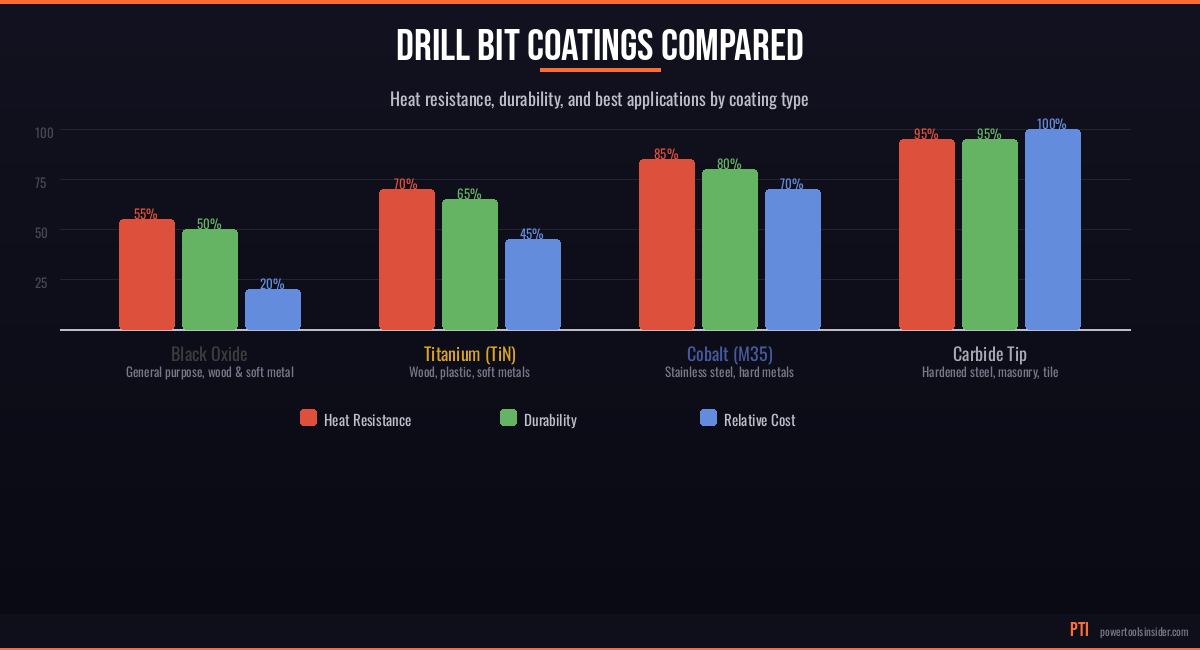
| Coating / Material | Color | Base Material | Surface Hardness | Heat Resistance | Best For | Cost vs Uncoated |
|---|---|---|---|---|---|---|
| Uncoated HSS | Silver/bright | High-speed steel | ~800 HV | Low | Softwood, plastic, light duty | Baseline |
| Black Oxide | Black | HSS + steam treatment | ~900 HV | Low-moderate | General wood and soft metal | +10-20% |
| Titanium Nitride (TiN) | Gold | HSS + PVD coating | ~2,300 HV | Moderate | Wood, soft metal, general purpose | +30-50% |
| Titanium Carbonitride (TiCN) | Blue-gray / purple | HSS + PVD coating | ~3,000 HV | Moderate-high | Cast iron, harder steels | +60-80% |
| Titanium Aluminum Nitride (TiAlN) | Dark gray / black | HSS or carbide + PVD coating | ~3,300 HV | Very high (800°C+) | CNC, production, dry drilling | +100-150% |
| Cobalt (M35/M42 alloy) | Gold-brown / dull silver | HSS alloyed with 5-8% cobalt | ~950-1,050 HV (through-hardened) | High | Stainless steel, hardened steel, cast iron | +50-100% |
| Diamond | Metallic / sparkle | Steel core + diamond particles | ~10,000 HV | Moderate (needs water cooling) | Tile, porcelain, glass, stone | +200-400% |
*Hardness values are approximate surface measurements. Cobalt hardness is lower at the surface than coated bits, but extends through the entire bit rather than being a thin surface layer.
Uncoated HSS — The Bare Minimum
Standard high-speed steel bits with no surface treatment are the cheapest drill bits you can buy. They are bright silver, and you have definitely used them — they are what comes in those $5 variety packs from the checkout aisle.
Uncoated HSS works fine for softwood, drywall, plastic, and the occasional thin aluminum sheet. The steel itself can handle temperatures up to around 600°C before losing hardness, which is adequate for low-demand tasks. The problem shows up quickly when you move beyond light duty: without any surface treatment, these bits generate more friction, heat up faster, and dull significantly sooner than coated alternatives.
When uncoated HSS fails — and it will on anything demanding — the tip loses its edge from thermal softening. That is why your bit smokes and squeals instead of cutting. If you are only hanging curtain rods in drywall, uncoated HSS is fine. For anything else, the small upgrade to at least black oxide pays for itself within a few holes. Understanding why drill bits break starts with understanding what your bit is actually made of.
Black Oxide — The Everyday Upgrade
Black oxide is not really a “coating” in the way most people think. It is a surface conversion treatment: manufacturers heat the finished HSS bit in a steam atmosphere at around 540-560°C, which converts the outermost layer of steel into magnetite (Fe3O4) — the same black iron oxide that forms naturally on cast iron.
This thin black layer does three useful things. First, it reduces friction by roughly 10%, because the oxide surface holds cutting oil better than bare steel. Second, it provides mild corrosion resistance, so your bits do not rust as quickly sitting in a toolbox. Third, it slightly improves heat dissipation at the cutting edge, extending bit life by about 50% compared to uncoated HSS.
What black oxide does not do is dramatically increase hardness. The surface is marginally harder than bare HSS, but you are still fundamentally working with the same steel underneath. On hardened metals or stainless steel, black oxide bits will struggle just like uncoated ones — they will just last a bit longer doing it.
| Property | Black Oxide Details |
|---|---|
| Treatment Type | Steam oxidation (surface conversion) |
| Surface Hardness | ~900 HV (marginal improvement over bare HSS) |
| Friction Reduction | ~10% vs uncoated |
| Life Extension | ~50% longer than uncoated HSS |
| Can Be Resharpened | Yes — coating is minimal, resharpening is fine |
| Best Applications | General wood, soft metals, everyday DIY |
When to choose black oxide: If you do general DIY — hanging shelves, drilling pilot holes, working with wood and occasional aluminum — black oxide bits are the smart baseline. They cost barely more than uncoated HSS and last noticeably longer.
The DEWALT DWA1181 21-Piece Black Oxide Set (around $25) is a solid example of what you get at this tier: a full range of sizes with split-point tips that start cleanly without walking. For budget-conscious buyers, the DEWALT DW1177 20-Piece Black Oxide Set delivers similar performance at an even lower price point.
Titanium Nitride (TiN) — The Gold Standard
If you have ever wondered why some drill bits are gold, this is your answer. Titanium nitride (TiN) is a thin ceramic coating applied through physical vapor deposition (PVD) — essentially vaporizing titanium in a nitrogen-rich vacuum chamber and depositing it onto the bit’s surface. The gold color is not cosmetic. It is the natural color of the TiN compound.
The performance difference over black oxide is significant. TiN-coated bits have a surface hardness of approximately 2,300 Vickers (HV), compared to about 800 HV for uncoated HSS. That nearly triples the hardness at the cutting surface, which translates to 2-3x longer bit life in typical use. The coating also substantially reduces friction, so bits run cooler and cut faster.
Here is the critical limitation most people miss: TiN is a surface coating, typically only 2-4 microns thick. Once you wear through that gold layer — and you can literally see the gold disappearing from the tip with use — you are back to the base HSS underneath. This also means resharpening a TiN bit removes the coating at the tip, eliminating the primary benefit. For most DIYers, it makes more sense to replace worn TiN bits than to resharpen them.
| Property | TiN Details |
|---|---|
| Treatment Type | PVD coating (physical vapor deposition) |
| Coating Thickness | 2-4 microns |
| Surface Hardness | ~2,300 HV (nearly 3x uncoated HSS) |
| Friction Reduction | Significant — lower coefficient of friction than black oxide |
| Life Extension | 2-3x longer than uncoated HSS |
| Can Be Resharpened | Technically yes, but removes coating at the tip |
| Best Applications | Wood, soft metals, aluminum, general-purpose drilling |
When to choose TiN: TiN bits are the sweet spot for most DIYers and serious hobbyists. They cost 30-50% more than black oxide but last two to three times longer. If you drill through wood, aluminum, mild steel, or plastic with any regularity, the gold bits pay for themselves quickly.
The DEWALT DW1361 Titanium Pilot Point 21-Piece Set (around $30) is the bestseller in this category for good reason — the Pilot Point tips prevent walking and the TiN coating delivers consistent performance across materials. If you prefer Bosch, their Bosch TI21A 21-Piece Titanium Set is equally capable with Bosch’s three-flat shank design that prevents slipping in the chuck.
Titanium Carbonitride (TiCN) — The Step Up
TiCN takes the TiN formula and adds carbon to the crystal structure. The result is a coating that is noticeably harder (around 3,000 HV versus TiN’s 2,300 HV) with a lower coefficient of friction. You can identify TiCN bits by their blue-gray or purple color — another case where the color tells you the chemistry.
The added carbon atoms make TiCN more resistant to adhesive wear, which is the type of wear that dominates when drilling harder metals like cast iron and medium-carbon steels. In production environments, TiCN-coated tools consistently outlast TiN-coated equivalents on ferrous metals.
For consumer use, TiCN bits are less common. You will find them more often in industrial catalogs than at your local hardware store. If you are a hobbyist machinist or regularly drill cast iron (engine blocks, pipe fittings, vintage machinery), TiCN is worth seeking out. For general DIY, the jump from TiN to TiCN is rarely worth the extra cost — the materials most people drill at home do not generate enough heat or abrasion to justify it.
Titanium Aluminum Nitride (TiAlN) — High-Heat Champion
TiAlN adds aluminum to the titanium nitride formula, and the aluminum makes all the difference at extreme temperatures. Where TiN coatings start breaking down above 600°C, TiAlN maintains its hardness and protective properties up to 800°C and beyond. This is because the aluminum oxidizes at high temperatures and forms a thin aluminum oxide barrier that actually improves the coating’s performance under heat.
The practical implication: TiAlN bits excel in situations where cooling is impractical or impossible — high-speed CNC drilling, production runs where you cannot stop to apply cutting fluid, and machining hardened alloys that generate extreme heat. The dark gray or black color of TiAlN bits reflects the coating’s composition.
For the vast majority of DIYers, TiAlN is overkill. You are paying a premium for heat resistance you will never need with a cordless drill. But if you see TiAlN bits at the store and wonder what they are, now you know — they are built for the industrial environment where speed and heat are unavoidable.
One consumer-accessible option worth noting: the Diablo Metal Demon 15-Piece Drill Bit Set uses a proprietary Thermal Shield coating similar to TiAlN that is designed for drilling mild, hardened, and stainless steels. Diablo bridges the gap between industrial performance and consumer accessibility — useful if you frequently drill hardened metals. For more on how coatings interact with blade and bit materials, see our blade and bit materials guide.
Cobalt — The One That Is Not a Coating
This is the most important distinction in this entire guide, and the one most people get wrong: cobalt is not a coating. It is an alloy. Manufacturers mix 5% cobalt (grade M35) or 8% cobalt (grade M42) directly into the high-speed steel during manufacturing. The cobalt is distributed throughout the entire bit, from tip to shank.
Why does this matter so much? Because every coating we have discussed so far — black oxide, TiN, TiCN, TiAlN — is a thin surface layer over standard HSS. Once that surface wears through, you are back to ordinary steel. Cobalt bits are fundamentally different: the entire structure is harder, tougher, and more heat-resistant than standard HSS. Even as the tip wears down, fresh cobalt-alloyed steel is exposed underneath. This is why cobalt bits can be resharpened and retain their performance advantage — the cobalt goes all the way through.
M35 vs M42: How Much Cobalt Do You Need?
M35 (5% cobalt) handles the vast majority of demanding drilling tasks: stainless steel (304 and 316), hardened bolts, cast iron, and other materials that destroy regular HSS bits. M35 bits are tough enough for hand-held drilling and tolerate a small amount of flex without snapping.
M42 (8% cobalt) is harder and more heat-resistant, but also more brittle. These bits are designed primarily for drill presses and rigid setups where the bit stays perfectly straight. If you try to use M42 bits freehand and the bit flexes even slightly, it can snap. For most workshop and jobsite use, M35 is the right choice.
| Property | Cobalt (M35/M42) Details |
|---|---|
| Treatment Type | Alloy — cobalt mixed into HSS during manufacturing |
| Cobalt Content | M35: 5% | M42: 8% |
| Through-Hardness | M35: ~950 HV | M42: ~1,050 HV (entire bit, not just surface) |
| Heat Resistance | Higher than standard HSS — maintains edge at temperatures that soften regular bits |
| Can Be Resharpened | Yes — cobalt advantage is retained because it extends through the entire bit |
| Trade-off | More brittle than standard HSS — can snap if flexed, especially M42 |
| Best Applications | Stainless steel, hardened steel, cast iron, abrasive alloys |
When to choose cobalt: If you are drilling stainless steel, hardened bolts, cast iron, or any material that makes regular bits smoke and squeal within seconds, cobalt is the answer. It is not a question of coating longevity — it is a fundamentally different material that can handle what coated HSS cannot.
The DEWALT DWA1240 14-Piece Cobalt Set (around $40) is a strong entry point with Pilot Point tips and a durable case. For a complete index set, the DEWALT DW1269 29-Piece Cobalt Set covers every standard size. On the Bosch side, the Bosch CO14B 14-Piece M42 Cobalt Set uses the higher 8% cobalt alloy — excellent for the toughest metals, though best used in a drill press.
If you are in the Milwaukee ecosystem, the Milwaukee Cobalt Red Helix 29-Piece Set (Home Depot exclusive) features a variable helix geometry that clears chips faster and runs cooler — a smart design that makes the most of the cobalt alloy. Milwaukee is a Home Depot exclusive, so you will not find these on Amazon.
Diamond — For When Nothing Else Works
Diamond drill bits solve a completely different problem. When you need to drill through tile, porcelain, glass, stone, or concrete, no amount of HSS — coated or alloyed — will cut it. These materials are harder than steel, so you need something harder still: industrial diamond particles bonded to a steel core.
Diamond bits work through abrasion rather than cutting. The diamond particles grind away the material, which is why technique matters as much as the bit itself. You need water cooling (a wet sponge held at the drill point works in a pinch), low speed (under 700 RPM for most materials), and patience. High speed or dry drilling will overheat the bit and destroy the diamond bond.
For tile and porcelain work during bathroom or kitchen projects, a basic diamond bit set is essential. The 15-Piece Diamond Hole Saw Set (around $15) covers the most common sizes from 1/4″ to 2″ and handles ceramic tile, porcelain, marble, and glass. For more on pairing the right bit with the right material, see our blade and bit materials guide and our in-depth Understanding Carbide guide. You might also find our best hole saw kits guide useful if you need larger diameter holes.
The Coating Decision Tree
Use this table to match your most common drilling material to the right bit type. Start from the left and follow your typical use case.
| What Are You Drilling? | Recommended Bit Type | Why |
|---|---|---|
| Softwood, drywall, plastic | Black oxide or uncoated HSS | Save your money — these materials are easy on bits |
| Hardwood, aluminum, mild steel | Titanium Nitride (TiN) — gold bits | Best bang for buck, 2-3x longer life |
| Cast iron, medium-carbon steel | TiCN or cobalt (M35) | Materials that generate serious heat need serious bits |
| Stainless steel, hardened steel | Cobalt (M35 or M42) | The entire bit is harder — not just the surface. Can be resharpened. |
| Tile, porcelain, glass, stone | Diamond | Only diamond is harder than ceramic and stone materials |
| High-volume production / CNC | TiAlN on carbide | Handles extreme heat without coolant at high speeds |
*If you are unsure, a good TiN (gold) set like the DEWALT DW1361 handles 80% of DIY tasks. Add a cobalt set for metal work and a few diamond bits for tile, and you are covered for virtually anything.
Can You Resharpen Coated Bits?
This is one of the most frequently asked questions, and the answer depends entirely on whether you are dealing with a coating or an alloy.
Black oxide bits: Resharpen freely. The black oxide treatment is so thin and the hardness gain so modest that resharpening has virtually no downside. If the bit is worth resharpening (i.e., it is a quality HSS bit, not a bargain-bin throwaway), go ahead.
TiN, TiCN, and TiAlN coated bits: You can physically resharpen them on a bench grinder or bit sharpener, but you will grind off the coating at the tip — which is exactly where you need it most. The freshly ground tip is now uncoated HSS, and the bit will perform like a bare steel bit in that area. For inexpensive TiN sets, it is usually more cost-effective to replace rather than resharpen. For more on extending drill bit life and preventing premature failure, see our guide on why drill bits break and how to fix it.
Cobalt bits: Resharpen with confidence. Since the cobalt is alloyed throughout the entire bit, every layer you expose is the same cobalt-enhanced steel. A resharpened cobalt bit performs identically to a new one. This is one of the strongest arguments for cobalt bits in a professional shop — they can be resharpened dozens of times over their lifetime.
Diamond bits: Cannot be resharpened. Once the diamond particles wear away, the bit is done. Use proper technique (low speed, water cooling) to maximize their life.
Practical Tips: Getting the Most From Any Drill Bit
Regardless of coating, these practices extend bit life dramatically:
- Use cutting fluid on metal: Even a drop of 3-in-1 oil reduces heat and friction significantly. This is especially important for uncoated and black oxide bits.
- Match speed to material: Slower speeds for harder materials, faster for soft ones. If the bit is turning blue, you are going too fast.
- Let the bit do the work: Excessive pressure generates heat, which is the number one killer of drill bits. Moderate, steady pressure with a sharp bit cuts faster than heavy pressure with a dull one.
- Clear chips regularly: Pull the bit out periodically to clear chips, especially in deep holes. Packed chips generate friction and heat.
- Use a center punch: Starting a hole with a center punch mark prevents the bit from walking and concentrates cutting force at the tip where it belongs.
- Store bits properly: A bit rolling around loose in a drawer chips edges. Use the index case or a bit roll. If you need a reliable drill for these bits, check our best cordless drills guide.
Frequently Asked Questions
Are gold drill bits better than silver ones?
Generally yes. Gold-colored drill bits have a titanium nitride (TiN) coating that increases surface hardness to about 2,300 HV and extends bit life 2-3x compared to uncoated silver HSS bits. The gold color is the natural color of the TiN compound, not decorative paint. However, gold bits are not automatically better for every task — for stainless steel, a silver-colored cobalt bit will outperform a gold TiN bit because cobalt is an alloy that extends through the entire bit.
Is cobalt better than titanium for drill bits?
They solve different problems. Titanium (TiN) is a surface coating that makes bits last longer on wood, aluminum, and mild steel. Cobalt is an alloy mixed throughout the entire bit, making it fundamentally harder and more heat-resistant. For stainless steel, hardened steel, and cast iron, cobalt is clearly better. For general-purpose drilling in wood and soft metals, TiN offers better value. Cobalt bits also have the advantage of being resharpened without losing their performance edge. See our drill bit sets roundup for specific product recommendations.
Can I drill stainless steel with titanium bits?
You can try, but you will burn through bits quickly. Stainless steel work-hardens as you drill, meaning it gets harder the longer you stay in one spot. TiN-coated HSS bits do not have the heat resistance or through-hardness to handle this effectively. Use cobalt (M35 or M42) bits for stainless steel — they are specifically engineered for this material. Use slow speed, steady pressure, and cutting fluid for best results.
Why do my drill bits turn blue?
A blue or purple discoloration on your drill bit means the steel has been overheated, typically above 300°C. This usually happens from drilling too fast, applying too much pressure, or not using cutting fluid on metal. Once a bit turns blue, the steel at the tip has lost its temper (hardness), and the bit will dull rapidly. Reduce speed, use lighter pressure, apply cutting fluid, and clear chips more frequently to prevent this.
Are expensive drill bits worth it for home use?
It depends on what you are drilling. For occasional wood and drywall work, a basic black oxide set for $15-20 is all you need. For regular DIY projects involving mixed materials, a TiN (gold) set in the $25-35 range is the best value because it lasts 2-3x longer. Only invest in cobalt ($40-80) if you regularly drill stainless steel or hardened metals. Buying cheap bits and replacing them frequently often costs more long-term than buying one quality set.
What drill bits work on hardened steel?
Cobalt drill bits (M35 or M42 grade) are the standard choice for hardened steel. The cobalt alloy maintains its cutting edge at the high temperatures generated when drilling hard metals. For extremely hardened materials, M42 (8% cobalt) bits offer superior performance, though they are more brittle and best used in a drill press. Use slow speed (around 100-300 RPM depending on bit size), firm steady pressure, and cutting oil. Carbide-tipped bits are another option for very hard materials but are even more brittle than cobalt. Check our guide on impact driver bits if you also need bits for driving fasteners.
Ready to Put This Knowledge to Work?
Our drill bit roundup breaks down which coating is worth paying for at each price tier — titanium, cobalt, and black oxide sets all tested and ranked.
Ready to put this coating knowledge to use? See our Best Drill Bit Sets 2026 guide for sets featuring titanium, cobalt, and black oxide coatings.
Power Tool Insider is reader-supported. When you buy through links on our site, we may earn an affiliate commission at no extra cost to you. This doesn’t affect our recommendations — we only recommend tools we’d actually use. Full disclosure.


