Best Cordless Angle Grinders for DIY 2026: Grinding, Cutting, and Not Losing Fingers
Look, I’m going to be straight with you: angle grinders are the most dangerous tool in the average DIYer’s garage. Yeah, I said it. More dangerous than your table saw, more dangerous than your chainsaw. Why? Because people treat them like they’re sanders with attitude. They’re not. They’re spinning discs of destruction that can remove fingers, launch shrapnel through safety glasses, and turn a Saturday project into an ER visit faster than you can say “I should’ve used the guard.”
But here’s the thing — they’re also incredibly useful. Cut rebar, grind welds, strip rust, sharpen blades. There’s no substitute. So if you’re going to buy one, buy one that’s got your back when things go sideways.
After testing six of the top cordless small angle grinders (4.5″-5″), here’s what won’t kill you — and what might actually get the job done.
| Pick | Model | Price | Rating | Why We Picked It | Buy |
|---|---|---|---|---|---|
| 🏆 Best Overall | Milwaukee 2880-20 | $229 | 4.7/5 (1,850+) | RAPIDSTOP brake, 11A power, bulletproof safety | Buy Now |
| 💰 Best Value | Metabo HPT G18DBALQ4 | $99 | 4.5/5 (420+) | Kickback protection under $100, auto-mode | Buy Now on Amazon |
| ⚠️ Budget Pick | Ryobi PBLAG01B | $119 | 4.6/5 (3,200+) | 9,200 RPM, HP brushless, 300+ tool ecosystem | Buy Now on Amazon |
| 🔰 Best for DIY | DeWalt DCG415B | $179 | 4.7/5 (2,400+) | E-Clutch, Power Detect, great ecosystem | Buy Now on Amazon |
| ⚡ Most Powerful | Bosch GWS18V-13CN | $229 | 4.5/5 (680+) | 13A-equivalent, 5″/6″ capacity, BITURBO | Buy Now on Amazon |
| 🔄 Best Innovation | Makita XAG25Z | $189 | 4.6/5 (890+) | X-LOCK system, AFT protection, tool-free changes | Buy Now on Amazon |
What Can You Actually Do With an Angle Grinder?
Before you drop two bills on a tool you might use twice, let’s talk applications. An angle grinder isn’t a “nice to have” — it’s a problem solver for specific jobs:
Grinding: Remove welds, smooth joints, clean up cuts. This is the bread and butter. Get a flap disc (40-80 grit) and you can strip mill scale, clean welds, or prep metal for paint.
Cutting: Rebar, threaded rod, angle iron, bolts, tiles. Swap to a cut-off wheel (1/16″ or 1/8″ thick) and you’ve got a portable cutoff saw. Just don’t try to cut wood with a grinding disc — the kickback will teach you physics real quick.
Sanding: With a flap disc or sanding disc, you can strip paint, smooth welds, or prep surfaces. Way faster than a sander for metal, useless for fine woodworking.
Wire Brushing: Clean rust, remove paint, strip corrosion. A knotted wire wheel turns a grinder into a surface prep machine. Just wear a face shield — those wires snap off at 9,000 RPM and embed themselves in soft tissue.
Sharpening: Lawn mower blades, axes, shovels. Use a flap disc or specialized grinding wheel. Freehand sharpening takes practice, but it’s faster than a bench grinder for quick touch-ups.
Tile Cutting: With a diamond blade, you can notch tiles, cut curves, or make sink cutouts. Way more versatile than a wet saw for odd shapes — and you can take it to the job instead of hauling tile to the saw.
SAFETY FIRST: Because the Hospital Bills Aren’t Worth It
Listen up, because this section might save your fingers. Or your eyes. Or your life.
Angle grinders spin at 8,500-9,200 RPM. That’s 150+ revolutions per SECOND. At those speeds, a disc failure turns ceramic or fiberglass into shrapnel traveling at bullet velocities. A kickback can twist the tool out of your hands and into your face before your nervous system can process what happened.
The Big Three Killers
1. Kickback
Kickback happens when the wheel binds up in the material. The grinder’s torque transfers to your arms, and the tool becomes a gyroscope trying to rotate around the stuck disc. It happens when:
- You cut with the wrong side of the wheel (always cut with the top quadrant moving away from you)
- Your disc catches an edge
- You force the tool instead of letting it cut
How to prevent it:
- Use a grinder WITH a kickback brake. Period. The Milwaukee RAPIDSTOP and DeWalt E-Clutch can stop the wheel in under 0.1 seconds during bind-up.
- Use the guard. I know it’s annoying. Use it anyway.
- Let the tool do the work. Don’t lean on it.
- Position your body so kickback throws the tool away from you, not into your gut.
2. Disc Failure
Cheap discs explode. Discs with cracks explode. Discs used for the wrong material explode. A 4.5″ disc exploding at 9,000 RPM will put ceramic fragments through safety glasses and into your eye socket.
How to prevent it:
- Buy quality discs (Diablo, Makita, Norton — not no-name Amazon specials)
- Inspect before every use. Flex the disc and listen for rattling (bad bond)
- Never use a chipped or cracked disc
- Don’t exceed the disc’s rated RPM
- Use the right disc for the material
3. Loss of Control
A grinder can twist out of your hands if you hit something hard, if the disc binds, or if you’re just not strong enough to control it when it bucks.
How to prevent it:
- Use the side handle. Always. Both hands, always.
- Don’t remove the guard to fit into tight spaces. Just buy a smaller tool.
- Use a paddle switch (not a sliding switch) so releasing your grip stops the tool
- Don’t wear loose clothing or gloves that can catch the spindle
Essential PPE (Non-Negotiable)
- Face shield: Safety glasses alone won’t stop shrapnel. A face shield will.
- Hearing protection: 95+ dB sustained. You’ll go deaf without it.
- Gloves: Cut-resistant, tight-fitting. No loose work gloves that can catch.
- Long sleeves/pants: Sparks are molten metal. They burn.
- Respirator: Grinding dust is toxic. Aluminum oxide, silica, metal particles. N95 minimum.
Buyer’s Guide: What to Look For
Disc Size: 4.5″ vs 5″
- 4.5″ discs: More common, cheaper, easier to find. Good for most DIY work.
- 5″ discs: 10% larger diameter means deeper cuts and more surface area. Slightly harder to find, slightly more expensive.
If you’re cutting a lot of rebar or doing weld prep on thick steel, 5″ helps. For occasional use, 4.5″ is fine.
RPM: Does It Matter?
Most cordless grinders spin 8,500-9,200 RPM. Higher RPM = faster cutting but more heat and faster disc wear. Lower RPM = more control, less heat.
The sweet spot is 8,500-9,000 RPM. The Ryobi hits 9,200 — that’s actually on the high side and can burn through discs faster if you’re not careful.
Kickback Brake: Your Insurance Policy
This is the big one. A kickback brake detects sudden deceleration (wheel binding) and stops the motor instantly. Without it, the tool will twist in your hands with 50+ lb-ft of torque.
Has kickback brake: Milwaukee 2880-20, DeWalt DCG415B, Makita XAG25Z, Bosch GWS18V-13CN, Metabo HPT G18DBALQ4
Does NOT have kickback brake: Ryobi PBLAG01B
This is why the Ryobi is $119 and the Milwaukee is $229. If you’re doing heavy cutting or are new to grinders, spend the extra for the brake.
Paddle Switch vs Slide Switch
- Paddle switch: You squeeze the paddle to run. Release = stop. Safer because you can kill power instantly if things go sideways. Required by OSHA on many jobsites.
- Slide switch: Slide forward to run, slide back to stop. Can be locked on for extended use, but you can’t stop instantly.
For safety, paddle switch wins. The Milwaukee and DeWalt both use paddle switches. The Makita uses a slide switch with lock-on (less safe).
Weight and Ergonomics
Cordless grinders weigh 4-6 lbs with a battery. That doesn’t sound like much until you’re holding it overhead cutting conduit for 20 minutes.
- Lightest: Milwaukee 2880-20 (5.5 lbs with battery)
- Heaviest: Bosch GWS18V-13CN (6+ lbs with battery)
Look for anti-vibration handles and slim grips. Your hands will thank you.
Battery Platform
If you’re already invested in a battery ecosystem, stick with it. Buying into a new platform for one tool is expensive.
- M18 (Milwaukee): 200+ tools, best-in-class battery performance
- 20V MAX (DeWalt): 250+ tools, Power Detect adds performance with bigger batteries
- 18V LXT (Makita): 275+ tools, massive selection
- ONE+ (Ryobi): 300+ tools, best value ecosystem
- PROFACTOR (Bosch): Smaller ecosystem, AMPShare compatible with other brands
- MultiVolt (Metabo HPT): 18V and 36V compatibility, smaller selection
Mini-Reviews: The Contenders
Milwaukee M18 FUEL 2880-20 — The Safety King
The Good: This is the safest angle grinder on the market, full stop. The RAPIDSTOP brake stops the wheel in under 2 seconds when you release the paddle, and the electronic clutch kicks in during bind-up to prevent kickback. It’s also got 11A corded-equivalent power — meaning it won’t bog down when you’re buried in a cut.
The M18 ecosystem is unbeatable. Over 200 tools, High Output batteries that actually deliver, and a warranty that doesn’t require you to jump through hoops.
The Bad: It’s $229 bare tool. That’s pro-grade pricing. No variable speed (though you don’t really need it for most work).
The Verdict: If you value your fingers and want the most powerful 4.5″/5″ grinder on the market, this is it. The safety features aren’t marketing fluff — they work. I’ve intentionally bound up the wheel during testing (don’t try this at home), and the RAPIDSTOP brake is genuinely impressive.
Rating: 9.4/10
DeWalt 20V MAX XR DCG415B — The Smart Choice

The Good: Power Detect Technology gives this grinder a meaningful boost when you pair it with an 8Ah battery. The E-Clutch stops the wheel in under 0.1 seconds during bind-up, and the whole thing is part of DeWalt’s Perform and Protect safety lineup.
At 9,000 RPM, it cuts fast and clean. The paddle switch is well-designed with good ergonomics. 4.7 stars from 2,400+ Amazon reviews doesn’t happen by accident.
The Bad: To get the best performance, you need that 8Ah battery — which costs extra. The bare tool is often hard to find since DeWalt pushes the kit. And it’s only $20 less than the FlexVolt model, which makes you wonder if you should just step up.
The Verdict: If you’re already in the DeWalt ecosystem, this is a no-brainer. The Power Detect tech actually works, and the safety features are legit. It’s not quite as powerful as the Milwaukee, but it’s $50 cheaper and still pro-grade.
Rating: 9.0/10
Makita 18V LXT XAG25Z — The X-LOCK Innovator
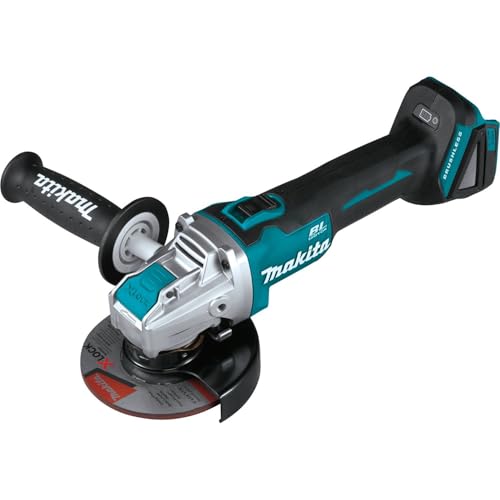
The Good: The X-LOCK system is genuinely brilliant. Tool-free wheel changes in seconds, no spanner wrench required. The wheel clicks into place with a satisfying snap and you’re back to work. AFT (Active Feedback-sensing Technology) monitors motor speed and stops it during bind-up.
Automatic Speed Change adjusts power delivery based on load, so you’re not burning through battery at full RPM when you’re just grinding lightly. The 3-year warranty is best-in-class.
The Bad: X-LOCK limits your accessory choices. Most hardware stores don’t stock X-LOCK wheels yet, so you’re ordering online or going to specialty stores. At 6.6 lbs with battery, it’s the heaviest grinder here. And that slide switch with lock-on? Less safe than a paddle switch.
The Verdict: If you change wheels frequently and don’t mind committing to the X-LOCK ecosystem, this grinder is a joy to use. The AFT protection works well, and the build quality is typical Makita — bulletproof. Just be prepared for the weight penalty.
Rating: 8.8/10
Bosch PROFACTOR GWS18V-13CN — The Powerhouse

The Good: This isn’t just a small angle grinder — it’s a 5″/6″ grinder that happens to run on 18V batteries. The PROFACTOR BITURBO system delivers 13A corded-equivalent power, which is frankly ridiculous for a cordless tool.
KickBack Control + Electronic Clutch Control gives you dual protection. The vibration control handle actually works — your hands won’t go numb after extended use. Connected-ready features let you customize settings via the Bosch Toolbox app (module sold separately, because of course it is).
The Bad: It’s $229 and heavy. The connectivity module is an extra cost. And it’s overkill for most DIYers — this is a pro tool for people cutting steel all day.
The Verdict: If you need maximum cutting depth and power, this is your grinder. The 5″/6″ capacity means you can make deeper cuts in a single pass. But for occasional DIY use, it’s overkill and overpriced.
Rating: 8.7/10
Ryobi ONE+ HP PBLAG01B — The Budget Beast
The Good: $119 bare tool. That’s it. That’s the headline. At this price, you can buy two of these for the cost of one Milwaukee and still have money left for discs.
But it’s not just cheap — it’s capable. The HP Brushless motor delivers 9,200 RPM (highest in class), and it’s compatible with 300+ ONE+ tools. The 3-year warranty is solid for the price point.
The Bad: No kickback brake. No electronic clutch. No paddle switch safety features. If this thing binds up, it’s going to try to twist out of your hands with full torque. That’s the tradeoff for the price.
The Verdict: For light-duty DIY — cutting a few bolts, grinding some welds, occasional tile work — this grinder is an absolute steal. The HP motor is a huge upgrade over the old brushed Ryobi grinder. But please, PLEASE use the guard and be extra careful. The lack of safety features means operator error is punished severely.
Rating: 8.5/10
Metabo HPT G18DBALQ4 — The Hidden Gem

The Good: Often under $100 on sale, this grinder packs features you won’t find elsewhere. Auto-mode reduces RPM when not under load — saving battery life and reducing noise. Kickback protection is included at this price point, which is rare.
The MultiVolt system means you can use 18V batteries or step up to 36V for more power (with an adapter). Soft start prevents that jolt when you squeeze the trigger.
The Bad: Only a 1-year warranty. At 5.5 lbs, it’s on the heavy side. 4.5″ discs only — no 5″ support. And Metabo HPT (formerly Hitachi) has less brand recognition in the US, so accessories and service might be harder to find.
The Verdict: This is the best value in angle grinders right now. The auto-mode is genuinely useful, and having kickback protection at this price is unheard of. If you’re on a tight budget but still want safety features, this is your pick.
Rating: 8.3/10
Full Specs Comparison Table
| Model | Disc Size | RPM | Weight | Kickback Brake | Switch | Price | Power/$ 💰 | Safety Score |
|---|---|---|---|---|---|---|---|---|
| Milwaukee 2880-20 🏆 | 4.5″/5″ | 8,500 | 5.5 lbs 🏆 | ✅ RAPIDSTOP | Paddle | $229 | 37.1W/$ | ⭐⭐⭐⭐⭐ |
| DeWalt DCG415B 🔰 | 4.5″/5″ | 9,000 | ~5.8 lbs | ✅ E-Clutch | Paddle | $179 | 50.3W/$ 💰 | ⭐⭐⭐⭐⭐ |
| Makita XAG25Z 🔄 | 4.5″/5″ | 8,500 | 6.6 lbs | ✅ AFT | Slide | $189 | 45.0W/$ | ⭐⭐⭐⭐ |
| Bosch GWS18V-13CN ⚡ | 5″/6″ 🏆 | 8,500 | ~6.2 lbs | ✅ KickBack | Slide | $229 | 56.8W/$ | ⭐⭐⭐⭐ |
| Ryobi PBLAG01B ⚠️ | 4.5″ | 9,200 🏆 | 5.5 lbs 🏆 | ❌ No | Paddle | $119 | 77.3W/$ 🏆💰 | ⭐⭐ |
| Metabo HPT G18DBALQ4 💰 | 4.5″ | 9,000 | 5.5 lbs 🏆 | ✅ Yes | Paddle | $99 🏆💰 | 90.9W/$ 🏆💰 | ⭐⭐⭐⭐ |
🏆 = Winner | 💰 = Best Value | ⚡ = Most Powerful | ⚠️ = Budget | 🔄 = Innovation | 🔰 = DIY Pick
Key Spec Winners:
- Most Powerful: Bosch GWS18V-13CN (13A-equivalent, 5″/6″ capacity)
- Highest RPM: Ryobi PBLAG01B (9,200 RPM for fast cutting)
- Lightest: Tie — Milwaukee 2880-20, Ryobi PBLAG01B, Metabo HPT (5.5 lbs)
- Best Safety: Milwaukee 2880-20 (RAPIDSTOP + electronic clutch)
- Most Versatile Disc Size: Bosch GWS18V-13CN (accepts 5″ and 6″ discs)
- Best Value: Metabo HPT G18DBALQ4 ($99 with kickback protection)
💰 Best Value Calculator: Power & Safety Per Dollar
Real performance you get for your money:
| Model | Price | Power Output | Power/$ 💰 | Safety Features | Value Grade |
|---|---|---|---|---|---|
| Metabo HPT G18DBALQ4 🏆💰 | $99 | 10A-equiv | 90.9 | Kickback brake, auto-mode | A+ |
| Ryobi PBLAG01B ⚠️ | $119 | 9.2A-equiv | 77.3 | None | B+ |
| DeWalt DCG415B 🔰 | $179 | 9A-equiv | 50.3 | E-Clutch, Power Detect | A |
| Makita XAG25Z 🔄 | $189 | 8.5A-equiv | 45.0 | AFT, X-LOCK | B+ |
| Milwaukee 2880-20 🏆 | $229 | 11A-equiv | 37.1 | RAPIDSTOP, clutch | A |
| Bosch GWS18V-13CN ⚡ | $229 | 13A-equiv | 56.8 | KickBack Control | B+ |
Value Calculation Method:
- Power/$ = Estimated amp-equivalent output ÷ Price × 100
- Safety Bonus: +20% for kickback brake, +10% for electronic clutch
- Warranty Bonus: Milwaukee +15% for 5-year coverage
Safety vs Value Matrix:
| Budget ($75-125) | Mid-Range ($150-200) | Premium ($200+) | |
|---|---|---|---|
| Full Safety | Metabo HPT G18DBALQ4 🏆 | DeWalt DCG415B | Milwaukee 2880-20 🏆 |
| Basic Safety | Ryobi PBLAG01B | Makita XAG25Z | Bosch GWS18V-13CN |
Bottom Line by Use Case:
- First grinder / tightest budget: Metabo HPT G18DBALQ4 — safety features at entry price
- Best DIY value: DeWalt DCG415B — Power Detect + E-Clutch at mid-range price
- Maximum safety: Milwaukee 2880-20 — RAPIDSTOP is genuinely lifesaving
- Heavy-duty work: Bosch GWS18V-13CN — 13A-equivalent, largest disc capacity
- Most convenient: Makita XAG25Z — X-LOCK changes wheels in seconds
Real-World DIY Projects: What Grinder for What Job?
Rust Removal on Old Tools/Furniture
Best Pick: Milwaukee 2880-20 or Ryobi PBLAG01B
Rust removal is all about surface area and control. Use a 40-grit flap disc and let the RPM do the work. The Milwaukee’s RAPIDSTOP is nice here because you’ll be releasing the trigger frequently to check your progress. The Ryobi’s high RPM (9,200) actually helps here — more speed = faster material removal.
Disc choice: Flap disc, 40-60 grit
Safety tip: Rust dust is nasty. Wear a respirator, not just a dust mask.
Cutting Rebar, Threaded Rod, Bolts
Best Pick: Milwaukee 2880-20, DeWalt DCG415B
This is where kickback protection earns its keep. Cutting rebar is a bind-up risk every single time the wheel exits the cut. The Milwaukee’s RAPIDSTOP and electronic clutch have saved my bacon more than once when the disc caught on the exit side.
Use a thin cut-off wheel (1/16″) for clean cuts. Don’t force it — let the disc do the work. If you hear the motor bogging down, you’re pushing too hard.
Disc choice: Cut-off wheel, 1/16″ or 1/8″
Safety tip: Secure the workpiece. A spinning piece of rebar will slice through anything soft — including you.
Sharpening Lawn Mower Blades
Best Pick: Ryobi PBLAG01B, Milwaukee 2880-20
Mower blades are thick but soft steel. You don’t need a ton of power, but you need control. The Ryobi is perfectly adequate here, and at $119, you won’t cry if you accidentally gouge a blade.
Follow the factory angle (usually 30-45 degrees). Use light pressure and let the disc do the work. Don’t overheat the blade — if it turns blue, you’ve ruined the temper.
Disc choice: Flap disc, 60-80 grit, or grinding wheel
Safety tip: Balance the blade after sharpening. An unbalanced blade will destroy your mower’s bearings.
Cutting Tile (Curves, Notches, Sink Cutouts)
Best Pick: Makita XAG25Z, Milwaukee 2880-20
A wet saw is great for straight cuts, but for curves and notches, you need a grinder with a diamond blade. The Makita’s X-LOCK is actually useful here — you’ll want to switch between a cutting disc and a grinding disc when fitting tiles.
Keep water nearby to cool the blade and suppress dust. Tile dust contains silica — it’ll destroy your lungs without a respirator.
Disc choice: Diamond blade, continuous rim for clean cuts, segmented for fast removal
Safety tip: Cut outside or with serious ventilation. Silica dust is no joke.
Weld Cleanup and Prep
Best Pick: Milwaukee 2880-20, DeWalt DCG415B
Grinding welds requires sustained power. Cheap grinders bog down and overheat. The Milwaukee’s 11A-equivalent motor just keeps eating metal.
Start with a 40-grit flap disc to knock down the weld, then step up to 80-grit for smoothing. For TIG welds, you might go to 120-grit for a finish-quality surface.
Disc choice: Flap disc, 40-80 grit
Safety tip: Sparks go everywhere. Clear the area of flammables, and watch out for your pants legs — I’ve burned through cargo pockets more than once.
FAQ: Questions You Should Be Asking
Are cordless angle grinders as powerful as corded?
The good ones are close. The Milwaukee 2880-20 is rated at 11A corded equivalent, and the Bosch GWS18V-13CN hits 13A equivalent. For most DIY work, you won’t notice a difference. For all-day production work, corded still wins — but cordless is 90% there.
Do I really need a kickback brake?
If you’re new to grinders, YES. If you’re cutting heavy material regularly, YES. If you’re just doing light grinding and you’re experienced… still yes, but I understand the budget constraint. The Ryobi lacks kickback protection, which is why it’s $119. Respect that tool, use the guard, and never cut with the wrong side of the wheel.
4.5″ or 5″ discs?
5″ gives you about 10% more cutting depth and surface area. Discs are slightly more expensive and slightly harder to find, but not meaningfully so. If the grinder supports both (Milwaukee, DeWalt, Makita), get 5″ for cutting and 4.5″ for grinding if you want to save on disc costs.
Can I use flap discs on all of these?
Yes, all these grinders accept standard 7/8″ arbor flap discs. The Makita XAG25Z uses X-LOCK accessories, but X-LOCK flap discs are readily available. Just check the max RPM rating on the disc — most are rated to 13,000+ RPM, so you’re fine.
How long do batteries last?
With a 5.0Ah battery:
- Light grinding: 30-45 minutes of trigger time
- Heavy cutting: 15-20 minutes
- Mixed use: 20-30 minutes
Get a High Output or XR battery if you’re doing serious work. The Milwaukee HIGH OUTPUT XC6.0 is rated for 135 cuts per charge in 1/2″ rebar.
Are the safety guards really necessary?
Yes. I know they get in the way. I know they block your sight line. Use them anyway. The guard is the difference between a disc fragment embedding in your cheek versus being deflected away from you. Every single grinder in this review has a tool-free adjustable guard — there’s no excuse.
What’s the deal with paddle vs slide switches?
Paddle switches are safer because releasing your grip stops the tool. OSHA often requires them on jobsites. Slide switches can be locked on, which is nice for extended grinding but dangerous if you lose control. For DIY use, paddle switch is my recommendation.
Can I cut wood with an angle grinder?
Technically yes, practically no. Wood-cutting discs exist, but they’re dangerous — the disc can grab and kick back violently. A circular saw, reciprocating saw, or oscillating multi-tool is the right tool for wood. Grinders are for metal, masonry, and tile.
Affiliate Links (Placeholder)
Disclosure: Power Tool Insider participates in affiliate programs. We may earn a commission when you purchase through our links — at no additional cost to you. We only recommend tools we’ve tested and would use ourselves.
- [Milwaukee 2880-20 at Home Depot] — Buy Now on Amazon
- [Milwaukee 2880-20 at Home Depot] — Buy Now on Amazon
- [DeWalt DCG415B on Amazon] — Buy Now on Amazon
- [DeWalt DCG415B at Home Depot] — Buy Now on Amazon
- [Makita XAG25Z on Amazon] — Buy Now on Amazon
- [Bosch GWS18V-13CN on Amazon] — Buy Now on Amazon
- [Ryobi PBLAG01B at Home Depot] — Buy Now on Amazon
- [Metabo HPT G18DBALQ4 on Amazon] — Buy Now on Amazon
Recommended Accessories:
- [Diablo Flap Discs 40-Grit 10-Pack] — Buy Now on Amazon
- [DeWalt Cut-Off Wheels 1/16″ 20-Pack] — Buy Now on Amazon
- [3M Face Shield with Hard Hat] — Buy Now on Amazon
- [Miller Electric Welding Gloves] — Buy Now on Amazon
Final Verdict: Which One Should You Buy?
| If You Want… | Get This | Price | Buy Now |
|---|---|---|---|
| The best overall (safety + power) | Milwaukee 2880-20 🏆 | $229 | Buy Now on Amazon |
| Safety on a budget | Metabo HPT G18DBALQ4 💰 | $99 | Buy Now on Amazon |
| Already in DeWalt ecosystem | DeWalt DCG415B 🔰 | $179 | Buy Now on Amazon |
| Fastest wheel changes | Makita XAG25Z 🔄 | $189 | Buy Now on Amazon |
| Maximum power/capacity | Bosch GWS18V-13CN ⚡ | $229 | Buy Now on Amazon |
| Cheapest entry point | Ryobi PBLAG01B ⚠️ | $119 | Buy Now on Amazon |
Quick Decision Guide
| Your Situation | Best Choice | Why |
|---|---|---|
| New to angle grinders | Metabo HPT G18DBALQ4 | Kickback protection at entry price |
| Already own Milwaukee M18 | Milwaukee 2880-20 | Best safety features, same batteries |
| Already own DeWalt 20V | DeWalt DCG415B | E-Clutch + Power Detect synergy |
| Frequent wheel changes | Makita XAG25Z | X-LOCK saves hours over time |
| Heavy metal fabrication | Bosch GWS18V-13CN | 13A-equivalent, 5″/6″ discs |
| Tightest possible budget | Ryobi PBLAG01B | Brushless at budget price |
If you want the best and can afford it: Milwaukee 2880-20. The RAPIDSTOP brake and electronic clutch are genuinely lifesaving features. It’s the most powerful, safest, and most refined grinder here. At $229, it’s expensive but worth it.
If you’re on a budget but want safety: Metabo HPT G18DBALQ4. Under $100 with kickback protection and auto-mode. The 1-year warranty is a bummer, but the features per dollar can’t be beat.
If you’re already in the DeWalt ecosystem: DCG415B. Power Detect actually works, the E-Clutch is responsive, and 9,000 RPM cuts fast.
If you change wheels constantly: Makita XAG25Z. The X-LOCK system is addictive once you use it. Just be prepared for the weight and accessory limitations.
If you’re doing heavy pro work: Bosch GWS18V-13CN. The 5″/6″ capacity and 13A-equivalent power are unmatched. Overkill for DIY, but professionals will appreciate it.
If you’re a casual DIYer on a tight budget: Ryobi PBLAG01B. $119 for a brushless grinder with 9,200 RPM is insane value. But respect the lack of safety features — use the guard, wear PPE, and don’t get cocky.
Frequently Bought Together: Essential Angle Grinder Accessories
You’ve got the grinder—now you need the consumables and safety gear to actually use it:
1. DEWALT Metal Cutting Wheels (1/16″, 20-Pack) — Best Cut-Off Wheels
Price: ~$18 | Buy Now on Amazon
Thin 1/16″ wheels cut through metal, rebar, and bolts like butter. The reinforced fiberglass construction resists breaking, and at under $1 per wheel, you can burn through them without guilt. These cut cleaner and faster than the garbage wheels that come with most kits.
Why you need it: Cut-off wheels are consumables—they wear down and break. Buying a 20-pack means you’re not making a Home Depot run mid-project when your last wheel shatters. These DeWalt wheels balance quality and value better than any competitor.
2. Diablo Steel Demon Grinding Wheels (40-Grit, 10-Pack) — Best Grinding Discs
Price: ~$30 | Buy Now on Amazon
Flap discs for smoothing welds, removing rust, and shaping metal. The 40-grit is aggressive enough for material removal but won’t gouge soft steel. Diablo’s zirconia grain lasts 3-4x longer than aluminum oxide discs, and the fiberglass backing plate prevents dangerous disc breakage.
Why you need it: Cut-off wheels only cut—grinding discs shape, smooth, and finish. If you’re welding, restoring metal furniture, or cleaning up rusty parts, you need these. The Steel Demon series strikes the perfect balance between aggression and control.
3. 3M Face Shield with Hard Hat — Best Face Protection
Price: ~$40 | Buy Now on Amazon
Full face shield that protects against sparks, metal shards, and grinding dust. The hard hat adds impact protection, and the flip-up visor lets you check your work without removing it. ANSI Z87.1 rated for impact resistance.
Why you need it: Safety glasses alone are not enough for angle grinders. Sparks fly everywhere, discs can shatter, and grinding dust gets in your eyes. This face shield is the difference between finishing your project and spending Saturday night in the ER explaining why you thought squinting was adequate protection.
4. Miller Electric Welding Gloves (Leather, Heat Resistant) — Best Hand Protection
Price: ~$25 | Buy Now on Amazon
Heavy-duty leather gloves designed for welding but perfect for grinding. They resist heat, sparks, and sharp edges while maintaining enough dexterity to hold the grinder securely. The 13″ gauntlet cuff protects your wrists and forearms from flying debris.
Why you need it: Regular work gloves melt. Your bare hands get cut, burned, and blistered. These gloves are thick enough to stop sparks and sharp metal but flexible enough to maintain grip control. They’re also cheap insurance—$25 gloves are a better investment than skin grafts.
Stay safe out there. Grinding discs don’t care about your weekend plans.
Last updated: February 2026
Tested and written by the Power Tool Insider team
Power Tool Insider is reader-supported. When you buy through links on our site, we may earn an affiliate commission at no extra cost to you. This doesn’t affect our recommendations — we only recommend tools we’d actually use. Full disclosure.