Whether you’re cutting holes for doorknobs, recessed lights, plumbing pipes, or electrical boxes, a hole saw is one of those tools you don’t think about until you need one. And when you need one, you need the right one. I’ve burned through enough cheap hole saws to know that a $15 kit from the bargain bin will chew through drywall fine, then stall, smoke, and wander the second it hits anything harder. The kits below actually work, on real materials, in real jobsite conditions.
This guide covers the best hole saw kits across every price point and material type, from budget-friendly sets for occasional DIY to professional carbide kits that chew through stainless steel. We’ll break down bi-metal vs. carbide vs. diamond, the sizes you actually need, and how to cut clean holes without burning up your bits.
| Award | Model | Price | Rating | Why We Picked It | Buy |
|---|---|---|---|---|---|
| Best Overall | DEWALT D180005 14-Piece | ~$65 | 4.6/5 | Widest size range, deep cut, proven durability | Buy Now |
| Best for Electricians | DEWALT D180002 9-Piece | ~$50 | 4.7/5 | Trade-specific sizes for rough-in work | Buy Now |
| Best Carbide | Diablo DHS09SGPCT 9-Piece | ~$80 | 4.6/5 | 50x longer life than bi-metal, cuts stainless | Buy Now |
| Best Value Bi-Metal | Bosch HSBIM9 9-Piece | ~$40 | 4.7/5 | Progressor teeth, fastest cuts in test | Buy Now |
| Best Budget | HYCHIKA 17-Piece Bi-Metal | ~$25 | 4.4/5 | Incredible value, solid for wood and drywall | Buy Now |
| Best for Tile and Stone | Drilax 10-Piece Diamond | ~$35 | 4.5/5 | Diamond grit handles porcelain, granite, glass | Buy Now |
Bi-Metal vs Carbide vs Diamond: What Cuts What?
Not all hole saws are created equal, and the tooth material matters more than anything else. Use the wrong type and you’ll burn through bits, overheat your drill, and end up with ragged holes. Here’s the breakdown.
Bi-Metal (HSS teeth welded to a spring steel body), This is the workhorse. Bi-metal hole saws handle wood, drywall, plywood, PVC, thin sheet metal, and most plastics without breaking a sweat. They’re affordable, widely available, and what 90% of DIYers and tradespeople reach for daily. The downside: they dull faster in hardwood, and they’ll burn out quickly in stainless steel or abrasive materials like cement board. If you’re mostly cutting wood and drywall, bi-metal is all you need.
Carbide-tipped (tungsten carbide teeth brazed onto the body), This is the upgrade for demanding materials. Carbide-tipped hole saws cut stainless steel, cast iron, hardwood, nail-embedded lumber, and abrasive materials that would destroy a bi-metal saw in minutes. They cost roughly 2-3x more, but the cutting life is dramatically longer, Diablo claims 50x the life of bi-metal. If you’re a plumber cutting through cast iron drain pipe or a carpenter dealing with reclaimed lumber full of hidden nails, carbide pays for itself fast.
Diamond grit (industrial diamond particles bonded to the rim), This is a completely different animal. Diamond hole saws are designed for tile, porcelain, granite, marble, glass, and stone. They don’t have traditional teeth at all, they grind through the material using abrasion. You must run them with water for cooling, and they require low speed and steady pressure. They won’t work on wood or metal. If you’re tiling a bathroom or cutting holes in a granite countertop for a faucet, these are the only option.
What Sizes Do You Actually Need?
Before you buy a 30-piece kit with sizes you’ll never use, think about what you’re actually cutting. Here are the most common hole sizes by project:
- Doorknob/deadbolt bore: 2-1/8″ (standard), this is the single most common reason people buy a hole saw
- Recessed lighting: 4″ to 6″ depending on fixture, check your can light specs before cutting
- Electrical boxes: varies by box type, but 2-1/8″ and 4″ cover most situations
- Plumbing rough-in: 1-1/4″ (1/2″ copper), 1-1/2″ (1″ copper), 2″ (1-1/2″ drain), 2-1/2″ (2″ drain)
- Conduit pass-through: 7/8″ (1/2″ EMT), 1-1/8″ (3/4″ EMT), 1-3/8″ (1″ EMT)
- Speaker/AV wiring: 1″ to 1-1/2″ for cable pass-through
- Tile faucet holes: 1-3/8″ is standard for most faucets
For most DIYers, a kit covering 3/4″ to 2-1/2″ handles the majority of jobs. Electricians and plumbers should look at trade-specific kits that focus on their most-used sizes and include the right arbors. If you need a 4″+ hole for recessed lights, you’ll likely need to buy that size individually, most kits top out at 2-1/2″ or 3″.
Our Top Picks
DEWALT D180005 14-Piece Master Hole Saw Kit, Best Overall
Price: ~$65 | Rating: 4.6/5
The DEWALT D180005 is the kit I recommend to anyone who asks “which hole saw set should I get?” It covers 11 sizes from 3/4″ all the way to 2-1/2″, which means it handles everything from conduit pass-throughs to doorknob bores. The bi-metal construction with a high-speed steel cutting edge delivers clean cuts in wood, metal, and plastic. What sets DEWALT’s hole saws apart from cheaper alternatives is the 1-7/8″ cutting depth, deeper than most competitors, which means you can cut through thicker stock like doubled-up 2×4 headers without repositioning.
The kit includes two mandrels: a 1/4″ pilot drill mandrel for the smaller saws and a 7/16″ quick-change mandrel for the larger ones. The patented tooth design optimizes chip removal, so the saw runs cooler and cuts faster. The large slot in the cup body makes plug removal easy, no more fighting a stuck wood disc with a screwdriver. This is a professional-grade kit at a reasonable price, and the hard case keeps everything organized in your truck or shop.
Pros
- 11 sizes cover virtually every common project
- 1-7/8″ deep cut handles thick materials
- Two mandrels included (standard and quick-change)
- Hard carrying case keeps everything organized
- Proven durability, the industry standard for a reason
Cons
- Bi-metal teeth dull on stainless steel and hardwood
- No larger sizes (3″+) for recessed lighting
- Individual saws aren’t the cheapest to replace
| Spec | Value |
|---|---|
| Pieces | 14 total (11 saws, 2 mandrels, 1 case) |
| Size Range | 3/4″ to 2-1/2″ |
| Tooth Material | Bi-metal (HSS edge) |
| Cutting Depth | 1-7/8″ |
| Arbor Included | Yes (2 mandrels) |
| Case Included | Yes (hard case) |
Bottom Line: The D180005 is the kit that covers the most ground for the money. If you only buy one hole saw set, this is the one. Pair it with a quality cordless drill and you’re set for years of doorknob installs, plumbing, and electrical work.
DEWALT D180002 9-Piece Electrician’s Kit, Best for Electricians and Plumbers
Price: ~$50 | Rating: 4.7/5
If you’re an electrician or plumber, you don’t need 15 random sizes, you need the six sizes you use every day in a compact kit that lives in your truck. The D180002 nails this. It includes 7/8″, 1-1/8″, 1-3/8″, 1-3/4″, 2″, and 2-1/2″ saws, which covers EMT conduit knock-outs (7/8″, 1-1/8″, 1-3/8″), standard junction box holes, and common drain/supply line pass-throughs. No filler sizes, no wasted space.
The saws themselves are the same quality as the D180005, bi-metal with DEWALT’s deep-gullet tooth design for efficient chip removal and cool-running cuts. The kit includes both a 1/4″ standard mandrel and a 7/16″ quick-change mandrel, so you can swap sizes fast when you’re roughing in a whole house. At around $50, it’s less than the master kit because you’re getting fewer sizes, but the sizes you get are exactly what the trades need. Plumbers will appreciate the 2″ and 2-1/2″ for drain lines, while electricians will live in the 7/8″ to 1-3/8″ range for EMT and Romex pass-throughs.
Pros
- Trade-specific sizes, no wasted saws you’ll never use
- Includes both standard and quick-change mandrels
- Same quality as DEWALT’s master kit at a lower price
- Compact carrying case fits in a tool bag
Cons
- Missing 2-1/8″ for doorknob bores
- Only 6 saw sizes, need to buy extras separately
- Not ideal for general remodeling work
| Spec | Value |
|---|---|
| Pieces | 9 total (6 saws, 2 mandrels, 1 case) |
| Size Range | 7/8″ to 2-1/2″ |
| Tooth Material | Bi-metal (HSS edge) |
| Cutting Depth | 1-7/8″ |
| Arbor Included | Yes (2 mandrels) |
| Case Included | Yes (hard case) |
Bottom Line: Purpose-built for electrical and plumbing rough-in. If you’re pulling wire or running pipe for a living, this kit has exactly the sizes you reach for 95% of the time, nothing more, nothing less.
Diablo DHS09SGPCT 9-Piece Carbide Kit, Best Carbide
Price: ~$80 | Rating: 4.6/5
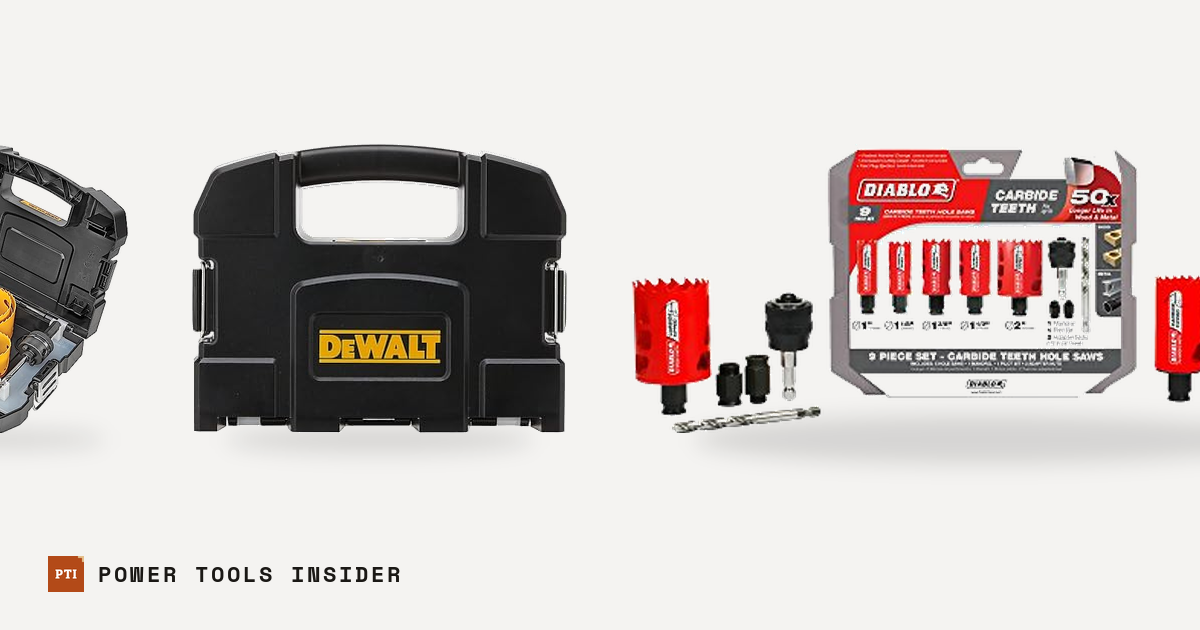
When bi-metal isn’t cutting it, literally, the Diablo carbide set is where you step up. Diablo’s TiCo high-density carbide teeth are in a different league from bi-metal: they cut stainless steel, cast iron, nail-embedded wood, and abrasive materials without flinching. Diablo claims 50x the cutting life of standard bi-metal saws, and while that number depends on the material, the real-world difference is dramatic. Where a bi-metal saw gets hot and dull after a few cuts in stainless, the Diablo carbide just keeps going.
The kit includes five saw sizes (1″, 1-1/8″, 1-3/8″, 1-1/2″, and 2″) plus Diablo’s 4-piece Snap-Lock Plus mandrel system, which lets you swap saw cups without any tools. The 2-3/8″ cutting depth is 40% deeper than most competitors, so you can cut through thicker stock in a single pass. The sizes lean toward electrical and plumbing applications. If you need larger carbide saws for doorknob bores or recessed lights, you’ll have to buy those individually. But for the sizes included, this kit is the best carbide option on the market at any price.
Pros
- TiCo carbide teeth last dramatically longer than bi-metal
- Cuts stainless steel, cast iron, nail-embedded lumber
- 2-3/8″ cutting depth, deepest in this roundup
- Tool-free Snap-Lock Plus mandrel system
- Universal arbor fits all major brands
Cons
- Only 5 saw sizes, no 2-1/8″ or larger
- Higher price per saw than bi-metal kits
- Overkill for basic wood and drywall jobs
| Spec | Value |
|---|---|
| Pieces | 9 total (5 saws, 4-piece mandrel system) |
| Size Range | 1″ to 2″ |
| Tooth Material | Carbide-tipped (TiCo) |
| Cutting Depth | 2-3/8″ |
| Arbor Included | Yes (Snap-Lock Plus system) |
| Case Included | No (individual packaging) |
Bottom Line: If you’re cutting anything harder than pine and drywall on a regular basis, the Diablo carbide set pays for itself in the first week. The go-to choice for plumbers, remodelers, and anyone tired of burning through bi-metal saws.
Bosch HSBIM9 9-Piece Bi-Metal Kit, Best Value Bi-Metal
Price: ~$40 | Rating: 4.7/5
The Bosch HSBIM9 punches well above its price point. At around $40, you’re getting a 9-piece kit with six saw sizes, two universal arbors, and a pilot bit, all with Bosch’s Progressor tooth design. That alternating tooth pattern is the secret sauce: the large teeth make aggressive cuts in thick materials, while the smaller teeth deliver cleaner finishes in thinner stock. In head-to-head testing, the Bosch saws produced the fastest cutting speeds among the bi-metal kits we evaluated.
The 8% cobalt alloy construction gives these saws better heat resistance than standard HSS, which translates to longer life when cutting metal. The universal SpinLock arbor fits hole saws from all major brands, so you’re not locked into the Bosch ecosystem. One nice detail: the reinforced shoulders on each saw prevent deformation during heavy use, which is a common failure point on cheaper hole saws. The included plastic case is basic but functional. For the price, it’s hard to find a better-performing bi-metal kit from a name brand.
Pros
- Progressor tooth design delivers fastest cuts
- 8% cobalt alloy for better heat resistance
- Universal arbor fits all major brands
- Excellent price-to-performance ratio
Cons
- Only 6 saw sizes, gaps in the lineup
- No 2-1/8″ for doorknob bores
- Plastic case feels flimsy
| Spec | Value |
|---|---|
| Pieces | 9 total (6 saws, 2 arbors, 1 pilot bit) |
| Size Range | 3/4″ to 2″ |
| Tooth Material | Bi-metal (8% cobalt alloy) |
| Cutting Depth | 1-5/8″ |
| Arbor Included | Yes (2 universal SpinLock arbors) |
| Case Included | Yes (plastic case) |
Bottom Line: Best bang for your buck in a name-brand bi-metal kit. The Bosch Progressor teeth cut noticeably faster than the competition, and the cobalt alloy construction means they’ll last. A smart pick for DIYers who want quality without paying pro prices.
HYCHIKA 17-Piece Bi-Metal Hole Saw Kit, Best Budget
Price: ~$25 | Rating: 4.4/5
Here’s the thing about the HYCHIKA kit: at $25, you get 11 saw sizes from 3/4″ to 2-1/2″, two mandrels, three drill bits, and a hex key in a blow-molded case. That’s more pieces than the DEWALT master kit at less than half the price. Are the individual saws as good as DEWALT or Bosch? No. The HSS cutting edge is thinner and will dull faster in hardwood and metal. But for occasional DIY use, hanging a few doors, running some cable, cutting through drywall and softwood, they get the job done.
The 2mm blade thickness and high-hardness alloy steel (69-81 HRC) are respectable specs for this price point, and users consistently report clean cuts in wood, PVC, and drywall. Where the HYCHIKA falls short is on tougher materials: don’t expect these to last through multiple cuts in metal or hardwood. If you’re a homeowner who needs a hole saw set for occasional projects and doesn’t want to spend $60+, this is the clear winner. If you’re a pro using hole saws daily, spend more.
Pros
- Unbeatable price, 17 pieces for around $25
- 11 saw sizes cover 3/4″ to 2-1/2″
- Includes mandrels, drill bits, hex key, and case
- Works well on wood, drywall, and PVC
Cons
- Thinner teeth dull faster than premium brands
- Struggles with hardwood and metal
- Mandrel quality is just adequate
- Not built for daily professional use
| Spec | Value |
|---|---|
| Pieces | 17 total (11 saws, 2 mandrels, 3 bits, 1 hex key) |
| Size Range | 3/4″ to 2-1/2″ |
| Tooth Material | Bi-metal (HSS edge) |
| Cutting Depth | ~1-5/8″ |
| Arbor Included | Yes (2 mandrels) |
| Case Included | Yes (blow-molded case) |
Bottom Line: The best hole saw kit you can buy for under $30. Perfect for homeowners and occasional DIYers who need a complete set without the professional price tag. Just don’t expect it to perform like a DEWALT on tough materials.
Drilax 10-Piece Diamond Hole Saw Set, Best for Tile and Stone
Price: ~$35 | Rating: 4.5/5
If you’re tiling a bathroom, installing a faucet through a granite countertop, or cutting holes in glass, you need diamond, not bi-metal, not carbide. The Drilax 10-piece set covers sizes from 1/4″ to 2″ with nickel-bonded diamond grit that grinds cleanly through porcelain, ceramic tile, granite, marble, quartz, and glass. The set includes a removable poly guide insert that helps keep the bit centered on smooth, slippery tile surfaces, a detail that saves a lot of frustration.
Drilax is a U.S.-based company (Warren, New Jersey) that specializes in diamond drilling tools, and it shows in the quality. The bits use a consistent diamond particle distribution for even wear, and the standard 3/8″ shank fits any drill. You must use water for cooling when drilling with diamond bits, dry drilling will burn them out immediately. Run your drill at low speed (under 800 RPM for most sizes, slower for larger diameters) with steady, moderate pressure. The included sizes cover most tile work: 1-3/8″ for faucet holes, 1/2″ for shower valve pipes, and 1/4″ for anchor bolts. For larger openings like shower drains (2″+), you may need to buy individual bits.
Pros
- Diamond grit handles porcelain, granite, marble, glass
- 10 sizes from 1/4″ to 2″ cover most tile work
- Includes centering guide for smooth surfaces
- Clean, chip-free cuts when used correctly
- Reusable storage case
Cons
- Must use water cooling, no dry cutting
- Requires slow speed and patience
- Only works on tile, stone, and glass, not wood or metal
- Shorter cutting depth than bi-metal saws
| Spec | Value |
|---|---|
| Pieces | 10 saws + guide insert + case |
| Size Range | 1/4″ to 2″ |
| Tooth Material | Diamond grit (nickel-bonded) |
| Cutting Depth | ~1-1/8″ |
| Arbor Included | Integrated 3/8″ shank |
| Case Included | Yes (zippered case) |
Bottom Line: The only option for cutting tile, stone, and glass. If you have a bathroom renovation or countertop project, the Drilax set delivers clean holes without cracking your expensive materials. Remember: water cooling is mandatory, not optional.
Full Specs Comparison
| Model | Pieces | Size Range | Material | Cut Depth | Arbor | Price |
|---|---|---|---|---|---|---|
| DEWALT D180005 | 14 (11 saws) | 3/4″ – 2-1/2″ | Bi-metal | 1-7/8″ | 2 included | ~$65 |
| DEWALT D180002 | 9 (6 saws) | 7/8″ – 2-1/2″ | Bi-metal | 1-7/8″ | 2 included | ~$50 |
| Diablo DHS09SGPCT | 9 (5 saws) | 1″ – 2″ | Carbide | 2-3/8″ | Snap-Lock | ~$80 |
| Bosch HSBIM9 | 9 (6 saws) | 3/4″ – 2″ | Bi-metal | 1-5/8″ | 2 included | ~$40 |
| HYCHIKA 17-Piece | 17 (11 saws) | 3/4″ – 2-1/2″ | Bi-metal | ~1-5/8″ | 2 included | ~$25 |
| Drilax 10-Piece | 10 saws | 1/4″ – 2″ | Diamond | ~1-1/8″ | Integrated | ~$35 |
Prices are approximate as of February 2026 and may vary.
Tips for Clean Holes Every Time
Even the best hole saw will produce garbage results if you use it wrong. Here are the techniques that separate clean cuts from blown-out messes.
Let the pilot bit do its job. The pilot drill bit isn’t just for centering, it establishes the hole before the saw teeth engage. Mark your center point, start drilling at moderate speed until the pilot is fully through, then let the saw teeth begin cutting. If you push too hard before the pilot is set, the saw will walk across the surface.
Control your speed. Slower is almost always better with hole saws. In wood, 500-1,000 RPM works for most sizes. In metal, drop to 150-300 RPM. In tile with diamond bits, stay under 800 RPM. Running too fast overheats the teeth, dulls them prematurely, and can burn the material. If you see smoke, you’re going too fast or pushing too hard.
Clear chips frequently. Every few seconds, pull the saw out of the cut to clear sawdust and chips. This prevents the saw from binding, reduces heat buildup, and produces cleaner cuts. This is especially important in deeper cuts and hardwood, trapped chips generate friction heat that ruins both the saw and the workpiece.
Use a backing board to prevent tear-out. When cutting through plywood, MDF, or painted surfaces, clamp a scrap piece of wood behind your workpiece. When the saw breaks through the back side, it cuts into the backer instead of blowing out a chunk of your good material. This is the single biggest difference between a clean hole and a ragged one. For a deeper dive into clean drilling technique, check out our guide on why drill bits break and how to prevent it.
Apply cutting oil on metal. For any metal thicker than sheet metal, use cutting oil or WD-40 on the cut line. This reduces friction, extends tooth life dramatically, and produces cleaner cuts. For tile and stone with diamond bits, use plain water, keep a spray bottle handy and mist the cut continuously.
Frequently Asked Questions
Can I use a hole saw in a drill press?
Yes, and it’s actually the ideal setup for precision work. A drill press gives you perfectly vertical holes and consistent speed control. Use the lowest speed setting appropriate for your material and clamp your workpiece securely. The one caution: never use a drill press without clamping the material down. A hole saw can catch and spin the workpiece violently if it’s not secured.
Why does my hole saw keep getting stuck?
The most common reasons are: cutting too fast without clearing chips, a dull saw that generates heat instead of cutting, or the saw teeth binding in the kerf. Pull the saw out every few seconds to clear sawdust. If the saw is dull, replace it. Also check that your pilot bit isn’t bent, as a wobbling pilot creates an uneven kerf that causes binding. Using cutting oil on metal helps prevent binding.
How do I remove the plug from a hole saw?
Most hole saws have slots in the side of the cup. Insert a flat-head screwdriver into the slot and pry the plug out. If there’s no slot, you can push the plug out from the back by inserting a dowel through the pilot bit hole and tapping it with a hammer. Some mandrels have a spring-loaded ejection feature. Never try to pry the plug out while the saw is still spinning.
What speed should I run a hole saw?
It depends on the material and hole diameter. For wood: 500-1,000 RPM for smaller sizes, 250-500 RPM for larger. For metal: 150-300 RPM. For tile and stone with diamond bits: 400-800 RPM. The general rule is larger diameter equals slower speed. If you see smoke or the saw feels hot, slow down. A variable-speed drill gives you the control you need.
Can I sharpen a hole saw?
Bi-metal hole saws can be touched up with a small file or diamond hone by carefully dressing each tooth at the original angle. Carbide-tipped saws can be sharpened with a diamond file but it takes patience. Diamond saws cannot be sharpened. In practice, most pros replace dull hole saws rather than sharpen them, since the time spent sharpening often costs more than a replacement saw.
Do I need a special arbor for each hole saw brand?
Most modern hole saws use standardized arbor threads, so a Bosch arbor will fit a DEWALT saw and vice versa. However, some brands like Diablo use proprietary quick-change systems like the Snap-Lock Plus that only work with their own saws. Always check the arbor thread size when mixing brands. Universal arbors from Bosch and DEWALT fit the widest range of saws. For more on drill accessories and compatibility, see our drill bit sets guide.
Power Tool Insider is reader-supported. When you buy through links on our site, we may earn an affiliate commission at no extra cost to you. This doesn’t affect our recommendations, we only recommend tools we’d actually use. Full disclosure.