A bad stud finder is worse than none at all, you trust the beep, drill into drywall, and hit nothing. The real problem with most stud finders is that they use one or two sensors and rely on a slow, calibration-dependent edge-finding routine. Move too fast, start too close to a stud, or hit a seam and you get bad readings.
The Franklin ProSensor line solved this with a multi-sensor array that shows you the full stud width the moment you touch the wall. For most homeowners and contractors, that’s the beginning and end of the buying decision. The only case to go elsewhere: if you need to detect AC wiring and metal simultaneously, then the Zircon A200 earns its keep.
These are the best stud finders for 2026, tested across standard framing, engineered lumber, and thicker drywall applications.
Best Stud Finders 2026, Quick Picks
| Pick | Model | Price | Best For |
|---|---|---|---|
| Best Overall | Franklin ProSensor 710+ | $42.36 | Same 13-sensor array as the 710, plus a bubble level. Fastest workflow |
| Best Upgrade | Franklin ProSensor M210 | $59.97 | Most accurate, engineered lumber and thick drywall |
| Best Multi-Scanner | Zircon A200 | $56.99 | Wood + metal + AC detection, complex installs |
Full Reviews
1. Franklin ProSensor 710+, Best Overall Stud Finder

Price: Around $42 | Buy Now on Amazon
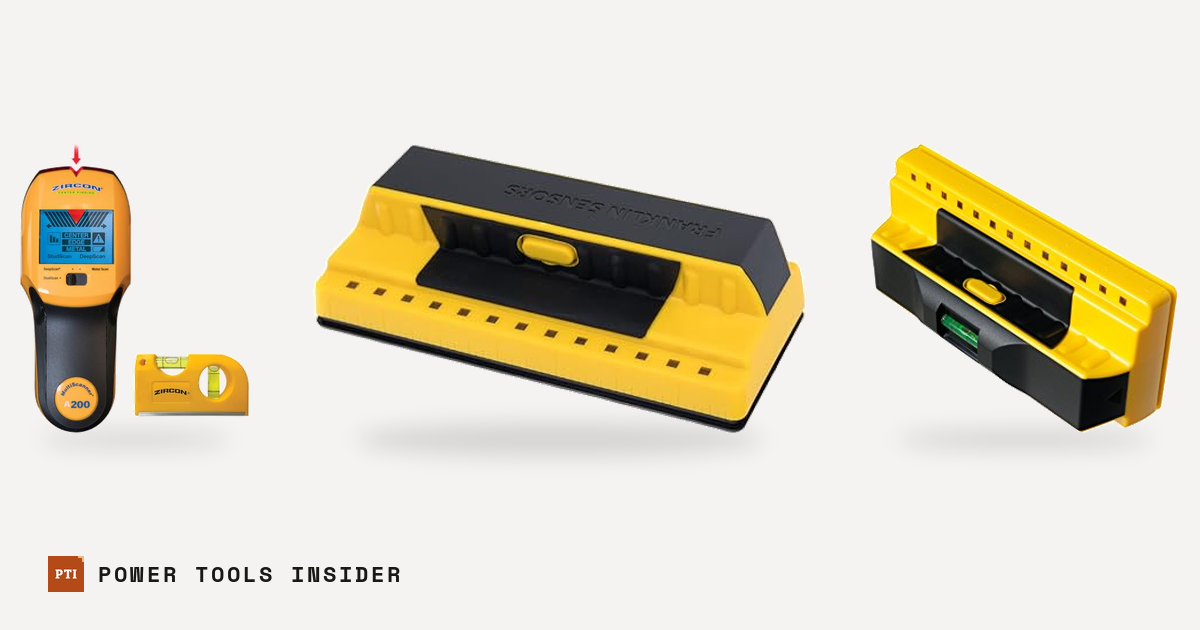
The ProSensor 710 uses 13 sensors arrayed across its face instead of the 1, 2 sensors found in edge-finding finders. LEDs light up across the face to show you the entire stud width in real time, no slow sweep, no calibration ritual, no false positives at outside corners. Place it against the wall, see the stud, mark it, move on.
On standard 1/2″ drywall over 16″ OC framing, this cuts locate time dramatically versus conventional finders. For hanging TV mounts, shelves, cabinet rails, and towel bars, it handles 90% of residential installs without any learning curve.
The 710 is a wood-stud finder only. No AC detection, no metal mode. It’s also rated for standard drywall depth, if you’re working through 5/8″ or double-layer drywall (older garages, commercial build-outs), step up to the M210. But for standard construction, this is the right tool at the right price.
Pros:
- 13-sensor array shows full stud width at a glance
- No calibration needed, works at corners and edges too
- One button, instant-on, straightforward operation
- Consistent on standard residential drywall
Cons:
- No AC or metal detection
- Depth limit, can struggle on very thick drywall
Bottom Line: Best stud finder for standard framing. If you’re doing routine residential work, buy this one.
2. Franklin ProSensor M210, Best for Pros
Price: Around $60 | Buy Now on Amazon
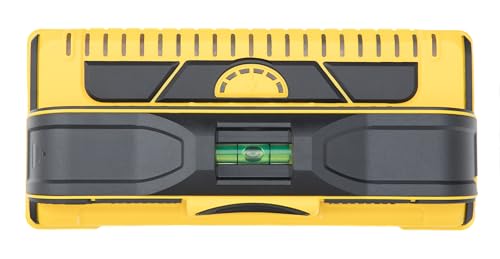
The M210 is Franklin’s most advanced stud finder, with more sensors than the 710 across a wider sensing face. The increased sensor count means deeper detection and better accuracy on materials where the 710 can give inconsistent readings: engineered lumber (LVL, I-joists), 5/8″ drywall, cement board, and tiled surfaces over drywall.
The form factor is wider and flatter than the 710, designed to press flush against the wall with less wrist angle. For professionals making dozens of locates per job, drywall installers, electricians doing retrofit work, tile setters marking backing board, the M210’s improved depth performance pays for itself quickly.
The M210 still doesn’t detect AC or metal. It’s a dedicated stud finder with a deeper and more accurate read. For mixed-material detection on a single tool, look at the Zircon A200.
Pros:
- More sensors than the 710, better depth and accuracy
- Handles engineered lumber and thicker substrates
- Wider sensing face covers more wall area per pass
- Same no-calibration operation as the 710 line
Cons:
- No AC or metal detection
- Costs ~$7 more than the 710, modest difference for a significant upgrade
Bottom Line: The right upgrade for professionals or anyone working with engineered lumber or thicker drywall. The extra detection depth is worth the $7 premium over the 710.
3. Zircon MultiScanner A200, Best Multi-Scanner
Price: Around $57 | Buy Now on Amazon
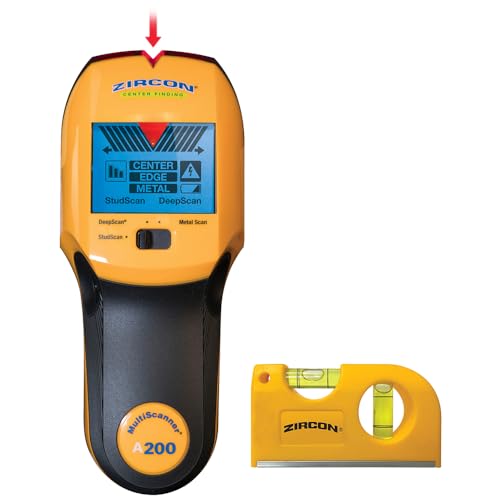
The Zircon A200 scans for three things: wood studs, metal objects (including metal studs, rebar, and conduit), and live AC wiring. For situations where you genuinely need all three, mounting a TV above a fireplace with a metal flue, installing outlets in an older home with irregular wiring paths, working in a garage with metal stud framing, this is the tool that covers the bases.
Zircon built ACT (Auto Correcting Technology) into the A200 to reduce the most common user error with edge-finding finders: starting a scan too close to a stud, which throws off calibration. ACT detects this and prompts you to reposition before giving a reading.
The bundle version (B0FXH7NLB3) includes a mini pocket level, useful for layout but not why you’re buying this tool. The A200 operates in separate stud, metal, and AC modes, you pick the mode for what you’re hunting. For purely stud-finding work, the Franklin 710 will be faster. But for mixed-material detection on one device, the A200 does the job.
Pros:
- 3-in-1: wood studs, metal, live AC wiring
- ACT corrects calibration errors automatically
- Handles metal studs, useful in commercial interiors
- Bundle includes a mini level
Cons:
- Separate modes, slower workflow than Franklin’s all-at-once display
- Edge-finding approach still requires a deliberate sweep
Bottom Line: Best when you need to detect multiple hazards or materials. For TV installations above fireplaces, metal stud work, or older homes with questionable wiring paths, the A200 earns its place in the tool bag.
4. Franklin ProSensor 710+, Also Consider
Price: Around $54 | Buy Now on Amazon
The 710+ shares the same 13-sensor core as the 710 with a slightly different indicator system. At a $1 price difference, the choice between 710 and 710+ mostly comes down to availability and which listing Amazon has in stock. The detection performance is effectively identical, both locate standard wood studs through 1/2″ drywall without calibration.
If the 710 and 710+ are priced equally, go with whichever has the better shipping date. If there’s a meaningful price gap, take the cheaper one, the core technology is the same.
Pros:
- Same 13-sensor ProSensor technology as the 710
- Comparable performance at comparable price
Cons:
- Minimal advantage over the standard 710
- No AC or metal detection
Bottom Line: A solid backup choice if the 710 is out of stock. Not worth paying significantly more for it over the standard 710.
How to Choose a Stud Finder
Multi-Sensor vs. Edge-Finding
The biggest split in stud finders is between multi-sensor finders (Franklin ProSensor line) and edge-finding finders (most everything else, including Zircon’s conventional mode).
Edge-finding finders sweep across the wall, detect a change in capacitance when they cross a stud edge, and beep. They require calibration away from a stud, a slow sweep speed, and the user to triangulate between two edges to find center. Common errors: starting too close to a stud, sweeping too fast, or hitting a seam.
Multi-sensor finders (ProSensor) read across the entire sensing face simultaneously. They show you the full stud width the moment you touch the wall. No calibration, no sweep. Much faster for high-volume work, and fewer false positives.
The tradeoff: multi-sensor units typically only detect wood studs. If you need metal detection or AC warning, you need an edge-finding unit with those modes (like the Zircon A200).
Detection Depth
Standard 1/2″ drywall: most finders handle this. The Franklin 710 and Zircon A200 are both rated for standard residential construction.
5/8″ drywall or double-layer: common in commercial construction, renovated garages, and some fire-rated assemblies. If you encounter this regularly, the M210 is worth the upgrade.
Tile over cement board: this is where most consumer stud finders struggle. The M210’s additional sensors help, but results are less consistent. Professional installations over tile typically use a longer screw-test on sacrificial areas.
Metal Studs
Metal stud framing is common in commercial construction, basement finishing, and some newer residential builds. Wood-only finders won’t reliably detect metal studs. The Zircon A200’s metal mode handles this, it reads the metallic signature rather than a capacitance change.
When AC Detection Matters
AC detection warns you when a live wire is running near a stud. It’s most relevant when:
- Drilling in unfamiliar walls where you don’t know wire routing
- Installing electrical boxes or mounting hardware near outlets
- Working in older homes where wiring was run unconventionally
AC detection on consumer finders is a warning system, not a precise locator. It can read through drywall but not deep into walls. Always follow standard safety practice: turn off the circuit at the breaker before drilling near any suspect area. See our best non-contact voltage tester guide if you need to actually test for live voltage before drilling.
Frequently Asked Questions
What’s the most accurate stud finder available?
The Franklin ProSensor M210 is the most accurate consumer stud finder currently available. Its multi-sensor array gives it better depth performance and fewer false positives than both conventional edge-finding finders and the earlier 710. For professionals doing high-volume work on varied substrates, it’s the right call.
Do I need AC detection on a stud finder?
For most standard framing work, hanging shelves, cabinet rails, TV mounts in typical residential walls, no. If you’re working near known wiring paths, above outlet boxes, or in unfamiliar older construction, AC detection gives you a useful early warning. The Zircon A200 covers this if you need it.
Why does my stud finder give false positives?
Common causes: starting calibration too close to a stud (the finder thinks “clear” is already over a stud), sweeping too fast, drywall seams and joint compound (different density than gypsum), or pipes and conduit behind the wall. Multi-sensor finders like the Franklin ProSensor line largely eliminate calibration false positives by not requiring calibration at all.
Can a stud finder work on plaster walls?
Yes, with caveats. Plaster walls have a different capacitance than drywall, and the wire mesh or metal lath in some plaster walls will trigger false metal detections. The Franklin ProSensor line handles plain plaster (without lath) reasonably well. On wire-lath plaster, use a strong rare-earth magnet to find the screws or nails in the studs, it’s more reliable than any electronic finder on that substrate.
How deep do stud finders detect?
Most consumer stud finders are rated for 3/4″ to 1″ total wall depth (including the drywall and any surface material). The Franklin 710 is rated for standard 1/2″ drywall. The M210 handles 5/8″ and thicker substrates more consistently. For walls with tile or multiple layers, standard finders become unreliable and you’ll need to use a pilot hole and probe method.
For drilling the pilot holes, see our pilot hole size chart, it covers the right bit size for screws into studs and framing.
Related Articles
Prices verified at time of publication. Amazon pricing changes frequently, check the current price before purchasing. All product links use our affiliate tag and help support Power Tools Insider at no cost to you.