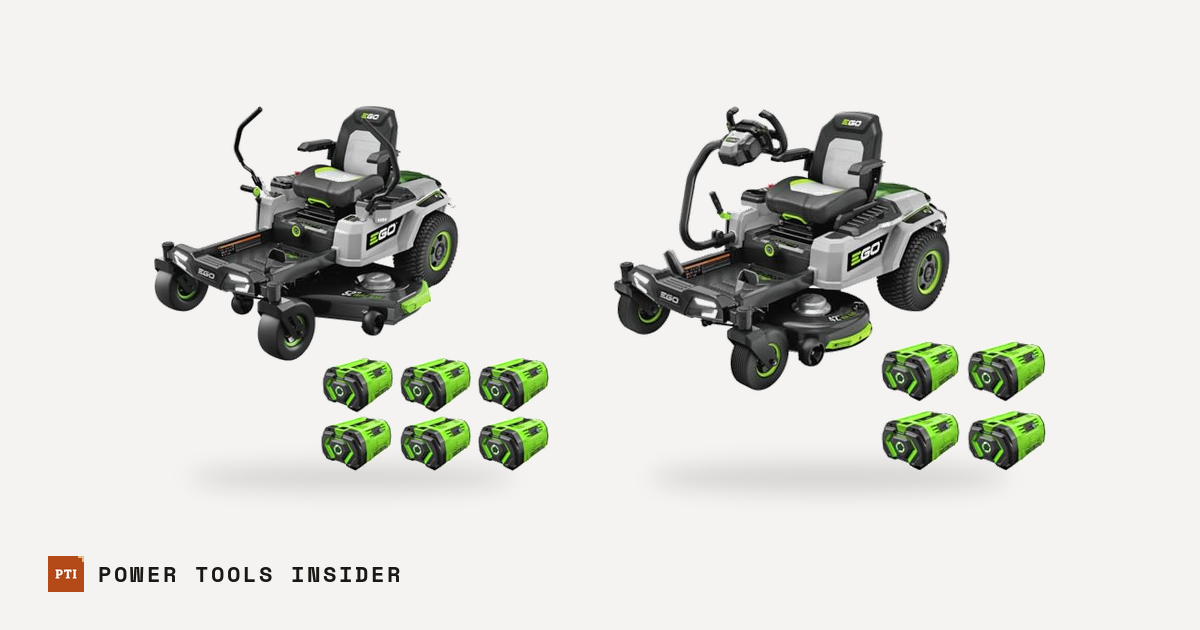
Gas riding mowers have had a monopoly on the category for decades. Not because battery couldn’t match them on power, but because no one had made a battery riding mower that could cut an acre in a single charge. In 2026, that’s changed. EGO’s Z6 does 2.5 acres. Ryobi’s ZR3 does 2 acres. The crossover point where battery riding mowers make financial and practical sense has arrived for most suburban and semi-rural properties.
This guide covers the models worth considering for 2026: EGO Z6 (three configurations), Ryobi R1 and ZR3, Greenworks CrossoverZ, and where the John Deere Z370R fits as a gas benchmark. Prices range from $2,999 to $6,999. At 3% affiliate commission, a single sale earns $90-$210, the highest-value product category on this site.
Quick Picks: Best Battery Riding Mowers 2026
| Best For | Model | Deck / Runtime | Price | Buy |
|---|---|---|---|---|
| Best for ½-1 Acre | Ryobi R1 30″ Rider | 30″ / 1 acre/charge | $2,999 | Buy Now |
| Best Value Zero-Turn | Ryobi ZR3 42″ Zero-Turn | 42″ / 2 acres/charge | $3,999 | Buy Now |
| Best for Beginners (Steering Wheel) | EGO Z6 e-STEER 42″ | 42″ / ~2.5 acres/charge | ~$3,999 | Buy Now |
| Best Performance | EGO Z6 52″ Lap Bar | 52″ / up to 4 acres/charge | ~$6,999 | Buy Now |
Ryobi R1 and ZR3 are Home Depot exclusives, not available on Amazon. EGO Z6 models are available on Amazon and Home Depot. Battery and charger included with all models listed.
The Reviews
Ryobi R1 80V HP 30″ Riding Mower, Best for Half-Acre to One-Acre Properties
Price: $2,999 at Home Depot (battery and charger included) | Deck: 30″
At $2,999 with battery and charger included, the Ryobi R1 is the lowest entry point into battery riding mowers from a major brand. Three brushless motors power the 30-inch cutting deck through up to one full acre per charge using the included 80V 14Ah battery. A second battery port is built in for extended runtime, if you add a second 14Ah pack, you can keep going without stopping to recharge.
The R1 runs on Ryobi’s 80V HP platform. The existing 80V batteries from other Ryobi tools (chainsaws, blowers, string trimmers) work in the R1, though runtime will vary since those packs are typically lower capacity than the included 14Ah. For homeowners already in the 80V ecosystem, that cross-compatibility adds real value. If you’re starting fresh, the R1 kit is self-contained.
The 30-inch deck is narrower than most gas riders, typically 42-46 inches at this price. That means more passes per acre, but also means the R1 fits through tighter gates and around obstacles that wider zero-turns can’t navigate. For properties with fence lines, garden beds, or tight corners, the extra maneuverability offsets the slower mow time.
Pros
- $2,999 with battery and charger, lowest price point from a major brand
- Cuts up to 1 acre per charge on included 14Ah battery
- Second battery port for extended runtime
- 30″ deck navigates tight spaces better than wider ZTRs
- 80V HP cross-compatible with Ryobi 80V tools
- 3 brushless motors, equivalent to 16 HP gas
Cons
- 30″ deck = more passes per acre than 42″ models
- Home Depot exclusive, no Amazon availability
- First-generation platform, limited long-term track record
- 80V ecosystem smaller than EGO 56V or Ryobi 40V
| Spec | Value |
|---|---|
| Cutting Width | 30 inches |
| Voltage | 80V HP (3-motor system) |
| HP Equivalent | ~16 HP gas equivalent |
| Runtime | Up to 1 acre (included 14Ah battery) |
| Battery Ports | 2 (second port for extended runtime) |
| Includes | Mower + 80V 14Ah battery + charger + mulch plug |
| Available At | Home Depot only |
| Price | $2,999 |
Bottom Line: The right pick for half-acre to one-acre properties where budget matters and tight maneuvering is a priority. The 30-inch deck is slower than a 42-inch ZTR on open lawns, but it handles obstacles that wider mowers can’t. Buy from Home Depot, $2,999 with battery included.
Ryobi ZR3 80V HP 42″ Zero-Turn, Best Value Zero-Turn
Price: $3,999 at Home Depot (2 batteries + charger included) | Deck: 42″
The ZR3 is Ryobi’s flagship: a 42-inch fabricated steel deck on a zero-turn frame powered by four brushless motors and two 80V 14Ah batteries. Ryobi rates the equivalent output at 25 HP and the runtime at up to two full acres per charge. Deck height adjusts across 15 positions from 1 to 4.5 inches, and the deck releases quickly for cleaning or storage.
For 1-2 acre properties, this is the most affordable new-from-manufacturer zero-turn with battery power on the market. Gas zero-turns with a 42-inch deck and 25 HP equivalent from Husqvarna or Cub Cadet run $2,500-$4,500, the ZR3 lands at exactly $3,999 with two batteries included, a price that competes directly with mid-range gas units while eliminating fuel, oil changes, and pull-cord maintenance.
The zero-turn format matters here. A zero-turn radius dramatically cuts mow time versus a traditional riding tractor, the ZR3 can pivot around trees, beds, and edges without backing up repeatedly. For properties with multiple obstacles (mature trees, landscaping beds, utility boxes), a ZTR cuts mow time by 30-50% compared to a traditional rider.
Pros
- 42″ fabricated steel deck with 15 height positions (1″-4.5″)
- 2 acres per charge on 2x 80V 14Ah batteries (both included)
- 4 brushless motors, equivalent to 25 HP gas
- Zero-turn radius for faster, more precise mowing
- $3,999 with full kit, competes with mid-range gas ZTRs
- Quick-release deck for cleaning and maintenance
Cons
- Home Depot exclusive, no Amazon availability
- Lap bar controls have a learning curve (vs. steering wheel)
- First-generation on this platform, reliability data still accumulating
- 80V ecosystem is smaller than EGO 56V
| Spec | Value |
|---|---|
| Cutting Width | 42 inches |
| Deck Construction | 12-gauge fabricated steel |
| Voltage | 80V HP (4-motor system) |
| HP Equivalent | ~25 HP gas equivalent |
| Runtime | Up to 2 acres per charge |
| Includes | Mower + 2x 80V 14Ah batteries + charger |
| Deck Height | 1″-4.5″, 15 positions |
| Controls | Lap bars (zero-turn) |
| Available At | Home Depot only |
| Price | $3,999 |
Bottom Line: The best value battery zero-turn for 1-2 acre properties. Two batteries and a 42-inch steel deck at $3,999 undercuts mid-range gas ZTRs on total cost while eliminating fuel and maintenance. More on the Ryobi 80V riding mower launch.
EGO Z6 42″ e-STEER, Best for Steering Wheel Buyers
Price: Around $3,999 (check current pricing) | Deck: 42″
Check EGO Z6 e-STEER 42″ on Amazon
EGO’s e-STEER model is the most significant product development in battery riding mowers in 2026: a zero-turn mower controlled by a steering wheel instead of lap bars. EGO calls it the industry’s first steering wheel on a cordless zero-turn. The e-STEER electronics translate steering wheel input into zero-turn radius movement, you get the speed and efficiency of a ZTR with the familiar feel of a conventional tractor.
This matters for a specific buyer: homeowners who’ve avoided ZTRs because lap bar controls feel intimidating or imprecise. Traditional riding tractors are slower, they can’t pivot in place and require wider turns. But lap bar ZTRs have a real learning curve, and some homeowners have damaged landscaping or tipped on slopes while getting used to them. The e-STEER eliminates that learning curve.
The 42-inch deck runs on four EGO 56V 12.0Ah batteries with 22 HP equivalent output and up to 2.5 acres per charge at speeds up to 8 MPH. The 56V platform is EGO’s advantage over Ryobi’s 80V system: those same batteries work across EGO’s 200+ handheld tools, string trimmers, leaf blowers, chainsaws. Every EGO battery you already own works in the Z6.
Pros
- Steering wheel controls, zero learning curve for tractor-trained buyers
- 42″ deck, 2.5 acres per charge (4x 56V 12.0Ah batteries)
- 22 HP equivalent, 8 MPH max speed
- EGO 56V cross-compatible with 200+ EGO handheld tools
- Color LCD display: real-time battery status, drive mode, operating data
- 3 drive modes: Control, Standard, Sport
Cons
- Higher cost than Ryobi ZR3 at the same deck size
- Requires 4x 56V 12.0Ah batteries (very high capacity packs)
- More expensive than Ryobi ZR3 at same 42″ deck size
| Spec | Value |
|---|---|
| Model | ZT4205S (e-STEER) |
| Cutting Width | 42 inches |
| Controls | Steering wheel (not lap bars) |
| Voltage | 56V ARC Lithium × 4 batteries |
| HP Equivalent | ~22 HP gas equivalent |
| Runtime | Up to 2.5 acres per charge |
| Max Speed | 8 MPH |
| Price | ~$3,999 (verify before purchase) |
Bottom Line: The only battery zero-turn with steering wheel controls. If you’re coming from a conventional riding tractor, this is the most natural transition. EGO ecosystem buyers get cross-platform battery compatibility that Ryobi’s 80V platform can’t match. Full EGO Z6 2026 lineup breakdown.
EGO Z6 52″, Best Performance for Large Properties
Price: Around $6,999 | Deck: 52″ | Rating: 4.2
The Z6 52-inch is the top-of-line: five independent brushless motors, 25 HP equivalent, six 56V 12.0Ah batteries, and up to four acres per charge. For properties over 2 acres where you’re mowing weekly, the runtime and cutting width combination means a full property cut in one session without stopping. The 52-inch deck covers more ground per pass than any other battery model in this roundup.
At $6,999, this is a premium product, and it sits squarely in the price range of contractor-grade gas zero-turns from Husqvarna and Bad Boy Mowers. The EGO’s value proposition: zero fuel cost, no oil changes, significantly lower noise (critical for early-morning or HOA-restricted communities), and the same battery chemistry that powers your entire EGO handheld lineup.
The Z6 52″ features a color LCD display (new for 2026) with real-time battery status across all six packs, plus a wider wheel track (+80mm over previous gen) for improved stability on slopes. Hydraulic seat suspension is included. Three drive modes (Control, Standard, Sport) let you match speed to terrain. The Speed mode is genuinely fast, 10 MPH, faster than most gas ZTRs at this price.
Pros
- 52″ deck, highest coverage per pass in this roundup
- 4 acres per charge on 6x 56V 12.0Ah batteries
- 5 independent brushless motors, most complex drivetrain here
- Color LCD display with 6-battery status monitoring
- Hydraulic seat suspension
- 10 MPH top speed in Sport mode
- EGO 56V cross-compatible with full EGO lineup
Cons
- $6,999, significantly more than Ryobi ZR3 at same 42″
- Requires 6x 12.0Ah batteries (4-hour charge time for full set)
- Lap bar controls only at this deck size
- Overkill for properties under 2 acres
| Spec | Value |
|---|---|
| Model | ZT5207L (52″ lap bar) |
| Cutting Width | 52 inches |
| Voltage | 56V ARC Lithium × 6 batteries |
| HP Equivalent | ~25 HP |
| Runtime | Up to 4 acres per charge |
| Max Speed | 10 MPH (Sport mode) |
| Drive Modes | Control / Standard / Sport |
| Display | Color LCD (battery status, drive mode, data) |
| Price | ~$6,999 |
Bottom Line: The most capable battery riding mower available for residential use. For 2-4 acre properties where you want a single-session cut and don’t want to deal with gas, this is the benchmark. Price is premium, Ryobi’s ZR3 at $3,999 handles up to 2 acres for significantly less.
Battery Riding Mower Buying Guide
Match Deck Size to Property Size
| Property Size | Recommended Pick | Deck Width | Runtime Needed |
|---|---|---|---|
| Under ½ acre | Walk-behind mower (see below) | 21″-22″ | 30-45 min |
| ½-1 acre | Ryobi R1 | 30″ | 1 acre/charge |
| 1-2 acres | Ryobi ZR3 or EGO Z6 42″ | 42″ | 2-2.5 acres/charge |
| 2-4 acres | EGO Z6 52″ | 52″ | 4 acres/charge |
| 4+ acres | Gas ZTR (battery not yet there) | 48″-60″ | Unlimited (gas) |
For properties under half an acre, a battery riding mower is overbuilt and over-priced. A battery walk-behind mower (EGO LM2135SP at $649, Greenworks 80V at $629) handles sub-acre lots in 20-30 minutes for a fraction of the cost. Save the riding mower investment for properties where you’re mowing for over an hour.
Battery vs. Gas: Total Cost of Ownership
| Factor | Battery Riding Mower | Gas Zero-Turn (~$3,500) |
|---|---|---|
| Purchase price | $2,999-$6,999 | $2,500-$4,500 |
| Annual fuel cost | $0 | $80-$150 (gas + oil) |
| Annual maintenance | Blade sharpening only (~$20/yr) | Oil change + filter + spark plug (~$60-100/yr) |
| Startup every use | Key-start, instant | Pull cord or electric start, warm-up |
| Noise level | ~75 dB | ~95 dB |
| Winter storage | Remove batteries, store inside | Fuel stabilizer + full winterization |
| Battery replacement (10 yr) | ~$800-$1,200 (4-6 packs) | $0 |
Over 10 years, battery and gas riding mowers cost roughly the same once fuel and maintenance savings offset the battery replacement cost. The battery mower wins on convenience, no pull cord, no fuel smell, no winterization, quieter operation. Gas wins on runtime flexibility: you can always fill up and keep going. For most suburban homeowners mowing 1-3 hours per week during the season, battery is the better practical choice.
Charging Logistics
Battery riding mowers require more planning than gas. Key questions to answer before buying:
- How long does a full battery set take to charge? EGO’s Rapid Charger does 6 packs in ~4 hours. A single 14Ah Ryobi battery takes 90 minutes. If you need to mow twice per week, this matters.
- Do you have power at the shed? You need a 120V outlet where you park the mower. Extension cords work but are not ideal for daily use.
- Can you charge overnight? For weekly mowing schedules, plug in after each use and charge overnight. You’ll never start with a depleted pack.
- Do you own compatible batteries? EGO 56V owners get immediate cross-compatibility. Ryobi 40V owners do not, the R1 and ZR3 run on 80V HP, a different platform.
Terrain Considerations
Battery riding mowers handle slopes differently than gas. Most manufacturers rate safe slope operation at 15-20 degrees. The EGO Z6’s wider wheel track (+80mm for 2026) improves stability over the previous gen. If your property has significant hills (>15% grade), test the mower’s traction and stability before committing to slopes, all battery ZTRs can tip on aggressive inclines without proper technique.
Memorial Day: The Peak Buying Window
Memorial Day (May 23-26) is the biggest sale event of the year for outdoor power equipment. Home Depot and Amazon both run significant discounts on riding mowers during this window. For a $3,999 Ryobi ZR3, even a 10% sale saves $400. Our Memorial Day Power Tool Deals page tracks sales as they go live, check it before buying at full price during the spring. We’ll update pricing when retailers announce their sale events.
How This Compares to Battery Walk-Behind Mowers
If your property is under an acre, you don’t need a riding mower. See our Best Cordless Lawn Mowers 2026 guide for the top walk-behind picks, EGO LM2135SP ($649), Greenworks 80V self-propelled ($629), and Ryobi 40V options under $500. Walk-behind mowers are faster for tight spaces and significantly cheaper. Riding mowers earn their keep on properties where mowing takes over an hour.
For the full battery platform comparison across EGO 56V, Ryobi 40V/80V, and Greenworks 60V/80V ecosystems, see our Battery Platforms Compared 2026 guide. If you’re deciding between EGO and Greenworks specifically for your outdoor power setup, see our EGO vs Greenworks 2026 comparison.
Frequently Asked Questions
Are battery riding mowers powerful enough for a real yard?
Yes, for properties up to 2-4 acres. The Ryobi ZR3 equates to 25 HP gas, covers 2 acres per charge, and handles normal residential terrain including moderate slopes. The EGO Z6 52″ cuts 4 acres per charge with 5 brushless motors. These are no longer novelty products, they’re legitimate alternatives to gas ZTRs for suburban and semi-rural homeowners.
How long does a battery riding mower last on a charge?
Runtime depends on deck size and terrain. The Ryobi R1 covers 1 acre (30″ deck). The ZR3 covers 2 acres (42″ deck, 2 batteries). The EGO Z6 42″ covers 2.5 acres and the 52″ covers 4 acres. These ratings assume level terrain at moderate speed, hills and high grass cut runtime by 15-30%.
Is a battery riding mower worth it vs gas?
For 1-3 acre properties where you’re mowing weekly: yes, with conditions. The convenience (no fuel, no maintenance, quieter) outweighs the higher upfront cost for most suburban buyers. The total cost of ownership over 10 years is roughly equal to gas when you factor in fuel, oil changes, and eventual battery replacement. The break-even point is typically 5-7 years.
Which is better, EGO Z6 or Ryobi ZR3?
For 1-2 acre properties on a budget: Ryobi ZR3 ($3,999). For buyers already in the EGO 56V ecosystem (handheld tools, walk-behind mowers): EGO Z6 42″ e-STEER ($3,999) or lap bar model. For 2+ acre properties where performance matters most: EGO Z6 52″ ($6,999). The EGO platform’s cross-compatibility with 200+ handheld tools is its strongest argument over Ryobi’s 80V platform, which has a smaller accessory lineup.
Can I use my existing Ryobi batteries with the R1 or ZR3?
Only if they’re 80V HP batteries. Ryobi 18V ONE+, 40V, and 24V batteries are NOT compatible with the R1 and ZR3, which run on the 80V HP platform, a separate battery system. If you own Ryobi 40V lawn equipment, those batteries won’t work in the riding mowers. Check your existing batteries before buying. The included 14Ah 80V HP battery is the right pack for these mowers.
Do gas zero-turns still make sense in 2026?
For properties over 3-4 acres where you need unlimited runtime and maximum cutting width (48-60 inches): yes. Gas still wins on sustained power over multiple hours and fuel availability anywhere. For properties under 3 acres where you’re mowing once or twice per week: battery has reached parity on performance while winning on convenience and operating cost. The John Deere Z370R (gas, 42-inch, 20 HP) sits at $2,799, $1,200 less than the Ryobi ZR3 battery equivalent, but adds fuel costs and annual maintenance going forward.
Power Tool Insider is reader-supported. When you buy through links on our site, we may earn an affiliate commission at no extra cost to you. This doesn’t affect our recommendations, we only recommend tools we’d actually use. Full disclosure.