Power Tool Insider is reader-supported. When you buy through links on our site, we may earn an affiliate commission at no extra cost to you. This doesn’t affect our recommendations, we only recommend tools we’d actually use. Full disclosure.
A portable air compressor is the shop tool that multiplies everything else. One unit runs your finish nailer on trim work, inflates truck tires in the driveway, and blows sawdust out of the tablesaw. They sit in the same category as extension cords and shop vacs, tools you don’t think about until you need one, and then you think about constantly.
We evaluated six models across every use case: the budget pancake that dominates Amazon bestseller lists, the oil-lubricated workhorse contractors swear by, and the cordless unit that eliminates the power outlet entirely. Here’s what actually matters and which one belongs in your shop.
| Award | Model | Price | Tank / PSI | Why We Picked It | Buy |
|---|---|---|---|---|---|
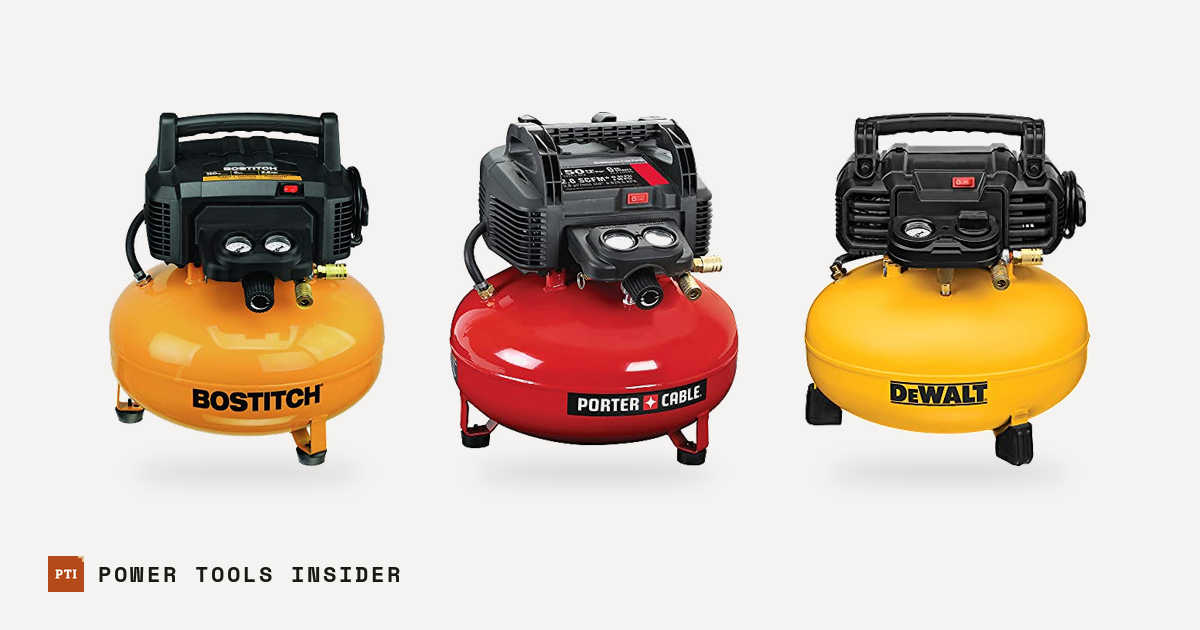
| Best Overall | Porter-Cable C2002 | ~$150 | 6 gal / 150 PSI | Amazon’s top-selling pancake, proven, parts everywhere, zero maintenance | Buy Now |
| Best Value | Bostitch BTFP02012 | ~$130 | 6 gal / 150 PSI | Routinely $20 cheaper than competitors, 78.5 dB quieter than most pancakes | Buy Now |
| Best for High-Pressure Work | DeWalt DWFP55126 | ~$179 | 6 gal / 165 PSI | 165 PSI ceiling + dual couplers for two simultaneous nailers | Buy Now |
| Best for Contractors | Makita MAC2400 Big Bore | ~$260 | 4.2 gal / 130 PSI | Oil-lubricated pump outlasts oil-free by years under daily professional use | Buy Now |
| Best Cordless | Makita AC001GZ 40V XGT | ~$429 (tool only) | 2 gal / 135 PSI | No outlet needed, 700 finish nails per charge, 58 dB quiet | Buy Now |
| Best Ultra-Quiet | California Air Tools 8010DSPC | ~$220 | 8 gal / 120 PSI | 60 dB operation, quieter than a conversation, usable indoors without ear protection | Buy Now |
Best Portable Air Compressors of 2026, Our Top Picks
All prices reflect Amazon at time of writing and will vary. Every ASIN on this list is currently in stock and verified active.
Porter-Cable C2002, Best Overall

Price: Around $150 | Tank: 6-gallon pancake | PSI: 150 max
The C2002 has been Amazon’s top-selling portable compressor for years, and with good reason. The 6-gallon pancake tank provides a low center of gravity that won’t tip in a work truck, the oil-free pump requires zero maintenance, and it tops out at 150 PSI, sufficient for every common pneumatic task: finish nailers, brad nailers, inflators, and blow-off.
Startup takes about 90 seconds on a cold morning. The motor is protected by a thermal overload switch so you won’t burn it out if you forget to drain the tank overnight. At roughly 30 lbs with a molded carry handle, it moves between rooms without issue.
The limitations: 150 PSI puts it at the floor for high-demand tools like impact wrenches, you’ll get intermittent use but not sustained operation. It also runs at roughly 80 dB, so hearing protection is a good habit for anything longer than a few minutes.
Pros
- Amazon’s #1 seller, replacement parts and accessories everywhere
- Oil-free pump requires zero maintenance
- Low pancake profile won’t tip in trucks or vans
- Thermal overload protection on motor
- Strong aftermarket: regulators, fittings, hose kits widely available
Cons
- 150 PSI ceiling limits sustained impact wrench or die grinder use
- ~80 dB, wear hearing protection for extended sessions
- Single coupler limits simultaneous multi-tool use
| Spec | Value |
|---|---|
| Tank Size | 6 gallon pancake |
| Max PSI | 150 PSI |
| Drive Type | Oil-free direct drive |
| Weight | ~30 lbs |
| Noise Level | ~80 dB |
| Power | 120V corded |
| Model Number | C2002 |
Bottom Line: The right first compressor for most DIYers. Proven, parts everywhere, and priced to leave room in the budget for a good nailer kit.
Bostitch BTFP02012, Best Value

Price: Around $130 | Tank: 6-gallon pancake | PSI: 150 max
The Bostitch BTFP02012 is the Porter-Cable’s closest competitor, same 6-gallon pancake tank, same 150 PSI ceiling, same oil-free pump. Where it wins is price: you’ll routinely find it $20-30 cheaper than the C2002, and it runs measurably quieter at 78.5 dB, a number you’ll appreciate if you’re working in a garage attached to a living space.
Bostitch specs a high-flow regulator and coupler as standard equipment, which on paper outflows the Porter-Cable. In daily use with nailers and inflators, you won’t notice the difference. What you will notice if you’re keeping the unit long-term: drain the tank after every use. There are more humidity-related rust reports with this model than the C2002, especially in coastal or high-humidity climates.
Pros
- Lowest price in the 6-gallon pancake category
- 78.5 dB, measurably quieter than most competing pancakes
- High-flow regulator and coupler included standard
- Oil-free: zero maintenance
Cons
- Tank rust reported in humid climates, drain after every use without fail
- Same 150 PSI ceiling as C2002, not for impact wrenches
- Some reports of regulator sticking over time
| Spec | Value |
|---|---|
| Tank Size | 6 gallon pancake |
| Max PSI | 150 PSI |
| Drive Type | Oil-free direct drive |
| Weight | ~29 lbs |
| Noise Level | 78.5 dB |
| Power | 120V corded |
| Model Number | BTFP02012 |
Bottom Line: If the Bostitch is $20 cheaper when you’re shopping, buy the Bostitch. If prices are equal, either one will run your nailer for the next decade.
DeWalt DWFP55126, Best for High-Pressure Work
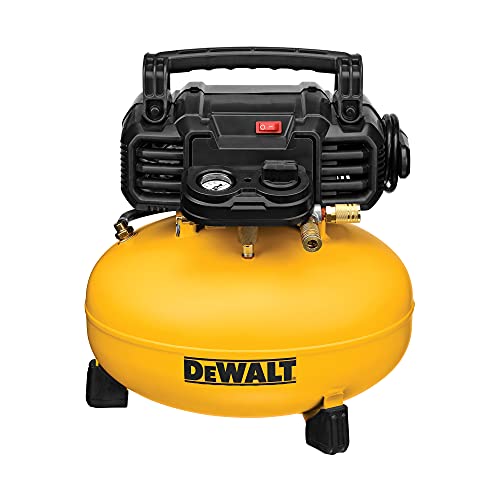
Price: Around $179 | Tank: 6-gallon pancake | PSI: 165 max
DeWalt engineered this compressor to 165 PSI, 15 more than the Porter-Cable and Bostitch. That PSI difference means the tank cycles less frequently with high-demand tools: you get longer run windows between pump kicks, and tools see more consistent pressure throughout the work cycle.
The DWFP55126 includes dual universal couplers, letting two people run pneumatic nailers simultaneously off the same unit, useful on a trim crew or framing team where the compressor follows the work. A console cover protects the regulator from jobsite abuse, something neither Porter-Cable nor Bostitch includes.
The DeWalt costs $30-50 more than the Bostitch. For occasional DIY use, that premium is difficult to justify. For anyone running it daily on a job site, the higher PSI and jobsite build quality earn the cost difference back quickly.
Pros
- 165 PSI, highest ceiling in the 6-gallon pancake class
- Dual universal couplers for two simultaneous users
- Console cover protects regulator on jobsites
- Oil-free: zero maintenance
- Strong DeWalt service network for warranty repairs
Cons
- $30-50 premium over competition for similar occasional-use performance
- Motor can be slow to recover in very cold weather
| Spec | Value |
|---|---|
| Tank Size | 6 gallon pancake |
| Max PSI | 165 PSI |
| Drive Type | Oil-free direct drive |
| Couplers | Dual universal couplers |
| Weight | ~30 lbs |
| Power | 120V corded |
| Model Number | DWFP55126 |
Bottom Line: The compressor to choose when you need dual nailer operation or that extra pressure headroom. Worth the premium for jobsite use; harder to justify for weekend projects.
Makita MAC2400 Big Bore, Best for Contractors

Price: Around $260 | Tank: 4.2-gallon twin-stack | PSI: 130 max
The MAC2400 is built differently from every other compressor on this list, oil-lubricated pump, Big Bore cylinder, 2.5 HP motor. The oil-lubricated design delivers one fundamental advantage: extended pump life. Where oil-free pumps degrade under heavy daily use, the MAC2400 just keeps running. Ten-year-old MAC2400s on active job sites are common.
The Big Bore cylinder moves more air per stroke, resulting in faster tank recovery after sustained tool use. For trim carpenters, flooring crews, or anyone running a nailer continuously for hours, this translates to fewer pauses waiting for pressure to rebuild.
At roughly 52 lbs, it’s the heaviest unit on this list. The twin-tank profile keeps it lower to the ground than hot-dog compressors, better for stability in work trucks. For pros willing to handle the weight and maintain the oil, the long-term cost of ownership comes out lower than replacing two or three oil-free units over the same period.
Pros
- Oil-lubricated pump, significantly longer service life than oil-free
- Big Bore cylinder for faster air recovery under heavy load
- 2.5 HP motor handles sustained high-demand use
- ~79 dB, quieter than most pancakes despite higher output
- Low twin-tank profile stays stable in trucks and vans
Cons
- ~52 lbs, heaviest unit on this list
- Oil-lubricated: requires oil level checks and moisture separator drains
- 130 PSI max, lower than the DeWalt and pancake competitors
- ~$100 more than a 6-gallon pancake at entry level
| Spec | Value |
|---|---|
| Tank Size | 4.2 gallon twin-stack |
| Max PSI | 130 PSI |
| Drive Type | Oil-lubricated, Big Bore pump |
| Motor | 2.5 HP |
| Weight | ~52 lbs |
| Noise Level | ~79 dB |
| Power | 120V corded |
| Model Number | MAC2400 |
Bottom Line: If you run a nailer 4+ hours a day professionally, buy the MAC2400. It will outlast three oil-free pancakes, and total cost of ownership favors it over time. For DIY use, it’s overkill.
Makita AC001GZ 40V XGT, Best Cordless
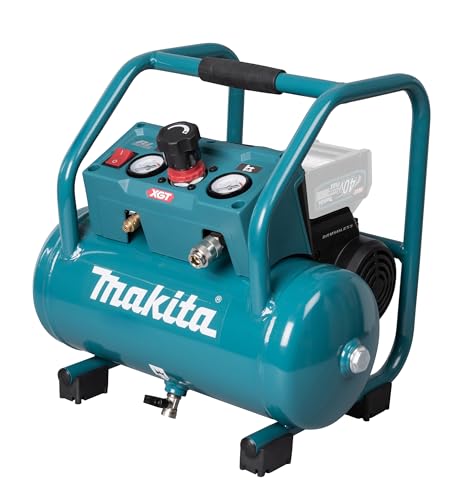
Price: Around $429 (tool only, battery sold separately) | Tank: 2-gallon | PSI: 135 max
The AC001GZ runs entirely on Makita’s 40V max XGT battery platform, no cord, no generator required. That fundamentally changes what “portable” means. Finish nail work in an attic, trim at a remote job site, or exterior work where running cord from an outlet creates a hazard: the AC001GZ handles all of it. On a fully charged 4.0Ah 40V XGT battery, it delivers approximately 700 finish nails per charge, a full day of light trim work.
The brushless motor and Quiet Series designation keep it at 58 dB, quieter than normal conversation. That’s remarkable for any compressor producing 135 PSI. Early-morning neighborhood trim work becomes a realistic option.
If you’re already in the Makita 40V XGT platform for saws or vacuums, the ecosystem integration is a genuine advantage. If you’re buying into XGT specifically for this compressor, factor in battery cost separately. The 40V XGT system is Makita’s premium platform, not the older 18V LXT. For a primer on battery platform tradeoffs, see our battery technology guide.
Also consider for M18 users: The Milwaukee M18 FUEL 2840-20 ($269 tool-only at Home Depot) runs on the M18 platform at 135 PSI and 68 dB. It’s the right choice if you’re deep in Milwaukee M18. No affiliate link available, Milwaukee is a Home Depot exclusive with no affiliate program.
Pros
- Truly cordless, works anywhere, including attics, crawl spaces, remote sites
- 58 dB Quiet Series, quietest unit on this list
- ~700 finish nails per charge (4.0Ah battery)
- 135 PSI covers all finish and trim nailer work
- Brushless motor for efficiency and long service life
Cons
- Expensive, tool-only; batteries are an additional cost
- 2-gallon tank cycles more often than 6-gallon corded models
- Requires Makita 40V max XGT batteries, incompatible with 18V LXT
- Lower nail output under cold battery conditions
| Spec | Value |
|---|---|
| Tank Size | 2 gallon |
| Max PSI | 135 PSI |
| Drive Type | Brushless, oil-free |
| Battery Platform | Makita 40V max XGT (sold separately) |
| Noise Level | 58 dB (Quiet Series) |
| Nail Capacity | ~700 finish nails per charge (4.0Ah) |
| Weight | ~14.3 lbs (without battery) |
| Model Number | AC001GZ |
Bottom Line: The best cordless compressor available if you need true portability. The Makita XGT ecosystem investment pays off as you add tools. Buy it when the cord is the problem, not just as an upgrade.
California Air Tools 8010DSPC, Best Ultra-Quiet

Price: Around $220 | Tank: 8-gallon | PSI: 120 max
California Air Tools built the 8010DSPC around one specification: noise. At 60 dB, it operates quieter than a normal conversation, no other corded compressor in this price range competes on that number. That opens use cases that pancake compressors close off: workshops adjacent to offices, garages attached to living spaces, early-morning residential job sites.
The 8-gallon stainless steel tank provides longer run times between cycles, even with a modest 1.0 HP motor. For finish work, cabinet installation, trim, upholstery, it keeps pace well. For production framing or continuous impact wrench operation, the 120 PSI ceiling and lower CFM will cause frequent cycling.
Oil-free pump and stainless steel tank together address the two most common compressor failure modes: pump wear and tank rust. At roughly 48 lbs, it’s heavier than pancake compressors, but the 8-gallon capacity means you move it less often.
Pros
- 60 dB, usable indoors without ear protection
- 8-gallon stainless steel tank resists rust and extends run time
- Oil-free: zero maintenance
- Ideal for workshops near living spaces or residential neighborhoods
Cons
- 120 PSI ceiling, lowest of the group; not for sustained impact wrench use
- ~48 lbs, heaviest oil-free unit on the list
- Lower CFM means more cycles under heavy continuous use
- Less common brand, fewer local service options
| Spec | Value |
|---|---|
| Tank Size | 8 gallon |
| Max PSI | 120 PSI |
| Drive Type | Oil-free, 1.0 HP motor |
| Tank Material | Stainless steel |
| Noise Level | 60 dB |
| Weight | ~48 lbs |
| Power | 120V corded |
| Model Number | 8010DSPC |
Bottom Line: Right when noise is the constraint, residential shops, HOA neighborhoods, shared buildings. If noise isn’t the issue, a DeWalt or Bostitch pancake gives more PSI for less money.
What Can You Do With a Portable Air Compressor?
New buyers often underestimate how many shop tasks a compressor unlocks. Once you have one, you’ll find reasons to use it constantly.
Inflate Tires and Sports Equipment
The most immediate use for most buyers. A 6-gallon pancake at 150 PSI fills a standard car or truck tire from 25 PSI to 35 PSI in about 20 seconds. Compare to the slow fill on a portable tire inflator. For flat trailer tires, wheelbarrow tires, or anything that deflates seasonally, the compressor handles it faster than any dedicated inflator. See our portable tire inflator guide if you need something more compact for roadside use.
Power Pneumatic Nailers and Staplers
Pneumatic nailers drive faster, hit harder, and jam less than most cordless models, and a 6-gallon compressor can run them all day. Brad nailers for trim, finish nailers for casing and crown, framing nailers for structural work, staplers for sheathing. Every compressor on this list handles finish and brad nailers comfortably. For framing nailer use, the DeWalt DWFP55126 or Makita MAC2400 Big Bore sustain pressure better under high-volume firing. See our nailer roundup for tool pairing guidance.
HVLP Spray Painting
Compressor-powered HVLP guns produce a finer finish than most electric HVLP units at the same price point, smoother atomization and better fan control. Cabinet painters and furniture refinishers typically run HVLP guns at 10-25 PSI with 5-9 CFM. The MAC2400’s higher CFM output makes it the best match here; the 6-gallon pancakes cycle frequently. For a full breakdown of HVLP and airless options, see our paint sprayer guide.
Blow-Off and Shop Cleaning
A blow gun on a compressed air line cleans sawdust from machinery in seconds, blows chips out of mortises, clears dust from electronics, and dries parts after washing. No shop vacuum matches the speed for large-surface cleanup. This is the use case that makes you realize you needed a compressor years ago.
Cordless vs. Corded Air Compressors: Which Is Right for You?
The corded vs. cordless question in compressors is more nuanced than with drills or saws. Corded compressors deliver continuous operation with no battery concern, plug in and run all day. Cordless compressors unlock locations where a cord doesn’t exist or creates a hazard, but they add significant cost and require battery management.
Buy corded if: You have 120V power at your work location, you use the compressor for extended continuous sessions, or you want the best price-per-PSI value. The Porter-Cable C2002 and Bostitch BTFP02012 are substantially less expensive than the Makita AC001GZ and deliver more tank capacity.
Buy cordless if: You work regularly in attics, crawl spaces, or remote sites without power access; you’re already invested in the Makita 40V XGT or Milwaukee M18 battery platform; or noise is a constraint and the 58 dB Quiet Series rating matters for your use case. The Makita AC001GZ is premium-priced, but for the right user it’s the right tool.
A note on battery platform compatibility: the Makita AC001GZ uses 40V max XGT batteries, a different system from Makita’s 18V LXT platform. Verify you’re buying the right battery before ordering.
How to Choose a Portable Air Compressor: PSI, CFM, Tank Size & Noise
Tank Size: Gallon Capacity and What It Means
Tank size determines how long you can run a tool before the motor restarts to refill. A 6-gallon pancake fires a finish nailer 20-30 times between cycles. A 2-gallon cordless fires 8-12. For finish and brad nailers, the most common pairing, 6 gallons is the sweet spot. For sustained die grinder or impact wrench use, go larger or expect frequent pauses.
PSI and CFM: Understanding the Two Numbers
Max PSI tells you the tank’s pressure ceiling. CFM (cubic feet per minute) measures how fast the compressor flows air to your tool. Most finish nailers operate at 70-90 PSI at 1-2 CFM, any unit on this list handles that easily. Impact wrenches and random orbital sanders need 90 PSI at 4-6 CFM sustained, a number the 6-gallon pancakes only match intermittently. For continuous high-CFM work, the Makita MAC2400 is the right choice.
Oil-Free vs. Oil-Lubricated
Oil-free pumps require zero maintenance and are ideal for occasional-to-regular use. Oil-lubricated pumps require periodic oil checks and moisture separator drains but last significantly longer under daily heavy use. If you run a compressor 4+ hours a day, the MAC2400’s oil-lubricated pump will outlast multiple oil-free units. For weekend use, oil-free is simpler and sufficient.
Noise Level (dB Ratings Matter)
Standard pancake compressors run at 78-80 dB, roughly the level of a garbage disposal or loud conversation. The California Air Tools 8010DSPC at 60 dB and the Makita AC001GZ at 58 dB are genuinely different. The decibel scale is logarithmic: 80 dB is approximately four times louder in perceived loudness than 60 dB. For workshops adjacent to living spaces, or HOA-restricted residential job sites, that difference matters practically.
Frequently Asked Questions
What size portable air compressor do I need for home use?
For the most common home tasks, inflating tires, running a brad nailer, blowing off sawdust, a 6-gallon oil-free pancake compressor at 150 PSI is the right starting point. The Porter-Cable C2002 or Bostitch BTFP02012 handle this well at $130-150. If you need to run an impact wrench or air sander regularly, step up to the Makita MAC2400 for higher CFM output.
What is the quietest portable air compressor?
The Makita AC001GZ 40V XGT cordless compressor runs at 58 dB, the quietest portable compressor in this roundup. Among corded models, the California Air Tools 8010DSPC at 60 dB is the quietest option at a reasonable price. Both are measurably quieter than standard pancake compressors at 78-80 dB, which the logarithmic dB scale means is actually several times louder in perceived loudness.
Can a portable air compressor run a framing nailer?
Yes, but the match matters. A 6-gallon pancake will run a framing nailer for short bursts, fastening a few boards, then pause while the motor refills the tank. For production framing where the nailer fires continuously, the Makita MAC2400 Big Bore’s higher CFM and faster recovery is a better choice. See our pneumatic nailer guide for pairing recommendations.
Is a cordless air compressor as powerful as a corded one?
Close, but not equivalent. The Makita AC001GZ delivers 135 PSI and handles all finish and brad nailer work competently. It falls behind corded compressors in two ways: run time (2-gallon tank means more frequent cycles vs. a 6-gallon corded tank) and sustained output for high-CFM tools like impact wrenches or air sanders. For finish work and inflation, cordless performance is excellent. For production or high-demand tool use, corded remains the better choice.
What PSI do I need to fill car tires?
Most passenger car tires require 30-35 PSI and truck tires 35-80 PSI depending on load rating (check the door jamb sticker on your specific vehicle). Every compressor on this list runs at 120-165 PSI, which is more than enough. The limiting factor is usually the speed of fill, a 6-gallon compressor at 150 PSI fills a standard car tire from 25 to 35 PSI in about 20 seconds. For roadside tire inflation without a full compressor, see our portable tire inflator guide.
Power Tool Insider is reader-supported. When you buy through links on our site, we may earn an affiliate commission at no extra cost to you. This doesn’t affect our recommendations, we only recommend tools we’d actually use. Full disclosure.