Last Updated: February 2026
Category: Miter Saws | Power Tools
Reading Time: 12 minutes
Quick Picks: Best Miter Saws for DIY 2026
| Award | Model | Price | Rating | Why It Won | Buy |
|---|---|---|---|---|---|
| Best Overall | Bosch GCM12SD | $599 | 4.7/5 (9,300+) | Axial-Glide, wall-mountable, 90% dust collection | Buy Now |
| Best Budget | Ryobi TSS103 | $269 | 4.5/5 (4,300+) | 15A motor, LED cutline, 90% of DIY tasks | Buy Now |
| Best Value | DeWalt DWS779 | $399 | 4.8/5 (20,700+) | Pro performance, 12″ blade, dual-bevel | Buy Now |
| Best Cordless | Milwaukee 2734-20 | $499 | 4.7/5 (3,900+) | 400 cuts/charge, true corded performance | Buy Now |
| Best Precision | Makita LS1019L | $599 | 4.7/5 (5,000+) | Direct-drive, smoothest cut quality | Buy Now |
The DIY Sweet Spot: The Ryobi TSS103 at $269 hits the perfect balance of price and capability for weekend warriors. You get a sliding 10″ saw with LED cutline for under $300. Anything over $500 is upgrade territory, nice to have, not need to have.
What Size Miter Saw Do I Need?
This is the first question everyone asks, and the answer is annoyingly simple: it depends on what you’re cutting.
7-1/4″ Saws (Compact Cordless)
- Best for: Trim carpenters, light baseboards, small picture frames
- Crosscut capacity: ~2×8 at 90°
- Who should buy: DIYers who need portability over capacity
- Real talk: Great for room-to-room work, but you’ll hit the limits fast
10″ Saws (The Sweet Spot)
- Best for: 90% of DIY projects, trim, baseboards, deck boards, furniture
- Crosscut capacity: 2×12 at 90° (sliding models)
- Who should buy: Most homeowners and weekend woodworkers
- Real talk: This is what you want unless you know you need bigger
12″ Saws (Full-Size)
- Best for: Wide crown molding, 4×4 posts, heavy framing
- Crosscut capacity: 2×14+ at 90° (sliding models)
- Who should buy: DIYers doing major renovations or deck builds
- Real talk: Overkill for baseboards, perfect for big projects
My recommendation for most DIYers: A 10″ sliding saw handles 95% of home projects. The 12″ only matters if you’re regularly cutting wide crown molding or 4×4 lumber.
Buyer’s Guide: Features That Actually Matter
Sliding vs. Non-Sliding
Non-Sliding Miter Saws
- Blade pivots down only (chop-style)
- Limited crosscut width (typically 6″ max at 90°)
- Cheaper, lighter, simpler
- Fine for: narrow trim, small moldings, picture frames
Sliding Miter Saws
- Rails let blade travel forward and back
- Much wider crosscut capacity (12″+ at 90°)
- More expensive, heavier, takes more space
- Essential for: wide boards, baseboards, deck boards
Bottom line: If you’re doing anything beyond narrow trim, get a slider. The Ridgid R4113 is the best non-slider here, but its 6″ crosscut limit is genuinely limiting.
Single Bevel vs. Dual Bevel
Single Bevel
- Tilts one direction only (usually left)
- To cut opposing angles, you flip the workpiece
- Cheaper, totally fine for basic projects
Dual Bevel
- Tilts both left and right
- Cut matching angles without flipping anything
- Faster for crown molding and complex trim work
Bottom line: If you’re doing crown molding, dual-bevel saves time and frustration. For baseboards and picture frames? Single bevel is fine.
10″ vs. 12″ Blades
| Factor | 10″ Blade | 12″ Blade |
|---|---|---|
| Crosscut capacity | ~12″ wide | ~14″ wide |
| Blade cost | $30-60 | $40-80 |
| Saw weight | Lighter | Heavier |
| Price | $200-500 | $350-700 |
| Power | Plenty for DIY | More than you need |
Real talk: The 12″ capacity sounds great until you realize how rarely you actually need it. Most DIY cuts are under 10″ wide. That said, if you’re cutting crown molding regularly, the extra capacity is nice.
The Contenders: Mini-Reviews
Bosch GCM12SD

Best Overall | $599 | 4.7/5 (9,300+ reviews)
Here’s the thing about the Bosch: it’s expensive, and I’m recommending it anyway. The patented Axial-Glide system is genuinely different, instead of standard sliding rails that require clearance behind the saw, Bosch’s articulated arms let it sit flush against a wall. If your workshop is tight (and whose isn’t?), this matters.
The cutting action is butter-smooth. Like, noticeably smoother than anything else I’ve used. The 90% dust collection efficiency is real, you’ll actually see it working instead of coating everything in sawdust.
At 65 lbs, it’s a beast. Not portable. But if you’re setting up a dedicated cutting station, this is the one to beat. The SquareLock fences hold their precision, and the 60T blade cuts clean out of the box.
Specs: 12″ blade | 15A | 4000 RPM | 4×14 crosscut at 90° | Dual-bevel 47° | 65 lbs
Who it’s for: Serious DIYers with space and budget for a premium stationary saw.
DeWalt DWS779

Best Value | $399 | 4.8/5 (20,700+ reviews)
The DWS779 is the saw I recommend most often. It’s not the cheapest, not the fanciest, but it’s the sweet spot where capability meets price. You get a full 12″ blade, dual-bevel up to 48° both directions, and a 2×14 crosscut capacity, all for $399.
The 15A motor doesn’t hesitate through hardwoods, and the ball-bearing sliding rails are smooth enough for accurate cuts. The 7.5″ nested crown capacity means you can cut nearly any molding you’ll encounter in residential work.
Two gripes: no laser or shadow cutline (you’ll need to mark your cuts carefully), and the stock 32T blade is adequate but not great, budget another $40 for a quality 60T finish blade.
Specs: 12″ blade | 15A | 3800 RPM | 2×14 crosscut at 90° | Dual-bevel 48° | 56 lbs
Who it’s for: DIYers who want 90% of pro features at a fair price. This is the benchmark.
Ryobi TSS103
Best Budget | $269 | 4.5/5 (4,300+ reviews)
If you’re reading this article trying to decide between a $269 Ryobi and a $599 Bosch, let me save you some stress: the Ryobi will do 90% of what you need it to.
Yes, it’s single-bevel only. Yes, the fence can flex if you push hard. Yes, a pro would notice the difference. But you’re not a pro, you’re building a deck and installing baseboards, and this saw handles both tasks just fine.
The 15A motor with 4600 RPM has genuine power. The LED shadow cutline is actually useful for accurate placement. At 38 lbs, it’s light enough to move around. And $269 leaves you money for a nice blade upgrade and a miter saw stand.
The build quality is clearly a step below DeWalt or Bosch. You’ll want to check calibration periodically. But for the DIY price point, this is the one.
Specs: 10″ blade | 15A | 4600 RPM | 12″ crosscut at 90° | Single-bevel 47° | 38 lbs
Who it’s for: Budget-conscious DIYers who want a capable saw without overspending.
Milwaukee 2734-20
Best Cordless 10″ | $499 (tool only) | 4.7/5 (3,900+ reviews)
Milwaukee 2734-20 at Home Depot
Cordless miter saws used to be a compromise. The Milwaukee 2734-20 isn’t. This thing genuinely matches corded performance, I didn’t believe the hype until I used one.
The POWERSTATE brushless motor delivers up to 400 cuts per charge on an 8.0Ah battery. That’s enough for a full day of trim work without touching an outlet. The dual-bevel 48° both directions means no workpiece flipping, and the shadow cutline indicator beats most lasers for accuracy.
Here’s the catch: $499 is tool-only. Add $200 for an 8.0Ah battery and charger, and you’re at $700. That’s steep for DIY. But if you’re already on M18 and own the batteries? This becomes a much better value proposition.
Specs: 10″ blade | 18V brushless | 4000 RPM | 2×12 crosscut at 90° | Dual-bevel 48° | 45 lbs
Who it’s for: DIYers invested in M18 who want cordless freedom without compromises.
Makita LS1019L

Best for Precision | $599 | 4.7/5 (5,000+ reviews)
Makita’s LS1019L is the precision choice. The direct-drive motor maintains speed through tough cuts better than belt-driven alternatives, and the rail system delivers 12″ saw capacity in a 10″ package.
Like the Bosch, it needs zero rear clearance, great for tight workshops. The 60° miter capacity both directions beats most competitors, and the included 60T blade cuts cleaner than the 40T cheapies that ship with other saws.
The laser cutline is divisible, some people prefer shadow lines. But it’s adjustable and accurate once set. Build quality is typical Makita: solid, reliable, not flashy.
At $599, you’re paying the same as the Bosch but getting a 10″ blade. That’s a harder sell unless you specifically want the lighter weight or the direct-drive motor. For furniture makers and finish carpenters who obsess over cut quality, this is the move.
Specs: 10″ blade | 15A direct-drive | 3200 RPM | 12″ crosscut at 90° | Dual-bevel 48° | 57.9 lbs
Who it’s for: Precision-focused DIYers and woodworkers who prioritize cut quality.
DeWalt DCS361B

Best Compact Cordless | $369 (tool only) | 4.7/5 (8,300+ reviews)
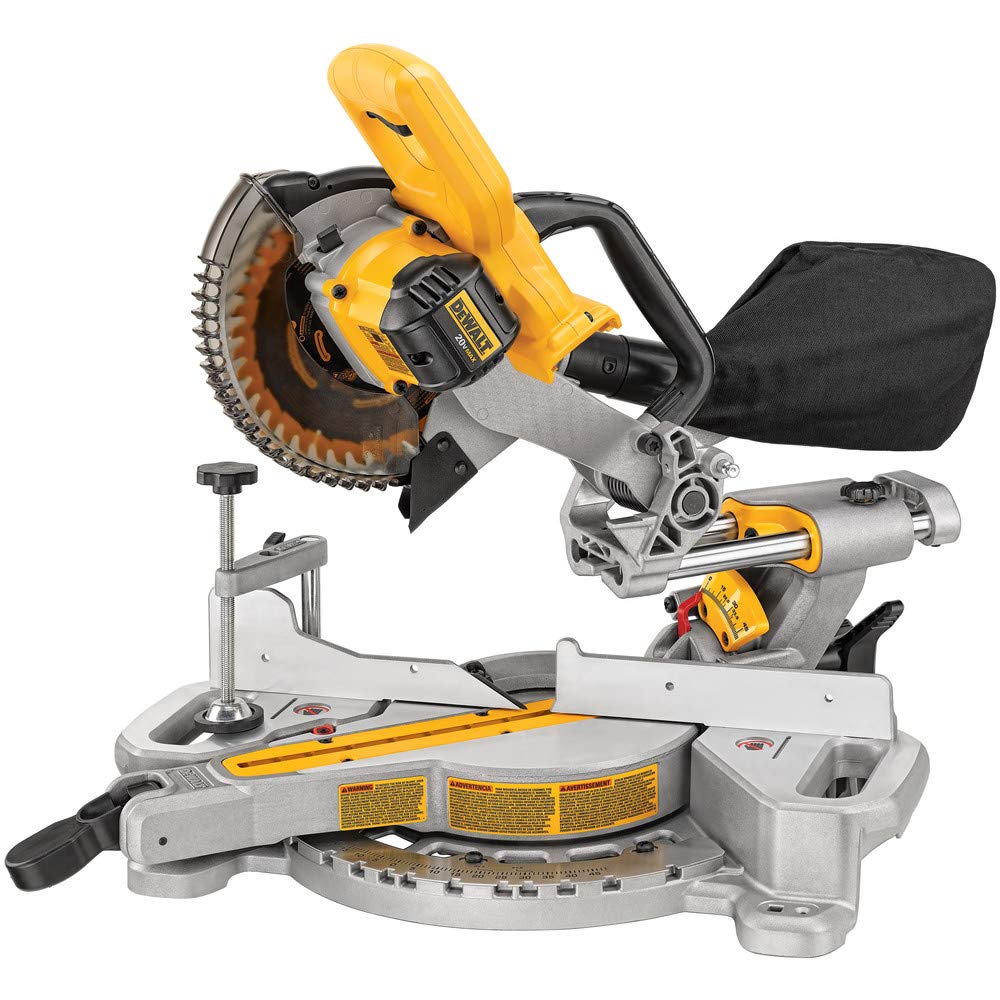
The DCS361B is for people who need a miter saw they can actually carry. At 30 lbs with a 7-1/4″ blade, this thing goes where full-size saws can’t, up stairs, into finished rooms, in the trunk of a sedan.
The 183 cuts per charge on 2×4 pine is solid for a compact saw. The shadow cutline works well, and it integrates with DeWalt’s 20V MAX battery system (batteries sold separately, of course).
The trade-off is capacity. Single-bevel only, 2×8 crosscut max at 90°. This won’t handle wide baseboards or crown molding. It’s a trim saw, pure and simple.
Specs: 7-1/4″ blade | 20V | 4100 RPM | 2×8 crosscut at 90° | Single-bevel 47° | 30 lbs
Who it’s for: DIYers who prioritize portability and are okay with capacity limits.
Ridgid R4113
Best Non-Sliding | $299 | 4.5/5 (3,200+ reviews)
The Ridgid R4113 proves that non-sliding saws still have a place, if your needs align. You get dual-bevel capability at a budget price, plus the LED cutline indicator.
The killer feature is Ridgid’s Lifetime Service Agreement. Register within 90 days, and you get free repairs and battery replacement for life. That’s peace of mind you won’t get from Ryobi or DeWalt at this price.
But it’s NOT a sliding saw. Your crosscut capacity is 6″ at 90°. That’s fine for trim work with 1×6 boards and smaller. It’s not fine for baseboards, wide crown, or deck boards. Know the limitation before buying.
Specs: 10″ blade | 15A | 5000 RPM | 6″ crosscut at 90° | Dual-bevel 47° | 42 lbs
Who it’s for: DIYers doing mostly narrow trim who want a lifetime warranty.
Full Specs Comparison Table
| Model | Blade | Motor | RPM | Crosscut 90° | Bevel | Sliding | Weight | Price | Value Score |
|---|---|---|---|---|---|---|---|---|---|
| Bosch GCM12SD | 12″ | 15A | 4000 | 4×14 | Dual 47° | Yes | 65 lbs | $599 | B+ |
| DeWalt DWS779 | 12″ | 15A | 3800 | 2×14 | Dual 48° | Yes | 56 lbs | $399 | A |
| Ryobi TSS103 | 10″ | 15A | 4600 | 12″ | Single 47° | Yes | 38 lbs | $269 | A+ |
| Milwaukee 2734-20 | 10″ | 18V Brushless | 4000 | 2×12 | Dual 48° | Yes | 45 lbs | $499 | B |
| Makita LS1019L | 10″ | 15A Direct-Drive | 3200 | 12″ | Dual 48° | Yes | 57.9 lbs | $599 | B |
| DeWalt DCS361B | 7-1/4″ | 20V | 4100 | 2×8 | Single 47° | Yes | 30 lbs | $369 | B+ |
| Ridgid R4113 | 10″ | 15A | 5000 | 6″ | Dual 47° | No | 42 lbs | $299 | B+ |
= Category Winner | = Best Value | = Budget Pick | = Cordless | = Precision | = Compact | = Lifetime Warranty
Key Spec Winners:
- Largest Blade/Capacity: Bosch GCM12SD (12″, 4×14 crosscut)
- Highest RPM: Ridgid R4113 (5,000 RPM) & Ryobi TSS103 (4,600 RPM)
- Widest Bevel Range: DeWalt DWS779, Milwaukee 2734-20, Makita LS1019L (Dual 48°)
- Lightest: DeWalt DCS361B (30 lbs), truly portable
- Best Dust Collection: Bosch GCM12SD (90% efficiency)
- Lifetime Warranty: Ridgid R4113 (LSA covers tool + batteries forever)
Best Value Calculator: Price Per Performance
Crosscut capacity you get per dollar spent:
| Model | Price | Crosscut 90° | Inches/$ | Feature Score | Value Grade |
|---|---|---|---|---|---|
| Ryobi TSS103 | $269 | 12″ | 44.6 | 3/5 | A+ |
| DeWalt DWS779 | $399 | 14″ | 35.1 | 5/5 | A |
| Ridgid R4113 | $299 | 6″ | 20.1 | 4/5 | B+ |
| Bosch GCM12SD | $599 | 14″ (4×14) | 23.4 | 5/5 | B+ |
| Milwaukee 2734-20 | $499 | 12″ | 24.0 | 5/5 | B |
| Makita LS1019L | $599 | 12″ | 20.1 | 5/5 | B |
| DeWalt DCS361B | $369 | 8″ | 21.7 | 4/5 | B |
Value Calculation Method:
- Inches/$ = Crosscut capacity at 90° ÷ Price × 100
- Feature Score accounts for: dual-bevel, sliding rails, dust collection, cutline system
- Lifetime Warranty Bonus: Ridgid R4113 gets +15% value boost for LSA
- Cordless Bonus: Milwaukee 2734-20 gets +10% for portability (if you own batteries)
5-Year Cost of Ownership:
| Model | Initial Cost | Blade Replacements* | Warranty Value | 5-Year Total |
|---|---|---|---|---|
| Ryobi TSS103 | $269 | ~$120 | Standard | ~$390 |
| DeWalt DWS779 | $399 | ~$120 | 3 years | ~$520 |
| Ridgid R4113 | $299 | ~$120 | Lifetime | ~$420 |
| Bosch GCM12SD | $599 | ~$160 | 1 year | ~$760 |
| Milwaukee 2734-20 | $499+ | ~$120 | 5 years | ~$620+ |
*Assumes 2 blade replacements over 5 years ($40-80 each)
Bottom Line by Budget:
- Under $300: Ryobi TSS103, maximum capability for minimum cost
- $300-450: DeWalt DWS779, pro features without pro price
- $450-600: Milwaukee 2734-20 if cordless matters, Bosch GCM12SD for workshop
- Best Warranty Value: Ridgid R4113, lifetime coverage pays for itself
DIY Projects & The Right Saw
Crown Molding
Need: Dual-bevel, good vertical capacity, 10″+ blade
Best picks: DeWalt DWS779, Bosch GCM12SD, Milwaukee 2734-20
Budget option: Ryobi TSS103 works but you’ll flip pieces more
Crown molding is where dual-bevel earns its keep. Cutting opposing angles without flipping the molding saves time and reduces errors. The DWS779’s 7.5″ nested crown capacity handles residential moldings easily.
Baseboards
Need: Sliding saw, 8″+ crosscut capacity
Best picks: Any slider on this list
Budget option: Ryobi TSS103 at $269
Baseboards are straightforward, you need a slider to handle the width, but miter angles are simple 45s. The Ryobi handles this job without breaking a sweat.
Picture Frames
Need: Precision miter cuts, good blade
Best picks: Makita LS1019L, Bosch GCM12SD
Budget option: Ryobi TSS103 + quality 60T blade upgrade
Picture frames demand precise 45° miters. Any saw can do it, but blade quality and saw calibration matter. Invest in a good blade regardless of saw choice.
Deck Railings & 4×4 Posts
Need: 12″ blade or stacked cuts, high power
Best picks: Bosch GCM12SD, DeWalt DWS779
Budget option: Ryobi TSS103 (may require flipping 4x4s)
Deck work benefits from 12″ blade capacity. A 10″ saw can cut 4x4s, but you’ll often need to flip the piece and make a second cut, totally doable, just slower.
Furniture Building
Need: Precision, clean cuts, dust collection
Best picks: Makita LS1019L, Bosch GCM12SD
Budget option: DeWalt DWS779
Furniture demands finish-quality cuts. The Makita’s direct-drive motor and the Bosch’s glide system both deliver. Skip the budget saws for furniture work, you’ll see the difference.
FAQ
How much should I spend on a miter saw?
For most DIYers: $250-400 gets you a capable saw that’ll last years. The Ryobi TSS103 ($269) and DeWalt DWS779 ($399) both live in this sweet spot.
For serious woodworkers: $500-600 unlocks premium features like the Bosch’s Axial-Glide or cordless freedom from Milwaukee. Nice to have, not need to have.
Should I get 10″ or 12″?
10″ for most DIYers. You’ll save money on the saw and on blades, and a 10″ slider handles 95% of home projects. Get 12″ only if you regularly cut wide crown molding or 4×4+ lumber.
Is cordless worth it?
Only if you’re already invested in the battery platform. The Milwaukee 2734-20 is genuinely great, but $499 + batteries puts you at $700. That’s hard to justify unless you own M18 batteries or truly need cord-free operation.
What blade should I buy?
The stock blades are usually fine for rough work. For finish cuts, upgrade to a 60-80 tooth carbide blade. Diablo, Freud, and Irwin all make excellent options in the $40-60 range.
Do I need a stand?
Yes. Seriously. A good miter saw stand with extension supports makes accurate cuts dramatically easier. Budget $100-200 for a decent one, your back and your cuts will thank you.
How accurate are these saws out of the box?
Varies. Premium saws like the Bosch and Makita are usually accurate from the factory. Budget saws like the Ryobi often need calibration. Always check your 90° and 45° settings with a reliable square before starting a project.
What’s the difference between shadow line and laser?
Shadow lines (LED cutlines) use light to cast a blade-width shadow on your workpiece. Lasers project a thin line. Shadow lines show actual blade width; lasers show blade edge only. Both work, it’s personal preference.
The Bottom Line
For most DIYers, the decision comes down to three tiers:
| Tier | Best Option | Price | Why | Buy |
|---|---|---|---|---|
| Budget | Ryobi TSS103 | $269 | Does 90% of DIY tasks for minimum cost | Buy Now |
| Value | DeWalt DWS779 | $399 | Pro features, 12″ capacity, dual-bevel | Buy Now |
| Premium | Bosch GCM12SD | $599 | Best cut quality, wall-mountable, 90% dust collection | Buy Now |
| Cordless | Milwaukee 2734-20 | $499 | True corded performance, 400 cuts/charge | Buy Now |
| Precision | Makita LS1019L | $599 | Direct-drive motor, finish-quality cuts | Buy Now |
| Portable | DeWalt DCS361B | $369 | 30 lbs, goes anywhere, runs on 20V batteries | Buy Now |
| Warranty | Ridgid R4113 | $299 | Lifetime Service Agreement covers everything | Buy Now |
Quick Decision Guide
| If You Need… | Choose This | Price |
|---|---|---|
| Lowest cost entry into miter saws | Ryobi TSS103 | $269 |
| Best balance of features and price | DeWalt DWS779 | $399 |
| Cordless freedom (already on M18) | Milwaukee 2734-20 | $499 |
| Ultimate workshop saw | Bosch GCM12SD | $599 |
| Portability for job sites | DeWalt DCS361B | $369 |
| Precision for finish carpentry | Makita LS1019L | $599 |
| Never worry about repairs | Ridgid R4113 | $299 |
My honest advice? Start with the Ryobi or DeWalt. Spend the savings on a quality blade and a proper stand. You can always upgrade later, and by then, you’ll know exactly what features matter to you.
Power Tool Insider is reader-supported. When you buy through links on our site, we may earn an affiliate commission at no extra cost to you. We only recommend tools we’d actually use.
Related Articles:
Power Tool Insider is reader-supported. When you buy through links on our site, we may earn an affiliate commission at no extra cost to you. This doesn’t affect our recommendations, we only recommend tools we’d actually use. Full disclosure.
Track Saw vs Miter Saw: A miter saw is built for repeatable crosscuts and precise angle cuts. But for long rip cuts on plywood or large sheet goods, a track saw with a guide rail delivers table-saw precision without the footprint. See our Best Track Saws 2026 guide for top picks.