Last updated: February 1, 2026 | Reading time: 12 minutes
Here’s the truth nobody tells you about jigsaws: most people buy the wrong one. They grab whatever’s on sale at Home Depot, slap a dull blade in it, then wonder why their “straight” cut looks like a toddler’s drawing.
A good cordless jigsaw isn’t about having the fastest motor or the most orbital settings. It’s about control, the ability to follow a line without fighting the tool, about blade deflection (or lack thereof), and about whether your hand goes numb after five minutes of cutting 3/4″ plywood.
I’ve spent the last three months cutting everything from 2x4s to aluminum trim to oak veneer. These six models separated themselves from the pack. Sink cutouts for a kitchen remodel, weekend projects around the house, one of these will do the job without emptying your wallet.
| Pick | Model | Highlights | Price | Buy |
|---|---|---|---|---|
| Best Overall | Buy Now | ~$199 | Best balance of power, control, and value. Low vibration, excellent blade tracking | Buy Now |
| Best Value | Buy Now | ~$99 | Under $100 and does 90% of what the $200+ models do. Lifetime warranty | Buy Now |
| Best for DIY | Buy Now | ~$199 | M18 ecosystem compatibility, fastest cutting speed, excellent dust collection | Buy Now |
| Best Barrel Grip | Buy Now | ~$199 | Same power as the D-handle with better curve control. Auto-start feature is brilliant | Buy Now |
D-Handle vs Barrel Grip: Which Style?
Before you drop two bills on a jigsaw, you need to answer one question: how do you want to hold the thing?
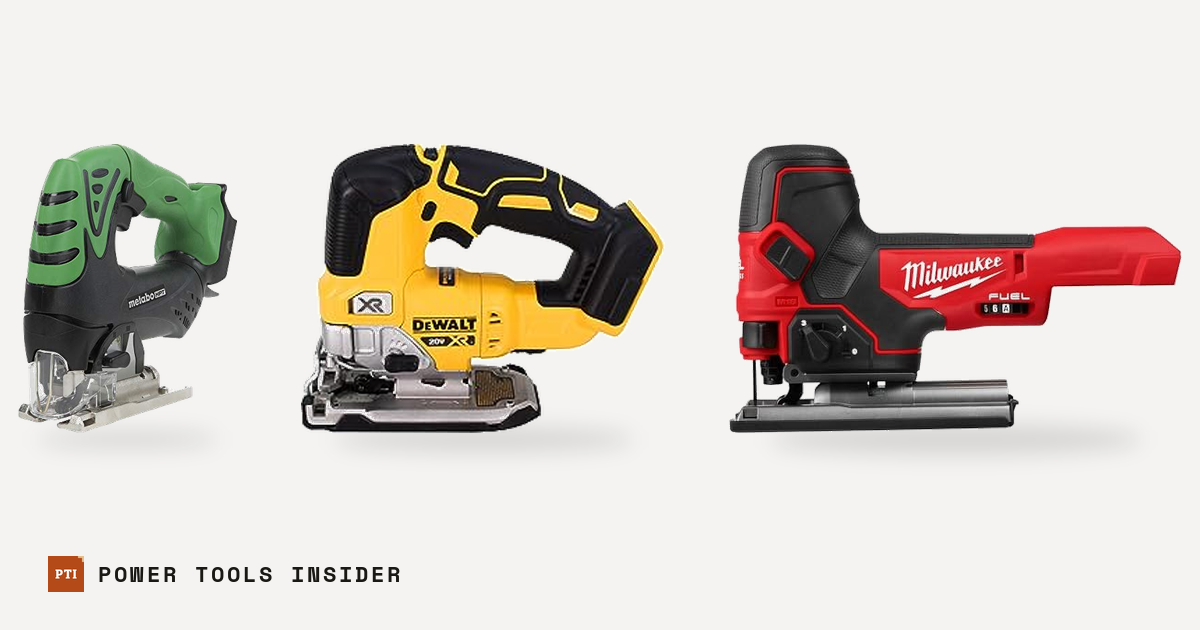
D-Handle (Top Handle) looks like a traditional power tool. You grip it like a drill, with your palm on top and fingers on the trigger. This is what 80% of people buy, and it’s the right choice if you:
- Want maximum visibility of the cut line
- Switch between cutting positions frequently (overhead, vertical, upside-down)
- Prefer the familiar “drill-like” control
- Cut a lot of straight or gently curved lines
Barrel Grip puts your hand behind the motor, gripping a barrel-shaped housing. It looks weird at first, but it makes sense when you realize your hand is now closer to the blade. Go barrel grip if you:
- Cut a lot of tight curves or scrollwork
- Want maximum control for detailed cuts
- Do overhead work (the lower center of gravity helps)
- Have smaller hands and find D-handles awkward
Here’s my hot take: most DIYers should start with a D-handle. Simpler to learn and more versatile for general use. Frustrated when cutting curves, or doing a lot of finish carpentry? A barrel grip is worth the learning curve.
Pro tip: The Milwaukee 2737-20 and 2737B-20 are the same tool, just with different grips. Try both if you can.
Buyer’s Guide: What Actually Matters
Jigsaw marketing loves to throw numbers at you. Here’s which ones actually affect your cuts:
Stroke Length
This is how far the blade travels up and down. Most cordless jigsaws are 1″ stroke length, anything less is underpowered for thick material. All the models on this list hit 1″, which is what you want for 2x material.
SPM (Strokes Per Minute)
Think RPM for reciprocating motion. Higher SPM = faster cutting, but also more vibration and rougher edges. Here’s the reality:
- 2,000-2,500 SPM: Fine finish work, metals, plastics
- 2,500-3,000 SPM: General wood cutting, the sweet spot
- 3,000+ SPM: Aggressive material removal, rough cuts
The Milwaukee models hit 3,500 SPM, which is great for speed but can get away from you if you’re not careful. Metabo HPT’s motor tops out at 2,500 SPM, slower, but more forgiving for beginners.
Orbital Settings
This is the “pendulum” or “orbit” setting that moves the blade forward slightly on the upstroke. More orbit = faster, rougher cuts. Less orbit = slower, cleaner cuts.
- 0 (straight): Metals, plastics, fine finish work
- 1-2: General wood cutting
- 3-4: Aggressive ripping through thick stock
Four settings (like DeWalt and Milwaukee offer) is nice. Three (Metabo HPT) is totally fine. Most people won’t use more than two of them anyway.
Bevel Capacity
Need to cut miters or angled edges? You need a jigsaw with a tilting base (shoe). Bevel capacity goes to 45° across every model here, which is standard. Look for positive stops at common angles (0°, 15°, 30°, 45°) so you’re not guessing with a speed square.
Blade Type
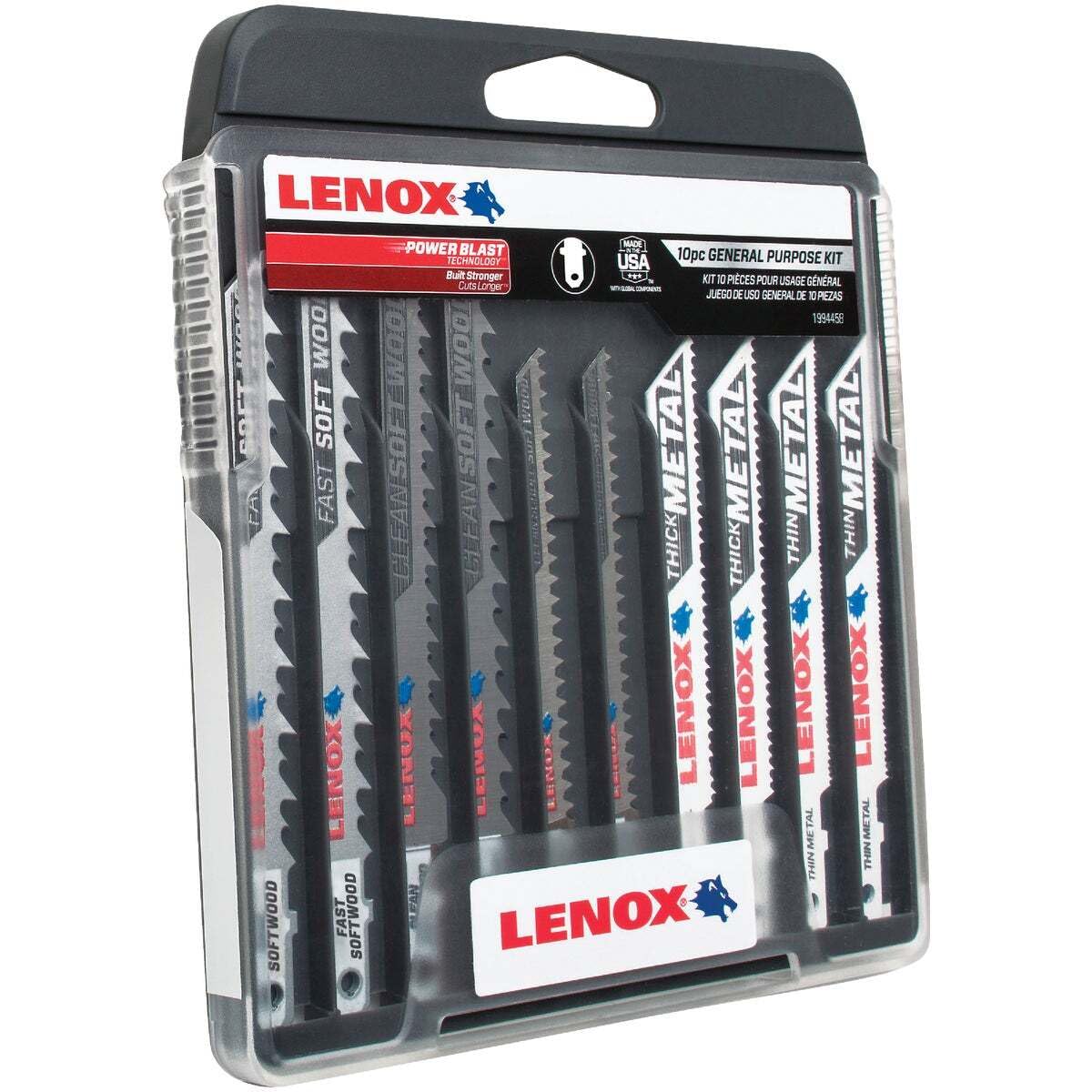
All the saws on this list use T-shank blades. Skip U-shank blades entirely, they’re obsolete in 2026 and harder to find. T-shank blades pop in and out without tools on every model here.
Weight
Sounds obvious, but a pound makes a difference when you’re cutting vertically or overhead. Bosch’s barrel grip comes in lightest at 4.4 lbs. Makita sits heaviest at 5.8 lbs, and you’ll feel that after an hour of cutting.
Mini Reviews: The Models That Matter
DeWalt DCS334B, Best Overall
Price: ~$199 (tool only) | Rating: 9.2/10
If I could only own one cordless jigsaw, this would be it. It doesn’t dominate any single category, it’s not the fastest, not the lightest, not the cheapest, but it gets closest to doing everything well.
Vibration control is the magic here. DeWalt’s counterbalance system actually works. After cutting half a sheet of 3/4″ plywood, my hand isn’t buzzing. Few jigsaws on this list can say that (looking at you, Makita).
On the DeWalt, blade deflection (the tendency for the blade to wander away from vertical) stays minimal. Cut a sink cutout where the edge has to be perpendicular to the surface, and that difference matters. A lot.
A variable speed dial plus a variable trigger gives you granular control. Set the max RPM with the dial, then feather the trigger for exactly the speed you need. Little things like that add up.
The catch? Cutting speed is slightly slower than the Milwaukee. Not by much, maybe 10-15% on thick stock, but if you’re a pro cutting all day, that adds up.
Bottom line: For 90% of DIYers and most pros, this is the right choice. A Goldilocks pick, not too aggressive, not too tame, just right.
Metabo HPT CJ18DAQ4, Best Value
Price: ~$99 (tool only) | Rating: 7.8/10
Let’s be real: not everyone needs a $200 jigsaw. If you’re cutting a few pieces of plywood a year for shop projects, why spend twice what you need to?
CJ18DAQ4 (formerly Hitachi Power Tools, successor to the CJ18DSLQ4) is Metabo HPT’s budget pick that doesn’t feel like a budget tool. At under $100 bare, it’s nearly half the price of the premium options, but it delivers maybe 80% of the performance.
Yes, it’s a brushed motor that “only” goes to 2,500 SPM. But here’s the thing: it still cuts through 2x lumber without bogging down. Changing blades takes no tools, the LED light is actually bright, and the dust blower keeps your line visible.
What you give up: the refinement of brushless motors, the top-end speed for production work, and the prestige of a “pro” brand name. What you keep: $100 in your pocket and a tool that’ll handle 90% of what homeowners need.
Oh, and the lifetime tool warranty? That’s not a typo. Metabo HPT warranties this thing for life. Break it in 2035 and they’ll still fix it.
Bottom line: The smart choice for DIYers on a budget or pros who need a backup/beater saw. Don’t let the low price fool you, this isn’t junk.
Grab this pick here: Buy Now on Amazon
Milwaukee 2737-20, Best for DIY
Price: ~$199 (tool only) | Rating: 9.0/10
Already own Milwaukee M18 tools? Stop reading and just buy this. Milwaukee’s 2737-20 sums up everything good about the M18 ecosystem in jigsaw form: fast, powerful, and built like a tank.
At 3,500 SPM, this is the fastest-cutting cordless jigsaw I tested. Ripping through 5/4 decking or knocking out countertop cutouts is where that speed matters. It plows through material that makes other saws bog down.
Dust management is best-in-class: the blower keeps your cut line clear, and there’s an actual dust collection port if you want to hook up a vacuum. Indoor work, kitchens, baths, built-ins, is where you’ll use that feature constantly.
I love the tool-free blade ejection. Push a button and the blade pops out safely. No more grabbing hot blades with pliers or burning your fingers.
Downsides: no lock-on button (your finger gets a workout on long cuts), and no variable speed dial, just the trigger. Fine for most work, but it gets annoying if you need consistent speed for scrolling.
Net verdict: if you’re already in the M18 ecosystem, this is a no-brainer. If you’re not, it’s still worth considering for the raw cutting power alone.
See it here: Buy Now at Home Depot
Milwaukee 2737B-20, Best Barrel Grip
Price: ~$199 (tool only) | Rating: 8.9/10
This is the exact same tool as the 2737-20 above, just with a barrel grip instead of a D-handle. Same motor, same speed, same power. But the grip changes everything about how you use it.
Auto-control start is the big upgrade here: the saw starts slow when the blade touches material, then ramps up to full speed. For following curves or starting cuts without the blade dancing all over the place, this is huge. Think training wheels for jigsaw cuts, except you won’t want to take them off.
Its barrel grip puts your hand lower and closer to the blade, giving you better leverage for tight turns. If you’re doing scrollwork, cutting sink templates, or any detailed curve cutting, you’ll feel the difference immediately.
Ambidextrous switches on both sides mean lefties don’t get screwed over. Small thing, but appreciated.
The catch? Same as the D-handle version, no lock-on button, no variable speed dial. Barrel grips also take some getting used to if you’ve never used one.
Where it lands: the best barrel grip option for most buyers. Only consider the Bosch below if you want smart features or need the absolute lightest weight.
Check current price: Buy Now at Home Depot
Makita XVJ02Z, Best for Precision
Price: ~$269 (tool only) | Rating: 8.8/10
The most expensive jigsaw on this list, and I’ll be honest: most DIYers don’t need to spend this much. Cabinetmakers and finish carpenters who need surgically precise cuts will find the XVJ02Z earns its price tag.
Makita’s soft-start feature slowly ramps the blade up to speed when you pull the trigger. No more jumping at the start of cuts. Combine that with the lock-on button (finally!) and the variable speed dial, and you get unmatched control.
Blade deflection is nearly nonexistent. I cut 1/8″ veneers for cabinet faces with this thing and the edges came out square enough to edge-band without cleanup. Try that with a budget saw.
Dual LED lights actually light up your work area, unlike most jigsaws, which have one dim bulb that’s more decoration than illumination.
Problems: it’s heavy. At 5.8 lbs with a battery, you’ll feel it on overhead work. Price stings too, $70 more than the DeWalt for marginal gains most users won’t notice. And there’s no dust collection port, which is inexcusable at this price.
My take: a specialist tool for precision work. If you’re building furniture or doing high-end finish carpentry, worth the premium. Plywood subfloors? Overkill.
Find it here: Buy Now on Amazon
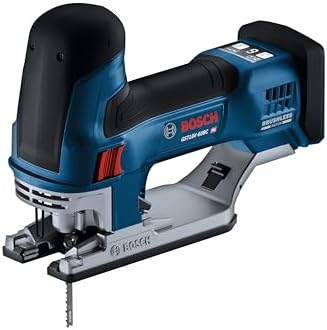
Bosch GST18V-60BCN, Best Smart Features
Price: ~$209 (tool only) | Rating: 8.5/10
Bosch took their barrel grip jigsaw and added Bluetooth, an app, and a bunch of smart features. Some of it is genuinely useful. Some of it is… well, let’s talk about it.
At 3,800 SPM, this is the fastest jigsaw here. Its brushless motor is efficient and powerful, and the adjustable blade guide actually reduces deflection, unlike most “anti-deflection” features that are marketing fluff.
Bosch’s PRO360 app lets you customize speed curves, set drop control (shuts off if you drop the tool), and track usage. Cool party tricks, but honestly? I set it up once and never opened the app again.
Drop control is genuinely nice for pros working on ladders or scaffolding. If you drop the saw, it shuts off instead of flailing around at 3,800 SPM.
Dealbreaker for some: no bevel adjustment, the base doesn’t tilt. If you need angled cuts, look elsewhere. That’s a strange omission on a $200+ tool.
Short answer: great saw, questionable value proposition. Get it for the cutting performance and light weight, not the app connectivity. And only if you never need to bevel cut.
Specs Comparison Table
| Spec | DeWalt DCS334B | Milwaukee 2737-20 | Milwaukee 2737B-20 | Makita XVJ02Z | Metabo HPT CJ18DAQ4 | Bosch GST18V-60BCN |
|---|---|---|---|---|---|---|
| Price (Bare) | ~$199 | ~$199 | ~$199 | ~$269 | ~$99 | ~$209 |
| Motor | Brushless | Brushless | Brushless | Brushless | Brushed | Brushless |
| Max SPM | 3,200 | 3,500 | 3,500 | 3,500 | 2,500 | 3,800 |
| Stroke Length | 1.0″ | 1.0″ | 1.0″ | 1.0″ | 1.0″ | 1.0″ |
| Orbital Settings | 4 | 4 | 4 | 4 | 3 | 4 |
| Bevel Capacity | 45° | 45° | 45° | 45° | 45° | None |
| Weight | 4.62 lbs | 4.85 lbs | 4.9 lbs | 5.8 lbs | 4.5 lbs | 4.4 lbs |
| Handle Type | D-Handle | D-Handle | Barrel | D-Handle | D-Handle | Barrel |
| Variable Speed Dial | Yes | No | No | Yes | No | Yes |
| Lock-On Button | No | No | No | Yes | No | No |
| Dust Collection | Blower only | Port + blower | Port + blower | Blower only | Blower only | Blower only |
| Amazon Rating | 4.7 (4,100+) | 4.8 (3,200+) | 4.8 (1,800+) | 4.7 (2,400+) | 4.8 (26) | 4.6 (850+) |
| Our Rating | 9.2/10 | 9.0/10 | 8.9/10 | 8.8/10 | 7.8/10 | 8.5/10 |
Real-World DIY Projects: Which Saw for What?
Cutting Sink/Cooktop Holes in Countertops
Best pick: DeWalt DCS334B or Milwaukee 2737-20
Countertop cutouts need clean edges (no splintering), accurate curves, and enough power to cut through 1.5″ laminate or butcher block. DeWalt’s low vibration helps you follow the template line, while Milwaukee’s dust collection keeps the work area clean. Use a down-cut blade for laminate to prevent chip-out.
Curves in Plywood (Furniture, Templates, Signs)
Best pick: Milwaukee 2737B-20 or Bosch GST18V-60BCN
Barrel grips win here. Lower hand position gives you better leverage for steering through curves, and Milwaukee’s auto-start feature prevents the blade from jumping at the beginning of cuts, crucial when accuracy matters. Doing scrollwork in 1/4″ plywood? Drop to orbital setting 0 and switch to a fine-tooth blade.
Scrollwork and Detail Cutting
Best pick: Makita XVJ02Z
When you’re cutting intricate patterns, think decorative brackets, holiday yard art, or inlay work, you need the precision the Makita delivers. Soft start prevents jump, the lock-on button saves your trigger finger on long cuts, and minimal blade deflection keeps your lines true. Worth the price if detail work is your thing.
Flooring Notches (Door Jambs, HVAC Vents)
Best pick: Metabo HPT CJ18DAQ4
This is grunt work, rough cuts in softwood that nobody will see. It has plenty of power for 3/4″ flooring, and at $99 you won’t cry if you hit a nail (which you will). A cheap blade works fine here, just replace it often. Save your expensive saw for finish work.
Frequently Asked Questions
Do I need a brushless motor?
Not necessarily. Brushless motors last longer, run cooler, and give you better battery life, but for occasional DIY use, a brushed motor like the Metabo HPT’s will last years. If you’re a pro using the tool daily, spring for brushless. If you’re cutting a few things a month, save the money.
What’s the difference between T-shank and U-shank blades?
T-shank blades are the modern standard, flat top with a T-shaped tang that locks in without tools. U-shank blades require a set screw or tool to tighten. All the saws on this list use T-shank. A U-shank jigsaw in 2026 will just frustrate you, so skip it.
Can I cut metal with these?
Yes, with the right blade. A fine-tooth blade (14-24 TPI) is what you want for metal, set the orbital action to 0 (straight) and cut slowly. Thin sheet metal? No problem. Steel pipe? It’ll work but it’ll take a while. Bandsaw-level performance isn’t happening, though.
How thick can these cut?
Wood capacity ranges from 2″ to 6″ depending on the model, but here’s the reality: jigsaws aren’t meant for thick stock. They’re for sheet goods, trim, and thinner materials. Cut a 4×4 with one of these and you’ll be there all day with a wavy line to show for it. A circular saw or recip saw handles thick lumber better.
Should I buy the kit or bare tool?
If you already own batteries from that brand, buy bare. If you’re starting fresh, the kit (tool + battery + charger) usually saves you $20-50 over buying separately. That said, starter kit batteries are often smaller (2.0Ah or 3.0Ah). For a jigsaw, you’ll want at least 4.0Ah for decent runtime.
Why is blade deflection such a big deal?
Push too hard, or run a cheap blade, and it wanders away from vertical mid-cut, that’s blade deflection. Beveled edges are the result when you wanted square cuts. Better jigsaws (Makita, DeWalt) have stiffer blade guides and better balance to minimize this. Use quality blades and let the saw do the work.
Can I use these for demolition?
Technically yes, practically no. Jigsaws are precision tools. Demo work, cutting through nails, old lumber, whatever, calls for a reciprocating saw (Sawzall) instead. Jigsaw blades are too expensive and too fragile for demo abuse. Don’t be that guy.
Final Thoughts: My Personal Pick
If I walked into a store today and could only buy one, I’d grab the DeWalt DCS334B. It’s not perfect, no lock-on button, slightly slower than the Milwaukee, but the combination of low vibration, excellent blade tracking, and fair price makes it the safe choice for almost everyone.
That said, if you’re buying your first jigsaw and money matters, the Metabo HPT CJ18DAQ4 is the smarter financial move. Put the $100 you saved toward a good selection of blades and a battery instead. You’ll get more use out of those than the marginal performance gains of a premium saw.
Already committed to a battery platform? Just buy the jigsaw from that brand. Milwaukee is excellent for M18 users, and Makita is solid for LXT owners. Ecosystem fit matters more than the incremental differences between models.
Whatever you choose, buy good blades. A $20 jigsaw with a $5 Bosch blade cuts better than a $200 jigsaw with the stock blade that’s been in the case since 2019. Trust me on this one.
Disclosure: Power Tool Insider is reader-supported. When you buy through links on our site, we may earn an affiliate commission at no extra cost to you. We test everything we recommend and never let affiliate relationships influence our opinions.
Last updated: February 1, 2026 | Prices and availability subject to change
Power Tool Insider is reader-supported. When you buy through links on our site, we may earn an affiliate commission at no extra cost to you. This doesn’t affect our recommendations, we only recommend tools we’d actually use. Full disclosure.